G. Mulè – författare
Visar alla böcker från författaren G. Mulè. Handla med fri frakt och snabb leverans.
3 produkter
3 produkter
1 091 kr
Skickas inom 10-15 vardagar
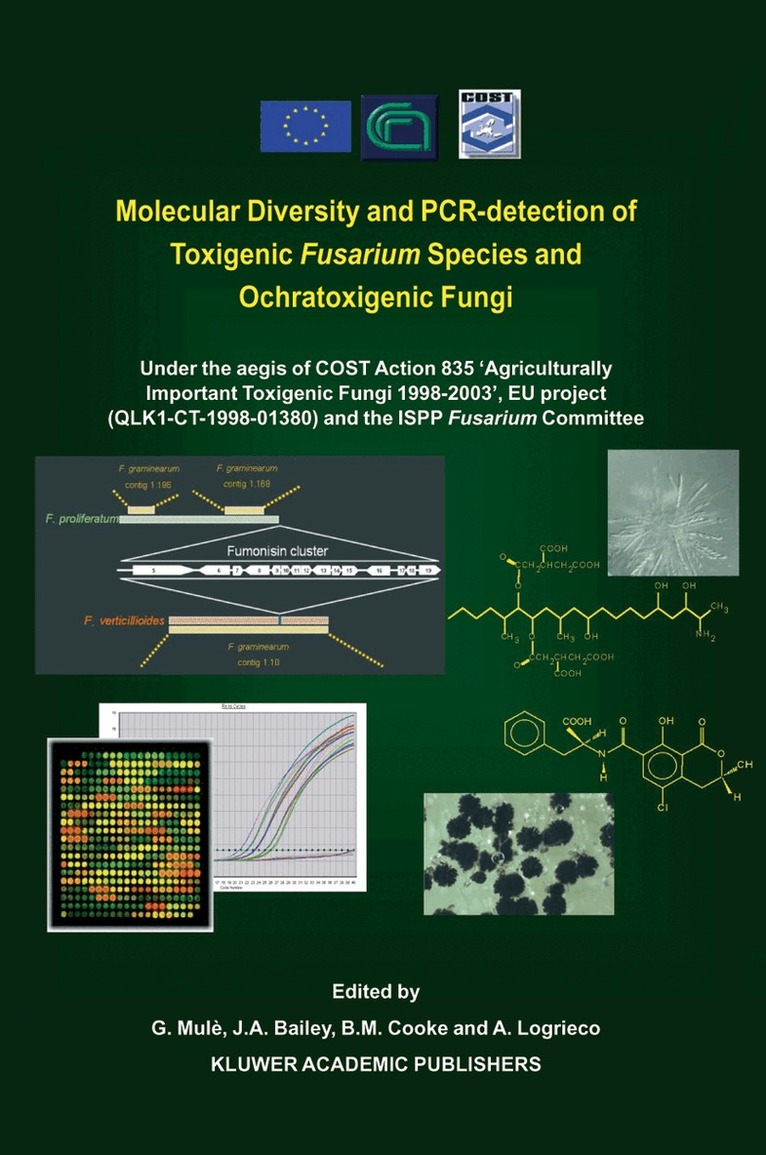
Toxigenic Fusarium species and ochratoxigenic fungi are responsible for plant diseases which have important effects on both human and animal health. The development of rapid, robust and sensitive detection methods based on molecular technologies is needed to identify fungal contamination in the field and quantify toxin accumulation in food products. Most of the contributions are from results obtained through the EU 5th Framework project (QLK1-1999-01380) "DETOX-FUNGI: early detection of toxigenic Fusarium species and ochratoxigenic fungi in plant products". Valuable contributions from other scientists have guaranteed a complete overview of increasingly important topic. The present issue contains contributions which cover many aspects of the molecular diversity, phylogeny, variability and PCR-detection of toxigenic fungi and their toxins. Notable amongst these are a review of the phylogeny and diagnosis of Fusarium species and a new system for identifying Fusarium species based on a DNA sequence database. Other papers describe the diversity and analysis of ochratoxigenic Aspergilli and Penicillia.This information will greatly aid those concerned with the early detection of these fungi and their mycotoxins, information which is so essential for overcoming the health risks associated with mycotoxin-contaminated food products.
1 612 kr
Skickas
Toxigenic Fusarium species and ochratoxigenic fungi are responsible for plant diseases which have important effects on both human and animal health. The development of rapid, robust and sensitive detection methods based on molecular technologies is needed to identify fungal contamination in the field and quantify toxin accumulation in food products. Most of the contributions are from results obtained through the EU 5th Framework project (QLK1-1999-01380) "DETOX-FUNGI: early detection of toxigenic Fusarium species and ochratoxigenic fungi in plant products". Valuable contributions from other scientists have guaranteed a complete overview of increasingly important topic. The present issue contains contributions which cover many aspects of the molecular diversity, phylogeny, variability and PCR-detection of toxigenic fungi and their toxins. Notable amongst these are a review of the phylogeny and diagnosis of Fusarium species and a new system for identifying Fusarium species based on a DNA sequence database. Other papers describe the diversity and analysis of ochratoxigenic Aspergilli and Penicillia.This information will greatly aid those concerned with the early detection of these fungi and their mycotoxins, information which is so essential for overcoming the health risks associated with mycotoxin-contaminated food products.
1 091 kr
Skickas inom 10-15 vardagar
Toxigenic Fusarium species and ochratoxigenic fungi are responsible for various plant diseases which have important consequential effects on both human and animal health worldwide. The development of rapid, robust and sensitive detection methods based on new molecular technologies is urgently needed in order to identify fungal contamination in the field and quantify toxin accumulation in food and animal feed. Most of the contributions in this special issue are from results obtained through the EU 5th Framework project (QLKI-CT-1998-01380) "DETOX-FUNGI: early detection of toxigenic Fusarium species and ochratoxi genic fungi in plant products", which has strongly stimulated interaction and co-operation between many European scientists. Valuable contributions from other scientists have guaranteed a complete overview of this stimulating and interesting topic. This is the third special issue published in the European Journal of Plant Pathology concerning my cotoxigenic fungi under the aegis of COST Action 835 'Agriculturally Important Toxigenic Fungi'. The first two dealt with 'Mycotoxins in Plant Disease' (Vol. 108(7) 2002) and 'Epidemiology of Mycotoxin Pro ducing Fungi' (Vol. 109(7) 2003). The present issue contains contributions which cover aspects of molecular diversity, phylogeny and PCR-detection of toxigenic Fusarium species and various ochratoxigenic fungi. We hope these will prove helpful to researchers involved in similar work and will stimulate the future studies required for the early detection of these fungi, which is so essential for overcoming the health risks associated with mycotoxin-contaminated food products.