G. Palm – författare
Visar alla böcker från författaren G. Palm. Handla med fri frakt och snabb leverans.
3 produkter
3 produkter
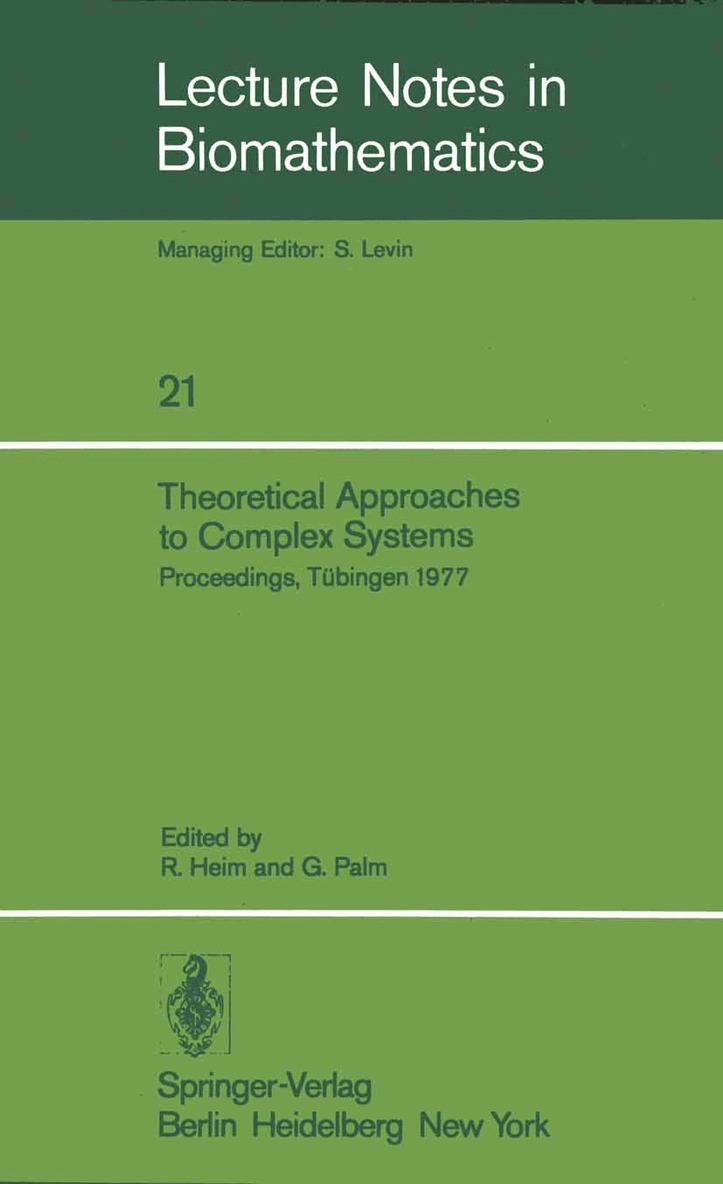
Del 21 - Lecture Notes in Biomathematics
Theoretical Approaches to Complex Systems
Proceedings, Tübingen, June 11–12, 1977
Häftad, Engelska, 1978
550 kr
Skickas inom 10-15 vardagar
This volume is the issue of the symposium 'Theoretical Approaches to Complex systems', held in Tlibingen on June 11 and 12, 1977. The meeting was dedicated to the late Ernst Pfaffelhuber of the Institute for Information Sciences, University of Tlibingen, in memory of his con- tributions to information theory, physics, and biology and of his many fruitful contacts with the Tlibingen scientists gathered on this occa- sion. We would like to express our gratitude to all participants for their willingness to offer a weekend, for their help and the care they took in writing a contribution to this volume. R. Heim G. Palm CONTENTS Introduction H. Hahn 3 Existence Criteria for Bifurcations as Stability Criteria for Critical Nonlinear Control Systems G. Palm Asymptotic System Analysis and Goal Functions 51 O. E. ROssler and P. J. Ortoleva 57 Strange Attractors in 3-Variable Reaction Systems w. u. an der Heiden 75 Structures of Excitation and Inhibition T. Poggio and V. Torre 89 A new Approach to Synaptic Interactions W. Reichardt Figure-Ground Discrimination by the Visual **...**. *. ** 117 System of the Fly M. Conrad Evolution of the Adaptive Landscape ********. *. **** 147 V.Braitenberg Cell Assemblies in the Cerebral Cortex *. ****. *. ***** 171 D. Varju Excitatory and Inhibitory Processes Giving Rise ********* 189 to the Delayed Response in the Retinal Ganglion Cell of the Frog R. Heim 209 On Constrained Transinformation Functions M.
E-bok
PDF, Engelska, 20121 672 kr
Läs direkt efter köp
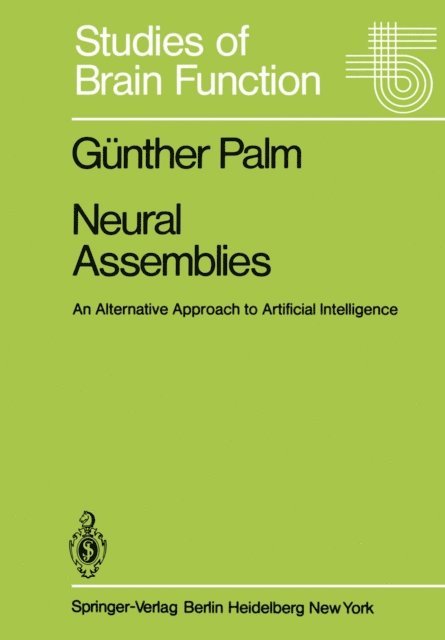
You can''t tell how deep a puddle is until you step in it. When I am asked about my profession, I have two ways of answering. If I want a short discussion, I say that I am a mathematician; if I want a long discussion, I say that I try to understand how the human brain works. A long discussion often leads to further questions: What does it mean to understand "how the brain works"? Does it help to be trained in mathematics when you try to understand the brain, and what kind of mathematics can help? What makes a mathematician turn into a neuroscientist? This may lead into a metascientific discussion which I do not like par ticularly because it is usually too far off the ground. In this book I take quite a different approach. I just start explaining how I think the brain works. In the course of this explanation my answers to the above questions will become clear to the reader, and he will perhaps learn some facts about the brain and get some insight into the construc tions of artificial intelligence.
E-bok
PDF, Engelska, 2013712 kr
Läs direkt efter köp