
G Q Max Lu - Böcker
Visar alla böcker från författaren G Q Max Lu. Handla med fri frakt och snabb leverans.
4 produkter
4 produkter
Del 4 - Series On Chemical Engineering
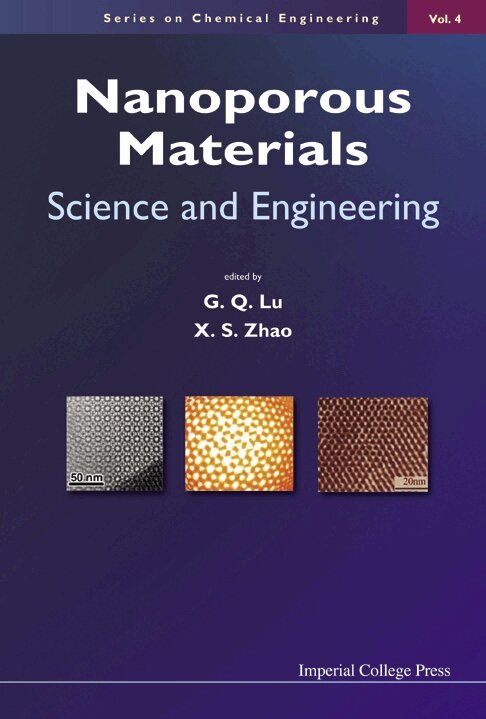
Nanoporous Materials: Science And Engineering
Inbunden, Engelska, 2004
3 802 kr
Tillfälligt slut
Porous materials are of scientific and technological importance because of the presence of voids of controllable dimensions at the atomic, molecular, and nanometer scales, enabling them to discriminate and interact with molecules and clusters. Interestingly the big deal about this class of materials is about the “nothingness” within — the pore space. International Union of Pure and Applied Chemistry (IUPAC) classifies porous materials into three categories — micropores of less than 2 nm in diameter, mesopores between 2 and 50 nm, and macropores of greater than 50 nm. In this book, nanoporous materials are defined as those porous materials with pore diameters less than 100 nm.Over the last decade, there has been an ever increasing interest and research effort in the synthesis, characterization, functionalization, molecular modeling and design of nanoporous materials. The main challenges in research include the fundamental understanding of structure-property relations and tailor-design of nanostructures for specific properties and applications. Research efforts in this field have been driven by the rapid growing emerging applications such as biosensor, drug delivery, gas separation, energy storage and fuel cell technology, nanocatalysis and photonics. These applications offer exciting new opportunities for scientists to develop new strategies and techniques for the synthesis and applications of these materials.This book provides a series of systematic reviews of the recent developments in nanoporous materials. It covers the following topics: (1) synthesis, processing, characterization and property evaluation; (2) functionalization by physical and/or chemical treatments; (3) experimental and computational studies on fundamental properties, such as catalytic effects, transport and adsorption, molecular sieving and biosorption; (4) applications, including photonic devices, catalysis, environmental pollution control, biological molecules separation and isolation, sensors, membranes, hydrogen and energy storage, etc.
Del 4 - Series On Chemical Engineering
Nanoporous Materials: Science And Engineering
Häftad, Engelska, 2004
2 444 kr
Skickas inom 5-8 vardagar
Porous materials are of scientific and technological importance because of the presence of voids of controllable dimensions at the atomic, molecular, and nanometer scales, enabling them to discriminate and interact with molecules and clusters. Interestingly the big deal about this class of materials is about the “nothingness” within — the pore space. International Union of Pure and Applied Chemistry (IUPAC) classifies porous materials into three categories — micropores of less than 2 nm in diameter, mesopores between 2 and 50 nm, and macropores of greater than 50 nm. In this book, nanoporous materials are defined as those porous materials with pore diameters less than 100 nm.Over the last decade, there has been an ever increasing interest and research effort in the synthesis, characterization, functionalization, molecular modeling and design of nanoporous materials. The main challenges in research include the fundamental understanding of structure-property relations and tailor-design of nanostructures for specific properties and applications. Research efforts in this field have been driven by the rapid growing emerging applications such as biosensor, drug delivery, gas separation, energy storage and fuel cell technology, nanocatalysis and photonics. These applications offer exciting new opportunities for scientists to develop new strategies and techniques for the synthesis and applications of these materials.This book provides a series of systematic reviews of the recent developments in nanoporous materials. It covers the following topics: (1) synthesis, processing, characterization and property evaluation; (2) functionalization by physical and/or chemical treatments; (3) experimental and computational studies on fundamental properties, such as catalytic effects, transport and adsorption, molecular sieving and biosorption; (4) applications, including photonic devices, catalysis, environmental pollution control, biological molecules separation and isolation, sensors, membranes, hydrogen and energy storage, etc.
Sustainable Energy And Environmental Technology - Proceedings Of The Asia-pacific Conference
Inbunden, Engelska, 1996
3 806 kr
Tillfälligt slut
The countries in the Asia-Pacific region enjoy economic growth rates amongst the highest in the world today. It has transformed the nature of their industries and raised the living standards of the populace. The accelerated developments in these countries have, however, created severe demands on energy and the environment.This conference aimed to address issues related to energy and environmental protection in the quest for sustainble development. It will bring together participants from academia, industries and government agencies, from over 18 countries primarily in the Asia-Pacific region, and provide a forum for them to interact, share information, report research in progress and identify opportunities in the relevant fields.
1 633 kr
Skickas inom 3-6 vardagar
This book presents a comprehensive review, analysis and synthesis of the advances in nanoreactors and their innovative applications in sustainable energy, environmental, and biomedical processes. It begins with an overview of bioinspired materials and artificial devices, followed by a detailed explanation of the definition and basic structural characteristics of nanoreactors. It focuses on key synthetic strategies for controlling the size, composition, morphology, and functionalisation of nanoreactors. The distinctive structure-activity relationships, including spatial limiting effects, pore selective/confinement effects, and isolation-synergy effects of active species at a cross-scale level, are reviewed and thoroughly discussed. A range of innovative applications of nanoreactors in catalysis, biomedical separation and reactions, wastewater treatment, and energy conversion and storage is examined. Finally, major bottlenecks and challenges in structural optimization will be highlighted and future design schemes and research frontiers in this burgeoning field proposed.