G. Wrightson – författare
Visar alla böcker från författaren G. Wrightson. Handla med fri frakt och snabb leverans.
3 produkter
3 produkter
1 064 kr
Skickas inom 10-15 vardagar
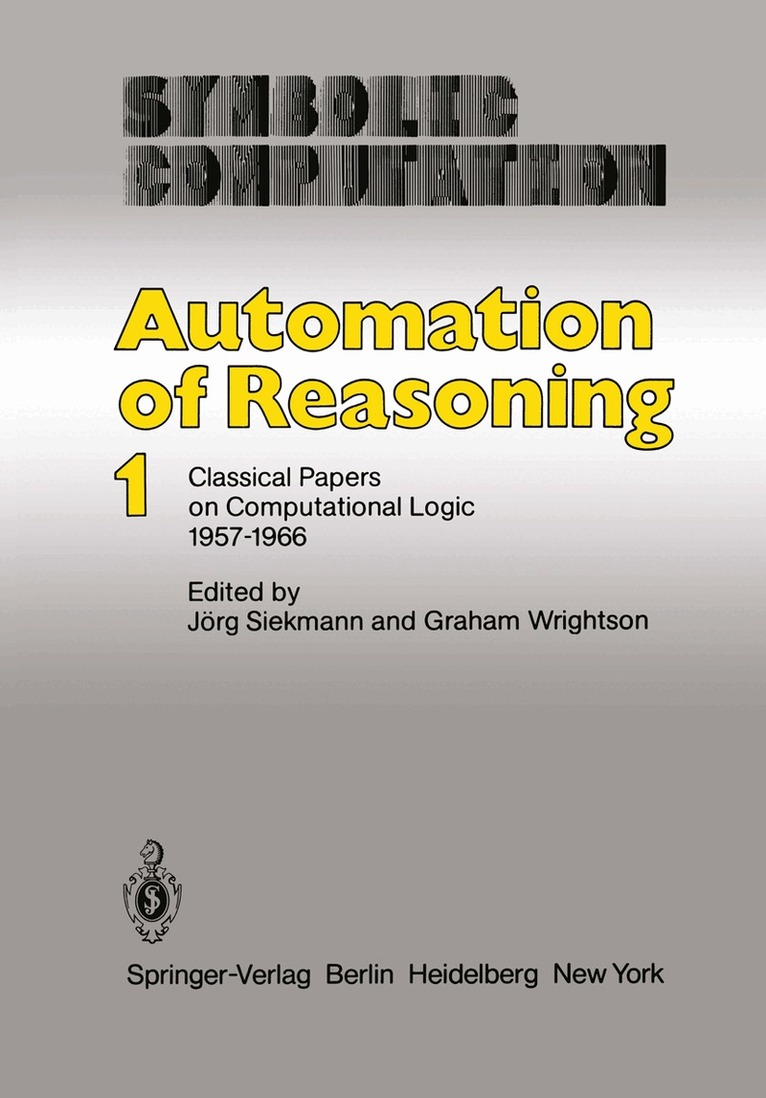
"Kind of Cl'Ude ~ but it UJorks~ boy~ it UJOrksl" Alan Ner. ueH to Herb Simon~ C1rl'istmas 1955 In 1954 a computer program produced what appears to be the first computer generated mathematical proof: Written by M. Davis at the Institute of Advanced Studies, USA, it proved a number theoretic theorem in Presburger Arithmetic. Christmas 1955 heralded a computer program which generated the first proofs of some propositions of Principia Mathematica, developed by A. Newell, J. Shaw, and H. Simon at RAND Corporation, USA. In Sweden, H. Prawitz, D. Prawitz, and N. Voghera produced the first general program for the full first order predicate calculus to prove mathematical theorems; their computer proofs were obtained around 1957 and 1958, about the same time that H. Gelernter finished a computer program to prove simple high school geometry theorems. Since the field of computational logic (or automated theorem proving) is emerging from the ivory tower of academic research into real world applications, asserting also a definite place in many university curricula, we feel the time has come to examine and evaluate its history. The article by Martin Davis in the first of this series of volumes traces the most influential ideas back to the 'prehistory' of early logical thought showing how these ideas influenced the underlying concepts of most early automatic theorem proving programs.
1 064 kr
Skickas inom 10-15 vardagar
"Kind of crude, but it works, boy, it works!" AZan NeweZZ to Herb Simon, Christmas 1955 In 1954 a computer program produced what appears to be the first computer generated mathematical proof: Written by M. Davis at the Institute of Advanced Studies, USA, it proved a number theoretic theorem in Presburger Arithmetic. Christmas 1955 heralded a computer program which generated the first proofs of some propositions of Principia Mathematica, developed by A. Newell, J. Shaw, and H. Simon at RAND Corporation, USA. In Sweden, H. Prawitz, D. Prawitz, and N. Voghera produced the first general program for the full first order predicate calculus to prove mathematical theorems; their computer proofs were obtained around 1957 and 1958, about the same time that H. Gelernter finished a computer program to prove simple high school geometry theorems. Since the field of computational logic (or automated theorem proving) is emerging from the ivory tower of academic research into real world applications, asserting also a definite place in many university curricula, we feel the time has corne to examine and evaluate its history. The article by Martin Davis in the first of this series of volumes traces the most influential ideas back to the 'prehistory' of early logical thought showing how these ideas influenced the underlying concepts of most early automatic theorem proving programs.
Del 44 - Colloquia Antiqua
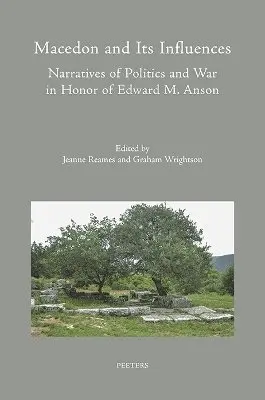
Macedon and its Influences
Narratives of Politics and War in Honor of Edward M. Anson
Inbunden, Engelska, 2024
2 447 kr
Skickas inom 3-6 vardagar
The papers in this volume, Macedon and Its Influences: Narratives of Politics and War in Honor of Edward M. Anson, explore themes especially prominent in Anson’s own extensive bibliography: warfare and political action in Macedonian history, especially during the reigns of Philip II and Alexander (III) the Great. The volume is divided into three parts, and the first three papers consider issues related to the Alexander sources themselves. The next six examine diplomatic, religious, and political dimensions of Alexander’s campaign and its immediate aftermath. The final five focus more particularly on military matters, spanning from the reign of Alexander I through Alexander III down to characterization of the Macedonian military machine in later Roman-era art and military treatises. This diverse collection of topics reflects the wide-ranging contribution that Ed Anson has made to research in Argead Macedonia and the era of the Diodochi.