
Gareth L Reese – författare
601 kr
Skickas inom 3-6 vardagar
688 kr
Skickas inom 3-6 vardagar
818 kr
Skickas inom 3-6 vardagar
601 kr
Skickas inom 3-6 vardagar
731 kr
Skickas inom 3-6 vardagar
688 kr
Skickas inom 3-6 vardagar
688 kr
Skickas inom 3-6 vardagar
133 kr
Läs direkt efter köp
This is a phrase-by-phrase commentary & exposition of the New Testament books of 1 & 2 Peter and Jude. This commentary is in use as a college textbook, yet is suitable for the lay church member. The author seeks to harmonize the teachings of these NT books with other relevant NT Scripture. The epistles of Peter and Jude provide Christians wtih guidance on how to rightly respond to suffering, trials and persecution; provide instruction to church leaders on how to shepherd the congregations under their care; offer inspired teaching regarding God's intended consummation of history; and respond to those who criticize the Christian doctrine presented by Jesus and His apostles.
This commentary is conservative, evangelical Christian in its outlook, yet skillfully examines the Scriptures from multiple theological viewpoints. The book includes Introductory Studies for each of the three NT epistles, covering authorship, date of writing, original target audience of the letter, historical background out of which the letter was written, and the original author's purpose for writing the letter. This commentary presumes the God-inspired nature of all Biblical writing, and so helpfully examines the original language in which the epistles were written.
This volume continues the author's series of commentaries on the books of the New Testament written from the unique standpoint of the Restoration Movement, a position which allows him to approach Scripture with no special theological doctrine or dogma to defend and explicate. This approach provides an unhindered freedom to listen to what the Holy Spirit would tell us within the pages of the sacred Scriptures. By deliberately employing the time-honored grammatico-historical method of interpretation, the Word of God is allowed to impress upon our minds the intent the Divine Author had in mind.
The epistles of Peter and Jude can play a key role in the 21st century church's attempt to correct the cultural drift and to arrest the slide into gnostic-like New Age ideas that have become part of the average man's worldview. The religion taught by Jesus and His apostles is still the "grace of God" - "stand firm in it!" and "contend earnestly for the faith once for all delivered to the saints!" Included in this commentary is a fully annoted bibliography of other commentaries on these NT books so that readers are encouraged to continue their own study of the teachings of Peter and Jude.
The author is Professor Emeritus of the New Testament at Central Christian College of the Bible (Moberly, MO).
731 kr
Skickas inom 3-6 vardagar
182 kr
Läs direkt efter köp
This is a phrase-by-phrase commentary and exposition of the New Testament books of Ephesians, Colossians, Philemon & Philippians – the group of writings collectively called Paul’s Prison Epistles. This commentary is in use as a college textbook, yet is suitable for the lay church member.
The epistles of Ephesians, Colossians, Philemon and Philippians are fundamentally Christological in their content, focusing on the glory of Christ and the grandeur of His church. In these letters, Christians are helped to understand the Deity and pre-eminence of Jesus Christ, and are given unparalleled insight into God’s way of saving man. Then having gone to such lengths to show what God has done for all mankind through Jesus the Son, Paul offers inspired teaching regarding how men – His church – should now pattern their lives in order to honor and reflect Him, drawing on the power and Spiritual resources He offers.
This commentary is conservative and evangelical Christian in its outlook, yet skillfully examines the Scriptures from multiple theological viewpoints. The book includes Introductory Studies for each of the four epistles, covering authorship, date of writing, original target audience, historical background out of which the letter was written, and the original author's purpose for writing. Additionally, the Introductory Studies fully address Biblical criticism issues unique to these epistles, including an extended review of the intensely Christological passage in Philippians 2:5-11, an examination of what theologians have called the “Colossian Crisis,” and the authorship and original destination of Ephesians. Since this commentary presumes the God-inspired nature of all Biblical writing, the author seeks to harmonize the teachings of these New Testament books with other relevant Scriptures, and also helpfully examines the original language in which the epistles were written. This work includes a fully annotated bibliography of other commentaries on these New Testament books so that readers are encouraged to continue their own study of the teachings of Paul’s Prison Epistles.
This volume continues the author's series of commentaries on the books of the New Testament written from the unique standpoint of the Restoration Movement, a position which allows him to approach Scripture with no special theological doctrine or dogma to defend and explicate. This approach provides an unhindered freedom to listen to what the Holy Spirit would tell us within the pages of the sacred Scriptures. By deliberately employing the time-honored grammatico-historical method of interpretation, the Word of God is allowed to impress upon our minds the intent the Divine Author had in mind.
Paul’s Prison Epistles can play a key role in the 21st century church's mission to help people rightly understand Jesus Christ and His work, and to arrest our culture’s slide into gnostic-like New Age ideas that have become part of the average man's worldview. The mystery of God’s will is still made known "in Christ", for it is still through Jesus alone that "redemption … forgiveness … and the riches of God’s grace" are "lavished upon us!" It is for us to "be strong in the Lord and the strength of His might" so that, "having done everything, we may stand firm."
The author is Professor Emeritus of the New Testament at Central Christian College of the Bible (Moberly, MO).
191 kr
Läs direkt efter köp
This is a phrase-by-phrase commentary and exposition of the New Testament book of Hebrews. This commentary is in use as a college textbook, yet is suitable for the lay church member.
Hebrews is one of the great sources for instruction in Christian faith, and for exhortations to faithfulness to Christ and His message. From start to finish, the writer of Hebrews demonstrates the superiority of Jesus Christ, His message, and His covenant. For those of us living under this New Covenant, our desire to be faithful to Jesus Christ is based on the Son of God’s superiority as a messenger, on the superior priestly line from which the Son of God comes, and on the once-for-all efficacy of the sacrifices and work which the Son of God has offered on our behalf. From start to finish, the exhortations and warnings contained in Hebrews point us to Jesus Christ Himself; He is the superior source and object of our desire to live “by faith.”
This commentary is conservative evangelical Christian in its outlook, yet skillfully examines Scripture from multiple theological viewpoints. Introductory Studies cover canonicity, authorship and attestation, the original target audience addressed, place and date of writing, and the original author's purpose for writing. The Introductory Studies also discuss questions raised about Hebrews by form critics – i.e., literary and rhetorical analysts of the Biblical literature – regarding the structure of the book, in order to answer the question, Is Hebrews a treatise, a sermon, or an epistle? The topic of covenants and covenant theology is addressed in a special Appendix. Finally, this commentary provides a unique and compelling outline for the book, based on the exposition of key Old Testament passages central to each section of Hebrews and the summary explanations provided by the Hebrews writer himself at 8:1 and 13:22.
Since this commentary presumes the God-inspired nature of all Biblical writing, the author seeks to harmonize the teachings of Hebrews with other relevant Scriptures, and also helpfully examines the original language in which the epistles were written. An annotated bibliography of other commentaries on Hebrews is included to encourage readers to extend their own studies.
This volume continues the author's commentary series on the books of the New Testament, and is written from the unique standpoint of the Restoration Movement, a position which allows him to approach Scripture with no special theological doctrine or dogma to defend and explicate. This approach provides unhindered freedom to listen to what the Holy Spirit would tell us within the pages of the Scripture. By deliberately employing the time-honored grammatico-historical method of interpretation, the Word of God is allowed to impress upon our minds the intent the Divine Author had in mind.
In the past, Restoration Movement preachers preached regularly from the book of Hebrews; their audiences committed great portions of this book to memory and sought to live daily in the light of what they had heard and learned. They did this because Hebrews provides a striking source of hope, boldness, grace, assurance, mercy, and motivation for staying true to Jesus Christ. The letter is an encouragement to remain faithful, for He alone provides the only real, working, efficacious, propitiatory sacrifice for sins that will ever be offered. It is for us to "hold fast the confession of our hope without wavering, for He who promised is faithful" (10:23), so that God will not be ashamed to be called our God (11:16) and we who have believed may enter the rest He offers (4:3).
The author is Professor Emeritus of the New Testament at Central Christian College of Bible (Moberly, MO)
199 kr
Läs direkt efter köp
This is a phrase-by-phrase commentary and exposition of the New Testament books of James and 1,2,3 John. This commentary is in use as a college textbook, yet is suitable for the lay church member.
James and 1 John are written as epistles to Christians in general (i.e., not as letters to a particular church in Rome or Ephesus). Both were written by apostles we encounter often in the pages of the New Testament; both are men who played large roles in the life of the early Church. Each of these four epistles is unique within the New Testament canon, and each raises issues of interest and importance for our Christian faith and practice:
The faultless roadmap for practical Christian living provided by the great spiritual principles taught by our Lord and Savior.The imperative need to receive the witness of God as given in Scripture through Jesus and His apostles.The fact that we have not followed myths when we embrace the doctrine of the powerful coming of our Lord Jesus Christ, God’s Son, into the world to save sinners.The nature of true Christian fellowship – its exclusivity Godward and the kind of lifestyle it demands.How believers can know – by experience – the fact of their salvation.The loving way to counteract religious error.How Christians are to respond to those leaving the church.The parallels between 1st/2nd century Gnosticism and the pluralism and New Age theology of our 21st century.This commentary is conservative and evangelical Christian in its outlook, yet skillfully examines the Scriptures from multiple theological viewpoints. Introductory Studies cover authorship and attestation, the place and date of writing, original target audience to whom the letters were addressed, and the original purpose for writing. The Introductory Studies also discuss questions raised about these epistles by recent higher criticism – e.g., the relationship of James’ theology to Paul’s, the nature of the Gnosticism addressed in John’s epistles, the theory of a Johannine community and its role (if any) in compiling epistles, and our ability to accurately reconstruct the life-setting of the 1st century Christianity which gave rise to each of these writings. Additionally, several Special Studies address important topics germane to these epistles.
Since this commentary presumes the God-inspired nature of all Biblical writing, the author seeks to harmonize the teachings of James and 1,2,3 John with other relevant Scriptures, and also helpfully examines the original language in which the epistles were written. A fully annotated bibliography of other commentaries on James and 1,2,3 John is included to encourage readers to extend their own studies.
This commentary continues the author's series on the books of the New Testament, and is written from the unique standpoint of the Restoration Movement, a position which allows him to approach Scripture with no special theological doctrine or dogma to defend and explicate. This approach provides an unhindered freedom to listen to what the Holy Spirit would tell us within the pages of the sacred Scriptures. By deliberately employing the time-honored grammatico-historical method of interpretation, the Word of God is allowed to impress upon our minds the intent the Divine Author had in mind.
The author is Prefessor Emeritus of the New Testament at Central Christian College of teh BIble (Moberly, MO).
514 kr
Skickas inom 3-6 vardagar
202 kr
Läs direkt efter köp
This is a phrase-by-phrase commentary and exposition of the New Testament books of 1 & 2 Thessalonians. This commentary is in use as a college textbook, yet is suitable for the lay church member.
1 & 2 Thessalonians were written by Paul, Silas & Timothy to a new church whose members were still learning what it means to live out their newfound faith. While working in Thessalonica, the missionaries had spent much time encouraging and instructing the recent converts in the basics of the faith (1 Thessalonians 2:8-12). Since both epistles appear to have been penned within the 2-year span immediately after leaving Thessalonica, it is not surprising to find the three writers continuing their efforts to strengthen the beliefs and practices of the new Christians. In the face of criticism from enemies of the gospel, the letters staunchly defend the gospel message and messengers, and encourage the believers to remain faithful in the face of the warned-about opposition. For those Christians who had developed mistaken ideas about what happens to those who die prior to Christ''s second coming, the letters paint a vivid picture of the events preceding Jesus'' return, and of the events that will happen as He returns. And because there were certain areas of Christian living where many of the Thessalonians were missing the mark, the epistles offer direct and clear instruction as to how Christians are to live in the present. Being the first of the letters signed by Paul which have been preserved, 1 & 2 Thessalonians give us an important window of insight on the gospel Paul preached from the beginning of his apostolic work - including his understanding about the deity and Lordship of Jesus, the expected timing of Christ''s return, and about how faith about the future works itself out in present-day living.
This commentary is conservative evangelical Christian in its outlook, yet skillfully examines the Scriptures from multiple theological viewpoints. Introductory Studies cover authorship and attestation, the place and date of writing, the original purpose for writing, an overview of several topics discussed by contemporary commentators and Biblical critics, and an extended review of Paul''s eschatology, including his views regarding the timing of the Lord''s second coming. Of note, four Special Studies address topics unique to 2 Thessalonians chapter 2 and which inextricably color the interpretation of that thorny chapter:
The Day of the Lord The Apostasia The Man of Lawlessness The RestrainerSince this commentary presumes the God-inspired nature of all Biblical writing, the author seeks to harmonize the teachings of 1 & 2 Thessalonians with other relevant Scriptures, and also helpfully examines the original language in which the epistles were written. A fully annotated bibliography of other commentaries on 1 & 2 Thessalonians is included to encourage readers to extend their own studies.
This commentary continues the author''s series on the books of the New Testament, and is written from the unique standpoint of the Restoration Movement, a position which allows him to approach Scripture with no special theological doctrine or dogma to defend and explicate. This approach provides an unhindered freedom to listen to what the Holy Spirit would tell us within the pages of the sacred Scriptures. By deliberately employing the time-honored grammatico-historical method of interpretation, the Word of God is allowed to impress upon our minds the intent the Divine Author had in mind.
The author is Professor Emeritus of the New Testament at Central Christian College of the Bible (Moberly, MO).
192 kr
Läs direkt efter köp
This is a phrase-by-phrase commentary and exposition of the New Testament book of 1 Corinthians. This commentary is in use as a college textbook, yet is suitable for the lay church member.
1 Corinthians was written by Paul during the same time period in his life as Romans, Galatians, and 2 Corinthians. It was written to a church with problems, that was struggling to find maturity in Christ. Evidently, some Corinthian church members had come to Paul, seeking his help with a series of thorny problems (1:11). It appears these same church members also brought a letter from the church itself, asking Paul for help with a different set of issues (7:1). This combination led Paul to compose 1 Corinthians. The members of Chloe''s household apparently brought four issues to Paul''s attention: the growing factions inside their church body, a case of gross immorality being allowed to go unchecked, litigation betwixt Christians, and the abuse of Christian liberty encouraged by the proximity to the pagan temples flourishing in Corinth. The church''s letter to Paul apparently sought guidance on six topics: concerning marriage, concerning things sacrificed to idols, concerning disorder in the public church assembly, concerning the resurrection of the dead, concerning the collection for the Jerusalem saints, and concerning Apollos. As he addressed their questions, Paul time and again sought to establish "the word of the cross" (1:18). That very message carries the timeless Christian principles needed to help the church solve these and whatever other problems might arise in the future, so that the church at Corinth might indeed become the temple of God (3:16-17) and the body of Christ (10:17, 11:29, 12:12-16)
Attention to 1 Corinthians ebbs and flows. As issues arise to which this letter speaks, interest revives. Certainly, 1 Corinthians addresses contemporary issues: worship styles, charismatic gifts, the role of women in ministry, the value of the Lord''s supper, sexual immorality and homosexuality, litigiousness, and even how much of one''s old culture - be that in the U.S. or when doing cross-cultural missionary work - ought Christianity to accommodate.
It is also worth noting the blood, sweat, and tears Paul expended in his efforts to solve these problems in Corinth: his own personal 18-month ministry to the church, multiple personal trips as he sought correctives, the letters of 1 & 2 Corinthians, and the in-person intervention of two of Paul''s most trusted co-workers. All of these actions were needed to bring resolution. Apparently, sin and its roots are at times hard to eradicate.
Since this commentary presumes the God-inspired nature of all Biblical writing, the author seeks to harmonize the teachings of 1 Corinthians with other relevant Scriptures, and also helpfully examines the original language in which the epistles were written. A fully annotated bibliography of other commentaries on 1 Corinthians is included to encourage readers to extend their studies.
This commentary continues the author''s series on the books of the New Testament, and is written from the unique standpoint of the Restoration Movement, a position which allows him to approach Scripture with no special theological doctrine or dogma to defend and explicate. This approach provides an unhindered freedom to listen to what the Holy Spirit would tell us within the pages of Scripture. By deliberately employing the time-honored grammatico-historical interpretation method, the Word of God is allowed to impress upon our minds the intent the Divine Author had in mind.
The author is Professor Emeritus of the New Testament at Central Christian College of the Bible (Moberly, MO).
265 kr
Läs direkt efter köp
This is a phrase-by-phrase commentary and exposition of the New Testament book of Romans. This commentary is used as a college textbook, yet is suitable for lay church members.
Romans was written by Paul during the same period as 1 Corinthians, Galatians, and 2 Corinthians. Though Paul had not yet visited the Roman churches to which the epistle is addressed, he still deals with profound topics requiring deep, critical thought. From start to finish in Romans, Paul''s goal is nothing less than the shaping and molding of our world views. With deftness and sureness, Paul covers topics such as the result of Adam''s sin on the rest of God''s creation, God''s providence, the predestination of men and things, the Jews'' place in God''s administration of history, and the matter of how God saves individual people. Throughout, Paul relentlessly seeks to help us think God''s thoughts after Him.
Romans 1:16-17 states the epistle''s theme - that the gospel reveals God''s way of saving man, a way that has always been conditioned on faithfulness. Paul also presses Christianity''s exclusive claims - that God''s way of saving man is found in the gospel and only in the gospel! There is simply no other Name or Way by which people can be saved only through Christ Jesus can we have right standing in God''s sight.
No book or section of Scripture has been more important in church''s history and in the lives of some of its most notable leaders than Romans. Over the centuries, this epistle has been used by God to change men and nations, based on the gospel''s revolutionary message that "The righteous shall live by faith."
Romans contains many difficult doctrines. A series of Special Studies gives focused attention to topics such as the "Call" and "Grace" offered in the gospel; God''s providence; sin; sanctification; the eternal security offered to believers; predestination; and faith, opinion, and love.
Since this commentary presumes the God-inspired nature of all Biblical writing, the author seeks to harmonize the teachings of Romans with other relevant Scriptures, and frequently examines the original language in which the epistle was written. An annotated bibliography is included to encourage readers to extend their own studies.
This commentary continues the author''s series on the books of the New Testament. Written from the unique standpoint of the Restoration Movement, he can approach Scripture with no special theological doctrine or dogma to defend and explicate. This provides an unhindered freedom to listen to what the Holy Spirit would tell us within the pages of Scripture. By deliberately employing the grammatico-historical method of interpretation, God''s Word is allowed to impress upon us the intent the Divine Author had in mind.
The author is Professor Emeritus of the New Testament at Central Christian College of the Bible (Moberly, MO).
497 kr
Läs direkt efter köp
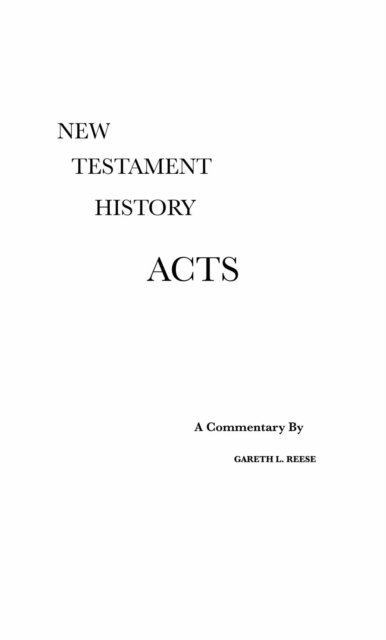
This is a phrase-by-phrase commentary and exposition of the New Testament book of Acts. This commentary is in use as a college textbook, yet is suitable for lay church members.
Acts is a history book, written by Luke to complement and continue the record begun in his Gospel. In Acts, Luke demonstrates how Jesus'' apostles faithfully and obediently put the Great Commission into practice, beginning "in Jerusalem, and then into all Judea and Samaria, and even to the remotest part of the earth" (Acts 1:8). Acts is also indispensable for the introductions it provides to many people encountered elsewhere in the New Testament: Peter, Paul, Barnabas, Silas, Timothy, Luke, Apollos, Priscilla and Aquila, etc.
The Restoration Movement consistently treats Acts as history, but also as a type of unbiased How-To manual for the church.
75% of the New Testament books find their historical backdrop in Acts. Knowing when the churches in the Galatian region or in the cities of Ephesus or Thessalonica were planted is important to interpreting the epistles bearing their names. Knowing the circumstances of Paul''s life during the time when he penned Romans or 1 Corinthians or Philippians colors our interpretation of those books. Knowing who Peter, Luke, and Timothy were influences our interpretations of numerous Scriptures. Such historical information is found in Acts.If the early church is the pattern and model for us to follow, Acts becomes a How-To manual of sorts. Who can be a Christian, and how does it happen? Who receives spiritual gifts, and how does it happen? What ordinances ought the church observe, and when? What makes a church grow, and how does it happen? What is the relationship between church and state? What is the right response to persecution and tribulation? How ought Christianity interact with other religions? How ought we to battle evil in the spiritual world around us? What is missionary work like, and whom should be sent? What is the right leadership structure in the church, and how are leaders selected? Such questions can be dealt with using the guidance the Holy Spirit provided in Acts.Since this commentary presumes the God-inspired nature of all Biblical writing, the author harmonizes Acts'' teachings with other relevant Scriptures, and frequently examines the original language in which it was written. And because of their importance, multiple Special Studies are provided on many of the How-To topics noted above.
This commentary continues the author''s series on the books of the New Testament, and is written from the unique standpoint of the Restoration Movement, a position which allows him to approach Scripture with no special theological doctrine or dogma to defend and explicate. This approach provides an unhindered freedom to listen to what the Holy Spirit would tell us in the Scriptures. By deliberately employing the time-honored grammatico-historical method of interpretation, the Word of God is allowed to impress upon our minds the intent the Divine Author had in mind.
774 kr
Skickas inom 3-6 vardagar
730 kr
Skickas inom 3-6 vardagar