Gary B. Gorton – författare
Visar alla böcker från författaren Gary B. Gorton. Handla med fri frakt och snabb leverans.
13 produkter
13 produkter
Inbunden, Engelska, 2015
1 282 kr
Skickas inom 5-8 vardagar
Financial crises are devastating in human and economic terms. To avoid the next one, it is important to understand the recent financial crisis of 2007-2008 and the financial eras which preceded it. Gary Gorton has been studying financial crises since his 1983 PhD thesis, "Banking Panics." The Maze of Banking contains a collection of his academic papers on the subjects of banks, banking, and financial crises. The papers in this volume span almost 175 years of U.S. banking history, from pre-U.S. Civil War private bank notes issued during the U.S. Free Banking Era (1837-1863); followed by the U.S. National Banking Era (1863-1914) before there was a central bank; through loan sales, securitization, and the financial crisis of 2007-2008. Banking changed profoundly during these 175 years, yet it did not change in fundamental ways. The forms of money changed, resulting in associated changes in the information structure of the economy. Bank debt evolved as an instrument for storing value, smoothing consumption, and transactions, but its fundamental nature did not change. In all its forms, it is vulnerable to bank runs without government intervention. These papers provide the framework for understanding how the financial crisis of 2007-2008 developed and what can be done to promote a stabile banking industry and prevent future economic crises.
E-bok
PDF, Engelska, 2015955 kr
Läs direkt efter köp
After the financial crisis of 2007-2008, analysts continue to question the security of banking sectors in nations in Europe, Latin America, Asia, and Africa. Why do such crises recur? What is it about the accumulation of bank debt that potentially jeopardizes national and global banking systems? There is no one better-equipped to answer such questions than Gary Gorton, who has been studying financial crises since his PhD thesis in 1983. The Maze of Banking contains a collection of his academic papers on the subjects of banks, banking, and financial crises. The papers in this volume span almost 175 years of U.S. banking history, from pre-U.S. Civil War private bank notes issued during the U.S. Free Banking Era (1837-1863), followed by the U.S. National Banking Era (1863-1914) before there was a central bank, through loan sales, securitization, and the financial crisis of 2007-2008. Banking changed profoundly during these 175 years, yet it did not change in fundamental ways. The forms of money changed, resulting in associated changes in the information structure of the economy. Bank debt evolved as an instrument for storing value, smoothing consumption, and transactions, but its fundamental nature did not change. In all its forms, it is vulnerable to bank runs without government intervention. Comprehensive and informative, the collection is the definitive volume on the history of the U.S. banking system. These papers provide the framework for understanding how the financial crisis of 2007-2008 developed and steps to promote a stable banking industry, thereby preventing future economic crises. The Maze of Banking is essential reading material for students and academics with an interest in economics, finance, and the history of banking.
E-bok
Engelska, 2015955 kr
Läs direkt efter köp
After the financial crisis of 2007-2008, analysts continue to question the security of banking sectors in nations in Europe, Latin America, Asia, and Africa. Why do such crises recur? What is it about the accumulation of bank debt that potentially jeopardizes national and global banking systems? There is no one better-equipped to answer such questions than Gary Gorton, who has been studying financial crises since his PhD thesis in 1983. The Maze of Banking contains a collection of his academic papers on the subjects of banks, banking, and financial crises. The papers in this volume span almost 175 years of U.S. banking history, from pre-U.S. Civil War private bank notes issued during the U.S. Free Banking Era (1837-1863), followed by the U.S. National Banking Era (1863-1914) before there was a central bank, through loan sales, securitization, and the financial crisis of 2007-2008. Banking changed profoundly during these 175 years, yet it did not change in fundamental ways. The forms of money changed, resulting in associated changes in the information structure of the economy. Bank debt evolved as an instrument for storing value, smoothing consumption, and transactions, but its fundamental nature did not change. In all its forms, it is vulnerable to bank runs without government intervention. Comprehensive and informative, the collection is the definitive volume on the history of the U.S. banking system. These papers provide the framework for understanding how the financial crisis of 2007-2008 developed and steps to promote a stable banking industry, thereby preventing future economic crises. The Maze of Banking is essential reading material for students and academics with an interest in economics, finance, and the history of banking.
Inbunden, Engelska, 2010
634 kr
Skickas inom 5-8 vardagar
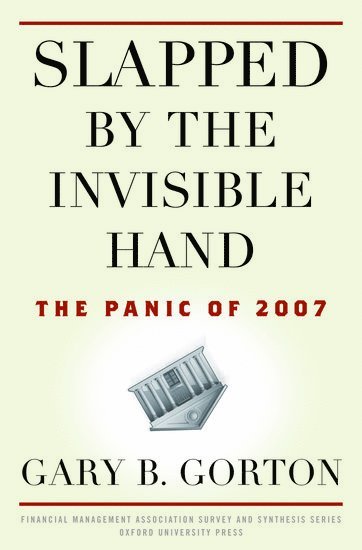
Originally written for a conference of the Federal Reserve, Gary Gorton's "The Panic of 2007" garnered enormous attention and is considered by many to be the most convincing take on the recent economic meltdown. Now, in Slapped by the Invisible Hand, Gorton builds upon this seminal work, explaining how the securitized banking system, the nexus of financial markets and instruments unknown to most people, stands at the heart of the financial crisis. The securitized banking system is, in fact, a real banking system, allowing institutional investors and firms to make large, short-term deposits. But, as any banking system, it was vulnerable to a panic. Indeed the events starting in August 2007 can best be understood as a panic-a wholesale panic, rather than a retail panic-involving financial firms "running" on other financial firms, resulting in the system becoming insolvent. As the financial crisis unfolded, Gorton was working inside an institution that played a central role in the collapse; thus this book presents the unparalleled perspective of a top scholar who was also a central insider.
E-bok
PDF, Engelska, 2010566 kr
Läs direkt efter köp
Originally written for a conference of the Federal Reserve, Gary Gorton''s "The Panic of 2007" garnered enormous attention and is considered by many to be the most convincing take on the recent economic meltdown. Now, in Slapped by the Invisible Hand, Gorton builds upon this seminal work, explaining how the securitized-banking system, the nexus of financial markets and instruments unknown to most people, stands at the heart of the financial crisis. Gorton shows that the Panic of 2007 was not so different from the Panics of 1907 or of 1893, except that, in 2007, most people had never heard of the markets that were involved, didn''t know how they worked, or what their purposes were. Terms like subprime mortgage, asset-backed commercial paper conduit, structured investment vehicle, credit derivative, securitization, or repo market were meaningless. In this superb volume, Gorton makes all of this crystal clear. He shows that the securitized banking system is, in fact, a real banking system, allowing institutional investors and firms to make enormous, short-term deposits. But as any banking system, it was vulnerable to a panic. Indeed the events starting in August 2007 can best be understood not as a retail panic involving individuals, but as a wholesale panic involving institutions, where large financial firms "ran" on other financial firms, making the system insolvent. An authority on banking panics, Gorton is the ideal person to explain the financial calamity of 2007. Indeed, as the crisis unfolded, he was working inside an institution that played a central role in the collapse. Thus, this book presents the unparalleled and invaluable perspective of a top scholar who was also a key insider.
E-bok
Engelska, 2010566 kr
Läs direkt efter köp
Originally written for a conference of the Federal Reserve, Gary Gorton''s "The Panic of 2007" garnered enormous attention and is considered by many to be the most convincing take on the recent economic meltdown. Now, in Slapped by the Invisible Hand, Gorton builds upon this seminal work, explaining how the securitized-banking system, the nexus of financial markets and instruments unknown to most people, stands at the heart of the financial crisis. Gorton shows that the Panic of 2007 was not so different from the Panics of 1907 or of 1893, except that, in 2007, most people had never heard of the markets that were involved, didn''t know how they worked, or what their purposes were. Terms like subprime mortgage, asset-backed commercial paper conduit, structured investment vehicle, credit derivative, securitization, or repo market were meaningless. In this superb volume, Gorton makes all of this crystal clear. He shows that the securitized banking system is, in fact, a real banking system, allowing institutional investors and firms to make enormous, short-term deposits. But as any banking system, it was vulnerable to a panic. Indeed the events starting in August 2007 can best be understood not as a retail panic involving individuals, but as a wholesale panic involving institutions, where large financial firms "ran" on other financial firms, making the system insolvent. An authority on banking panics, Gorton is the ideal person to explain the financial calamity of 2007. Indeed, as the crisis unfolded, he was working inside an institution that played a central role in the collapse. Thus, this book presents the unparalleled and invaluable perspective of a top scholar who was also a key insider.
Inbunden, Engelska, 2012
361 kr
Skickas inom 5-8 vardagar
Prior to the financial crisis of 2007-2008, economists thought that no such crisis could or would ever happen again in the United States, that financial events of such magnitude were a thing of the distant past. In fact, observers of that distant past--the period from the half century prior to the Civil War up to the passage of deposit insurance during the Great Depression, which was marked by repeated financial crises--note that while legislation immediately after crises reacted to their effects, economists and policymakers continually failed to grasp the true lessons to be learned.Gary Gorton, considered by many to be the authority on the financial crisis of our time, holds that economists fundamentally misunderstand financial crises--what they are, why they occur, and why there were none in the U.S. between 1934 and 2007. In Misunderstanding Financial Crises, he illustrates that financial crises are inherent to the production of bank debt, which is used to conduct transactions, and that unless the government designs intelligent regulation, crises will continue. Economists, he writes, looked from a certain point of view and missed everything that was important: the evolution of capital markets and the banking system, the existence of new financial instruments, and the size of certain money markets like the sale and repurchase market. Delving into how such a massive intellectual failure could have happened, Gorton offers a back-to-basics elucidation of financial crises, and shows how they are not rare, idiosyncratic, unfortunate events caused by a coincidence of unconnected factors. By looking back to the "Quiet Period " from 1934 to 2007 when there were no systemic crises, and to the "Panic of 2007-2008, " he brings together such issues as bank debt and liquidity, credit booms and manias, and moral hazard and too-big-too-fail, to illustrate the costs of bank failure and the true causes of financial crises. He argues that the successful regulation that prevented crises did not adequately keep pace with innovation in the financial sector, due in large part to economists' misunderstandings. He then looks forward to offer both a better way for economists to conceive of markets, as well as a description of the regulation necessary to address the historical threat of financial crises.
E-bok
PDF, Engelska, 2012220 kr
Läs direkt efter köp
Before 2007, economists thought that financial crises would never happen again in the United States, that such upheavals were a thing of the past. Gary B. Gorton, a prominent expert on financial crises, argues that economists fundamentally misunderstand what they are, why they occur, and why there were none in the U.S. from 1934 to 2007. Misunderstanding Financial Crises offers a back-to-basics overview of financial crises, and shows that they are not rare, idiosyncratic events caused by a perfect storm of unconnected factors. Instead, Gorton shows how financial crises are, indeed, inherent to our financial system. Economists, Gorton writes, looked from a certain point of view and missed everything that was important: the evolution of capital markets and the banking system, the existence of new financial instruments, and the size of certain money markets like the sale and repurchase market. Comparing the so-called "Quiet Period" of 1934 to 2007, when there were no systemic crises, to the "Panic of 2007-2008," Gorton ties together key issues like bank debt and liquidity, credit booms and manias, moral hazard, and too-big-too-fail--all to illustrate the true causes of financial collapse. He argues that the successful regulation that prevented crises since 1934 did not adequately keep pace with innovation in the financial sector, due in part to the misunderstandings of economists, who assured regulators that all was well. Gorton also looks forward to offer both a better way for economists to think about markets and a description of the regulation necessary to address the future threat of financial disaster.
E-bok
Engelska, 2012220 kr
Läs direkt efter köp
Before 2007, economists thought that financial crises would never happen again in the United States, that such upheavals were a thing of the past. Gary B. Gorton, a prominent expert on financial crises, argues that economists fundamentally misunderstand what they are, why they occur, and why there were none in the U.S. from 1934 to 2007. Misunderstanding Financial Crises offers a back-to-basics overview of financial crises, and shows that they are not rare, idiosyncratic events caused by a perfect storm of unconnected factors. Instead, Gorton shows how financial crises are, indeed, inherent to our financial system. Economists, Gorton writes, looked from a certain point of view and missed everything that was important: the evolution of capital markets and the banking system, the existence of new financial instruments, and the size of certain money markets like the sale and repurchase market. Comparing the so-called "Quiet Period" of 1934 to 2007, when there were no systemic crises, to the "Panic of 2007-2008," Gorton ties together key issues like bank debt and liquidity, credit booms and manias, moral hazard, and too-big-too-fail--all to illustrate the true causes of financial collapse. He argues that the successful regulation that prevented crises since 1934 did not adequately keep pace with innovation in the financial sector, due in part to the misunderstandings of economists, who assured regulators that all was well. Gorton also looks forward to offer both a better way for economists to think about markets and a description of the regulation necessary to address the future threat of financial disaster.
Inbunden, Engelska, 2018
419 kr
Skickas inom 5-8 vardagar
If you’ve got some money in the bank, chances are you’ve never seriously worried about not being able to withdraw it. But there was a time in the United States, an era that ended just over a hundred years ago, in which bank customers had to pay close attention to whether the banking system would remain solvent, knowing they might have to rush to retrieve their savings before the bank collapsed. During the National Banking Era (1863–1914), before the establishment of the Federal Reserve, widespread banking panics were indeed rather common.Yet these pre-Fed banking panics, as Gary B. Gorton and Ellis W. Tallman show, bear striking similarities to our recent financial crisis. In both cases, something happened to make depositors—whether individual customers or corporate investors—“act differently” and find reason to question the value of their bank debt.Fighting Financial Crises thus turns to the past for a fuller understanding of our uncertain present, investigating how panics during the National Banking Era played out and how they were eventually quelled and prevented. Gorton and Tallman open with a survey of the period’s “information environment,” tracing the development of national bank notes, checks, and clearing houses to show how the key to keeping order was to disseminate information very carefully. Identifying the most effective responses based on the framework of the National Banking Era, they then consider the Fed’s and the SEC’s reactions to the recent crisis, building an informative new perspective on how the modern economy works.
E-bok
Engelska, 2018620 kr
Läs direkt efter köp
If you’ve got money in the bank, chances are you’ve never seriously worried about not being able to withdraw it. But there was a time in the United States, an era that ended just over a hundred years ago, when bank customers had to pay close attention to the solvency of the banking system, knowing they might have to rush to retrieve their savings before the bank collapsed. During the National Banking Era (1863–1913), before the establishment of the Federal Reserve, widespread banking panics were indeed rather common. Yet these pre-Fed banking panics, as Gary B. Gorton and Ellis W. Tallman show, bear striking similarities to our recent financial crisis. Fighting Financial Crises thus turns to the past to better understand our uncertain present, investigating how panics during the National Banking Era played out and how they were eventually quelled and prevented. The authors then consider the Fed’s and the SEC’s reactions to the recent crisis, building an informative new perspective on how the modern economy works.
Häftad, Engelska, 2021
333 kr
Skickas inom 5-8 vardagar
If you’ve got money in the bank, chances are you’ve never seriously worried about not being able to withdraw it. But there was a time in the United States, an era that ended just over a hundred years ago, when bank customers had to pay close attention to the solvency of the banking system, knowing they might have to rush to retrieve their savings before the bank collapsed. During the National Banking Era (1863–1913), before the establishment of the Federal Reserve, widespread banking panics were indeed rather common.Yet these pre-Fed banking panics, as Gary B. Gorton and Ellis W. Tallman show, bear striking similarities to our recent financial crisis. Fighting Financial Crises thus turns to the past to better understand our uncertain present, investigating how panics during the National Banking Era played out and how they were eventually quelled and prevented. The authors then consider the Fed’s and the SEC’s reactions to the recent crisis, building an informative new perspective on how the modern economy works.
Inbunden, Engelska, 2023
308 kr
Skickas inom 5-8 vardagar
How financial crises are inherent features of macroeconomic dynamicsThere are no bigger disruptions in the functioning of economies than financial crises. Yet prior to the crash of 2007–2008, macroeconomics incorporated financial crises simply as bad shocks, like earthquakes, failing to consider them as an intrinsic phenomenon of the evolution of macroeconomic variables, such as credit, investment, and productivity. Macroeconomics and Financial Crises rethinks how technological change, credit booms, and endogenous information production combine to generate financial crises as inherent and recurrent reactions to macroeconomic dynamics.Gary Gorton and Guillermo Ordoñez identify short-term debt, collateral, and information as common elements that are present in all financial crises. Short-term debt is a critical element for storing value over short periods without fear of loss, but there needs to be collateral backing the debt. Critically, the collateral should be such that no agent wants to produce information about its quality. The debt backed by such collateral is information-insensitive. Gorton and Ordoñez argue that, during a credit boom, as more and more firms get loans, the economy reaches a tipping point where information production becomes too tempting, disrupting short-term debt and cutting most firms out of the credit market.Showing how a financial crisis is an information event triggered by the dynamics of macroeconomic variables, Macroeconomics and Financial Crises provides new perspectives on the intricate relations between macroeconomics and financial crises.