Gary Lawson - Böcker
Visar alla böcker från författaren Gary Lawson. Handla med fri frakt och snabb leverans.
5 produkter
5 produkter
434 kr
Skickas inom 7-10 vardagar
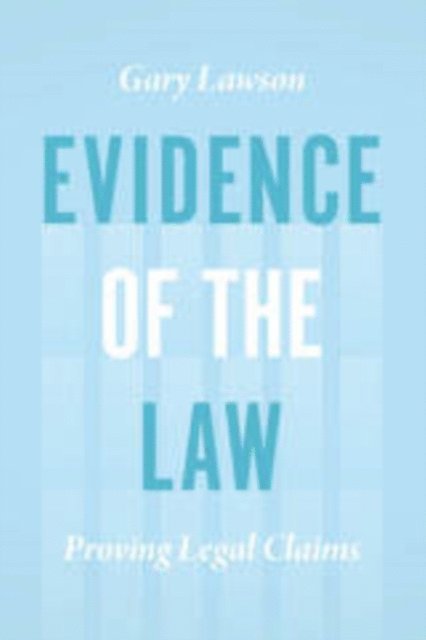
How does one prove the law? If a neighbor breaks your window, the law regulates how you can show your claim to be true or false; but how do you prove that in breaking your window your neighbor has broken your law? American jurisprudence devotes an elaborate body of doctrine and an equally elaborate body of accompanying scholarly commentary to worrying about how to prove facts. It establishes rules for the admissibility of evidence, creates varying standards of proof, and assigns burdens of proof that determine who wins or loses when the facts are unclear. But the law is shockingly inexplicit when addressing these issues with respect to the proof of legal claims. Indeed, the entire language of evidentiary proof, so sophisticated when it comes to questions of fact, is largely absent from the American legal system with respect to questions of law. As Gary Lawson shows, legal claims are inherently objects of proof, and whether or not the law acknowledges the point openly, proof of legal claims is just a special case of the more general norms governing proof of any claim.As a result, similar principles of evidentiary admissibility, standards of proof, and burdens of proof operate, and must operate, in the background of claims about the law. This book brings these evidentiary principles for proving law out of the shadows so that they can be analyzed, clarified, and discussed. Viewing legal problems through this lens of proof illuminates debates about everything from constitutional interpretation to the role of stipulations in litigation. Rather than prescribe resolutions to any of those debates, Evidence of the Law instead provides a set of tools that can be used to make those debates more fruitful, whatever one's substantive views may be. As lawyers, judges, and legal subjects confront uncertainty about what the law is, they can, should, and must, Lawson argues, be guided by the same kinds of abstract considerations, structures, and doctrines long used to make determinations about questions of fact.
1 266 kr
Skickas inom 7-10 vardagar
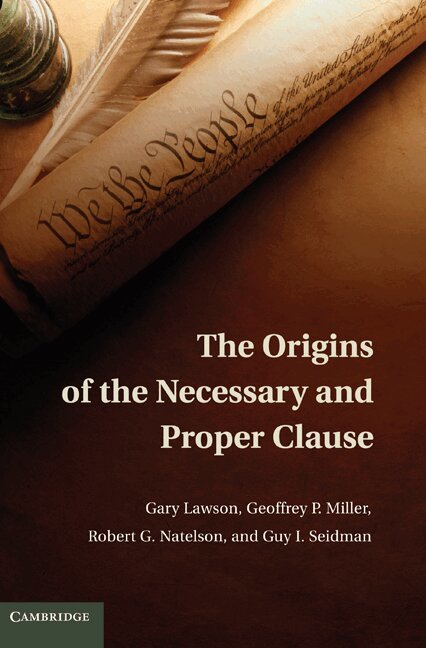
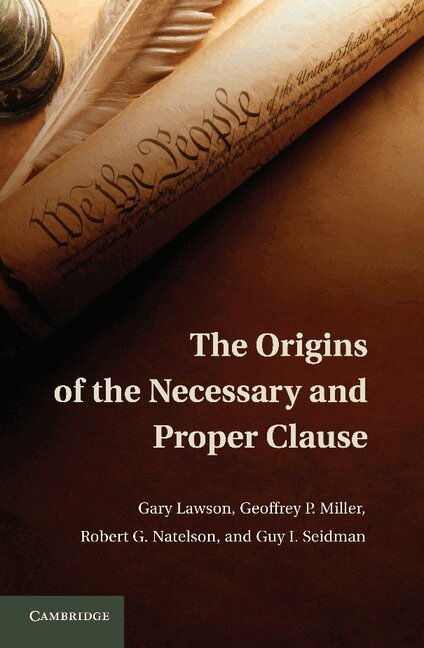
The Necessary and Proper Clause is one of the most important parts of the US Constitution. Today this short thirty-nine-word paragraph is cited as the legal foundation for much of the modern federal government. Through three independent lines of research, the authors trace the lineage of the Necessary and Proper Clause to the everyday law of the Founding Era - the same law that American founders such as Madison, Hamilton, and Washington applied in their daily lives. Origins of the Necessary and Proper Clause are found in law-governing agencies, public administration, and corporations. Moreover, all of those areas were undergirded by common principles of fiduciary responsibility - reflecting the Founders' view that a public office is truly a public trust. This explains the choice of language in the clause and provides clues about its meaning. This book thus serves as a reference source for scholars seeking to understand the intellectual foundations of one of the Constitution's most important clauses.
515 kr
Skickas inom 7-10 vardagar
The Necessary and Proper Clause is one of the most important parts of the US Constitution. Today this short thirty-nine-word paragraph is cited as the legal foundation for much of the modern federal government. Through three independent lines of research, the authors trace the lineage of the Necessary and Proper Clause to the everyday law of the Founding Era - the same law that American founders such as Madison, Hamilton, and Washington applied in their daily lives. Origins of the Necessary and Proper Clause are found in law-governing agencies, public administration, and corporations. Moreover, all of those areas were undergirded by common principles of fiduciary responsibility - reflecting the Founders' view that a public office is truly a public trust. This explains the choice of language in the clause and provides clues about its meaning. This book thus serves as a reference source for scholars seeking to understand the intellectual foundations of one of the Constitution's most important clauses.
1 524 kr
Tillfälligt slut
Like other books in the Core Clinical Concepts in Audiology Series, Speech Audiometry is designed to be particularly helpful and appealing to students and clinicians. It provides a single, easy to manage volume that provides broad coverage of speech audiometry and masking in clinical protocols. In addition to providing appropriate background information, the coverage presents a broad spectrum of assessment tools ranging from traditional to modern. Procedures in this book will assist clinicians in determining differential diagnosis, assessing auditory processing ability, identifying pseudohypacusis, determining cochlear implant candidacy, predicting hearing aid benefit, and counseling. Speech Audiometry, Word Recognition, and Binomial Variables: Interview with Gary Lawson, PhD Douglas L. Beck, AuD, speaks with Dr. Lawson about his 2011 textbook on speech audiometry, critical differences in word recognition scores, dynamic range of speech, and more. Read the interview here: http://www.audiology.org/news/Pages/20120125.aspx. Interview republished with permission from the American Academy of Audiology. Copyright 2012
445 kr
Skickas inom 3-6 vardagar
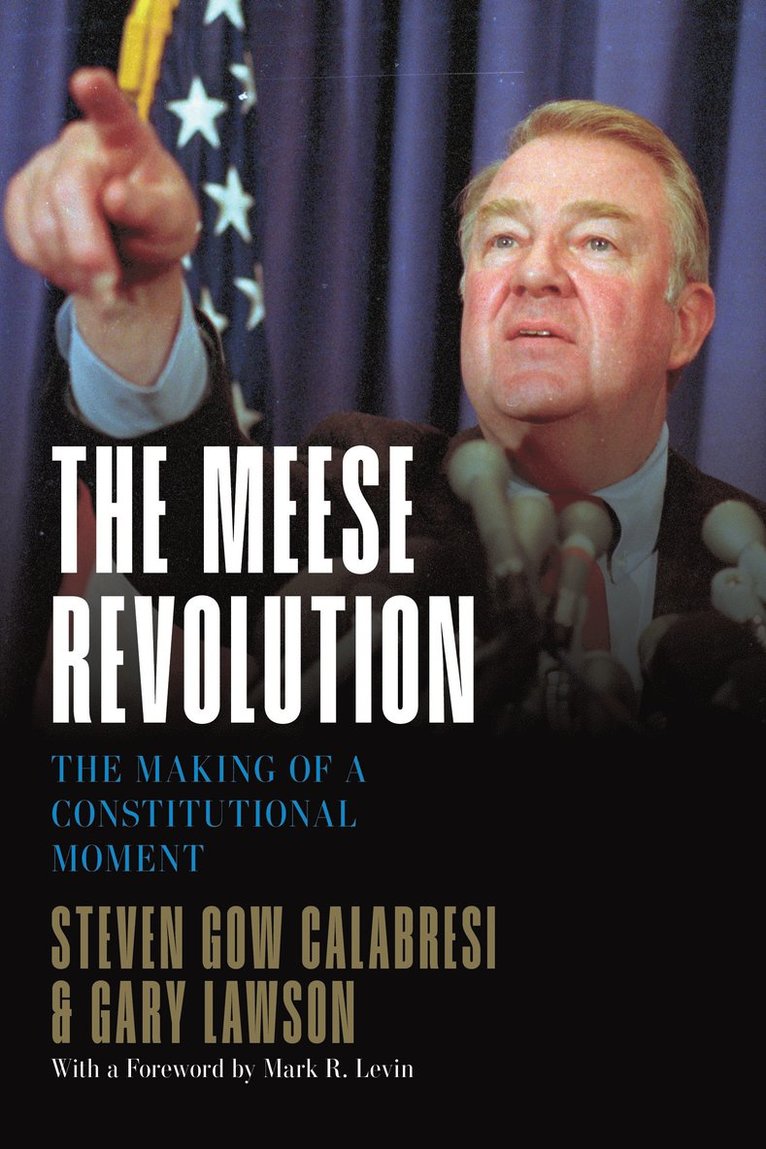
The Meese Revolution explores how Ed Meese became the most powerful and important Attorney General in American history.Edwin Meese III is the most influential person ever to hold the office of U.S. Attorney General – and almost no one knows it. Ed Meese was at the center of virtually every major accomplishment of Ronald Reagan’s transformative presidency, from winning the Cold War without firing a shot to the economic boom that by the end of the 1980s was the envy of the world. More to the point for this book, Ed Meese is the person most responsible for the rise of constitutional originalism, which treats the text and original meaning of the Constitution rather than the policy fads of the moment as authoritative law. In 2024, originalism is a major force in the courts, with a majority of Supreme Court justices and a raft of lower-court and state-court judges at least taking it seriously as a major contributor to decision-making. That result was unthinkable in 1985 when Meese took office and originalism was essentially unknown to the legal academy and almost wholly absent from the judicial process. Ed Meese turned the U.S. Department of Justice into “the academy in exile,” where originalism was developed, refined, theorized, and put into practice.This book describes the rise of originalism, which necessitates telling the story of Ed Meese, without whom it surely does not happen. Meese’s story threads through virtually all important legal and policy events of the 1980s, many of which continue to shape the world of the twenty-first century. We are still living through the Meese Revolution.