Gary M. Seitz – författare
Visar alla böcker från författaren Gary M. Seitz. Handla med fri frakt och snabb leverans.
2 produkter
2 produkter
1 595 kr
Skickas inom 11-20 vardagar
This book concerns the theory of unipotent elements in simple algebraic groups over algebraically closed or finite fields, and nilpotent elements in the corresponding simple Lie algebras. These topics have been an important area of study for decades, with applications to representation theory, character theory, the subgroup structure of algebraic groups and finite groups, and the classification of the finite simple groups. The main focus is on obtaining full information on class representatives and centralizers of unipotent and nilpotent elements. Although there is a substantial literature on this topic, this book is the first single source where such information is presented completely in all characteristics. In addition, many of the results are new--for example, those concerning centralizers of nilpotent elements in small characteristics. Indeed, the whole approach, while using some ideas from the literature, is novel, and yields many new general and specific facts concerning the structure and embeddings of centralizers.
979 kr
Skickas inom 5-8 vardagar
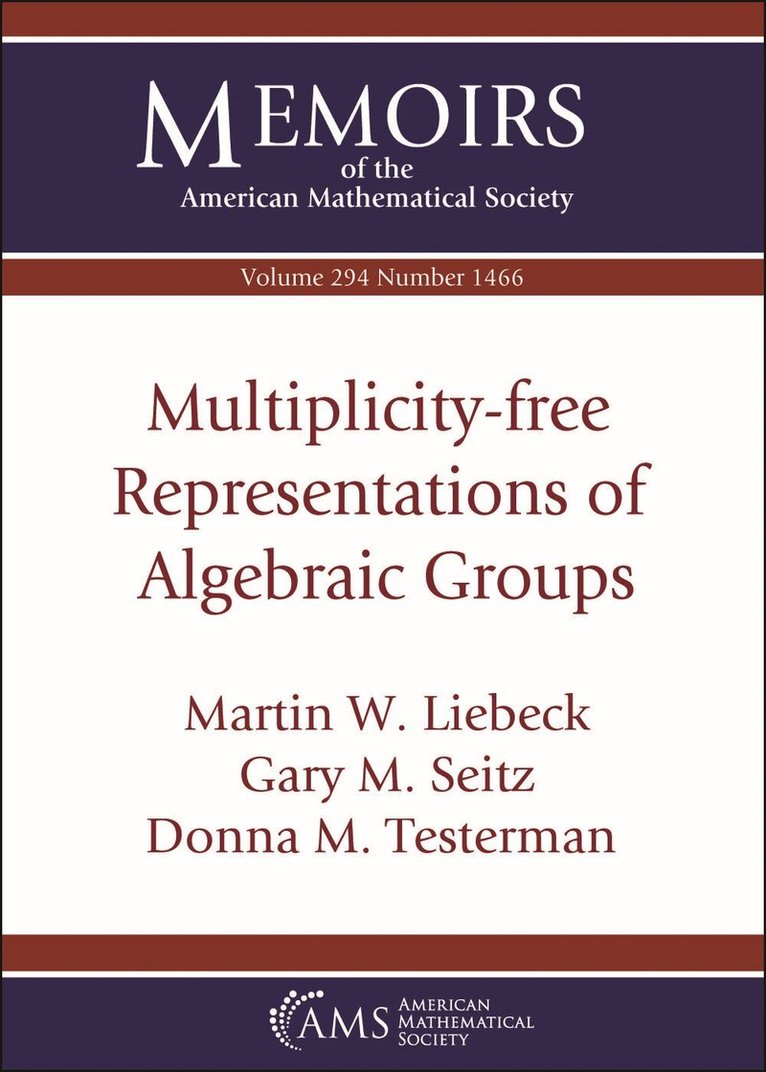
Let K be an algebraically closed field of characteristic zero, and let G be a connected reductive algebraic group over K. We address the problem of classifying triples (G, H, V), where H is a proper connected subgroup of G, and V is a finite-dimensional irreducible G-module such that the restriction of V to H is multiplicity-free -- that is, each of its composition factors appears with multiplicity 1. A great deal of classical work, going back to Dynkin, Howe, Kac, Stembridge, Weyl and others, and also more recent work of the authors, can be set in this context. In this paper we determine all such triples in the case where H and G are both simple algebraic groups of type A, and H is embedded irreducibly in G. While there are a number of interesting familes of such triples (G, H, V), the possibilities for the highest weights of the representations defining the embeddings H < G and G < GL(V) are very restricted. For example, apart from two exceptional cases, both weights can only have support on at most two fundamental weights; and in many of the examples, one or other of the weights corresponds to the alternating or symmetric square of the natural module for either G or H.