Gavin Lowe – författare
Visar alla böcker från författaren Gavin Lowe. Handla med fri frakt och snabb leverans.
3 produkter
3 produkter
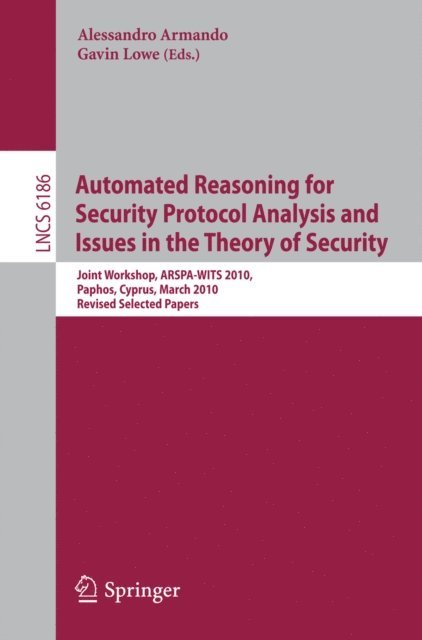
Automated Reasoning for Security Protocol Analysis and Issues in the Theory of Security
Joint Workshop, ARSPA-WITS 2010, Paphos, Cyprus, March 27-28, 2010, Revised Selected Papers
Häftad, Engelska, 2010
664 kr
Skickas inom 10-15 vardagar
ThisvolumecontainstheworkshopproceedingsofARSPA-WITS2010,theJoint Workshop on Automated Reasoning for Security Protocol Analysis and Issues in the Theory of Security, held during March 27-28, 2010 in Paphos (Cyprus). ARSPA-WITS2010o?eredaforumfordiscussingnewresultsintheoriesofc- putersecurity,openquestionsandfundamentalconcernsaboutexistingtheories, and issues related to the development and application of automated reas- ing techniques and tools for the formal speci?cation and analysis of security protocols. There were 28 submissions. All the submissions were thoroughly evaluated on the basis of at least three referee reports, and an electronic Program C- mittee meeting was held by using the EasyChair on-line conference system. The committee decided to accept the 11 papers included in this volume. The authors were giventhe opportunity to revise their paper in light of the feedback received during the workshop. The workshop program was enriched by two invited talks by Flemming Nielson and Catuscia Palamidessi, whose titles and abstracts are also included in this volume.April 2010 Alessandro Armando Gavin Lowe Conference Organization Program Chairs Alessandro Armando Universita di Genova, Italy (Co-chair) Gavin Lowe Oxford University, UK (Co-chair) Program Committee Lujo Bauer CMU, USA Yannick Chevalier Universite Toulouse III, France Luca Compagna SAP Research, France Cas Cremers ETHZ, Switzerland Jorge Cuellar Siemens, Germany Pierpaolo Degano Universita di Pisa, Italy Sandro Etalle Technical University of Eindhoven and University of Twente, The Netherlands Riccardo Focardi Universita di Venezia, Italy Dieter Gollman Technische Universitat Hamburg-Harburg, Germany Joshua Guttman MITRE, USA Jan Jurjens TU Dortmund and Fraunhofer ISST, Germany Gavin Lowe Oxford University, UK (Co-chair) Catherine Meadows Naval Research Laboratory, USA John Mitchell Stanford University, USA
885 kr
Skickas inom 5-8 vardagar
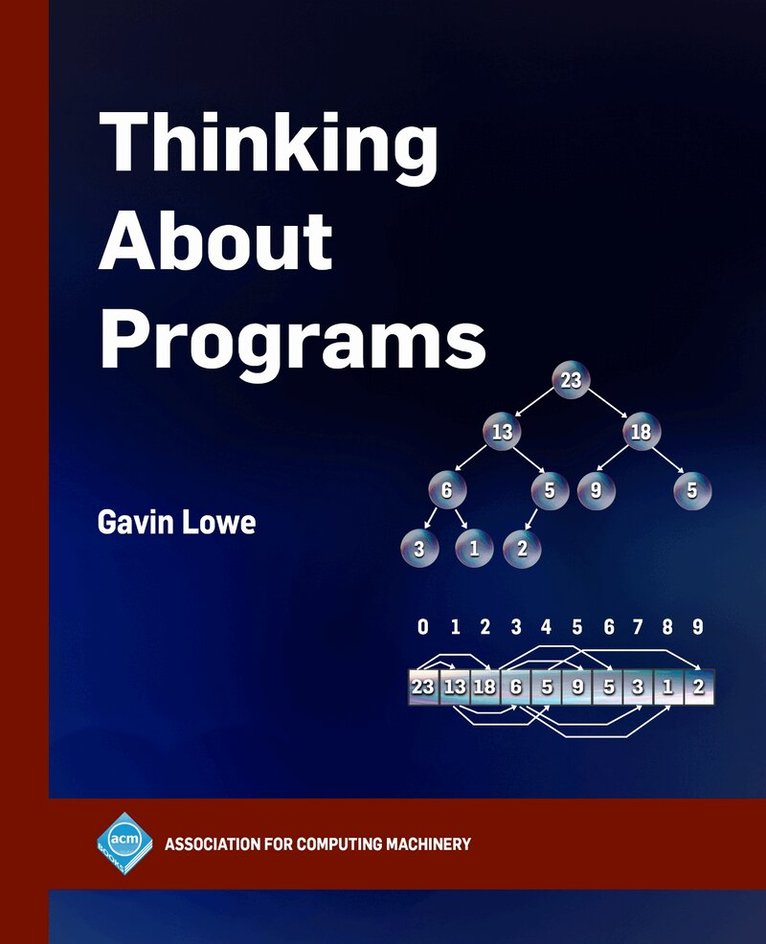
This book describes how to think about computer programs, and how to use mathematics as part of that thinking. Many books and online tutorials teach the basics of coding: the syntax of the language, and how to translate an algorithm into code. But how do you come up with that algorithm? And how can you be confident that the algorithm is correct?The first part of the book considers small programs that use a loop, and how to demonstrate their correctness using loop invariants. It also covers some algorithms and algorithmic techniques that every programmer should know. The second half of the book considers slightly larger programs. It teaches the basics of modularisation, splitting up a program into manageable chunks. It teaches about abstract datatypes, values within a program that can be treated as mathematical values: how to specify their behaviours formally; and how to treat them as abstract mathematical objects when programming. It also teaches how to use data structures to represent abstract datatypes, and what it means for such a representation to be correct. And it presents some abstract datatypes and data structures that every programmer should know.The book is aimed at those who want to obtain a better understanding of programs they work on, and so become better programmers. The target audience ranges from those who are just starting out, to professional programmers. The book aims to be pragmatic: the philosophy is to include enough formality to be convincing and to guide the programmer towards correct code, without getting bogged down in the mathematics.
665 kr
Skickas inom 5-8 vardagar
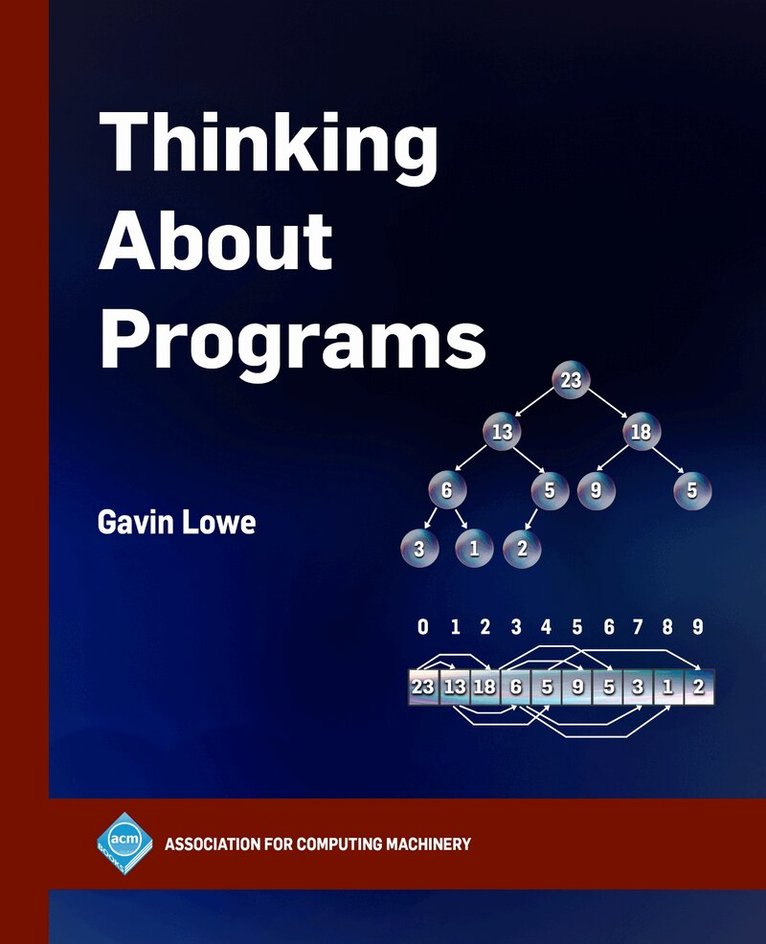
This book describes how to think about computer programs, and how to use mathematics as part of that thinking. Many books and online tutorials teach the basics of coding: the syntax of the language, and how to translate an algorithm into code. But how do you come up with that algorithm? And how can you be confident that the algorithm is correct?The first part of the book considers small programs that use a loop, and how to demonstrate their correctness using loop invariants. It also covers some algorithms and algorithmic techniques that every programmer should know. The second half of the book considers slightly larger programs. It teaches the basics of modularisation, splitting up a program into manageable chunks. It teaches about abstract datatypes, values within a program that can be treated as mathematical values: how to specify their behaviours formally; and how to treat them as abstract mathematical objects when programming. It also teaches how to use data structures to represent abstract datatypes, and what it means for such a representation to be correct. And it presents some abstract datatypes and data structures that every programmer should know.The book is aimed at those who want to obtain a better understanding of programs they work on, and so become better programmers. The target audience ranges from those who are just starting out, to professional programmers. The book aims to be pragmatic: the philosophy is to include enough formality to be convincing and to guide the programmer towards correct code, without getting bogged down in the mathematics.