Genovese - Böcker
Visar alla böcker från författaren Genovese. Handla med fri frakt och snabb leverans.
2 produkter
2 produkter
1 709 kr
Skickas inom 3-6 vardagar
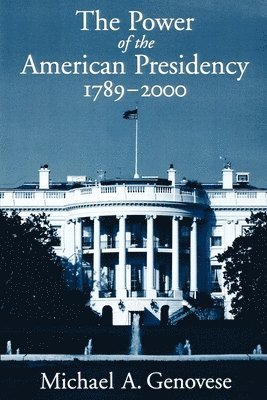
In its more than 200-year history, the office of the President of the United States has undergone a variety of dramatic changes. Because the founding fathers left the privileges and responsibilities of the job constitutionally vague and ill-defined, each occupant of the office - from George Washington to Bill Clinton - has tried to set the limits of presidential power as he has seen fit based on the domestic and international circumstances of the day as well as on his own ambition and abilities. In The Power of the American Presidency, Michael A. Genovese, one of the best known and respected scholars on the presidency, takes students on a journey through the personalities and politics of some of the most fascinating and at times powerful men in American history. Organized chronologically, the text offers an overview of the evolution and elasticity of presidential power by providing case studies of each president's personal characteristics and the defining historical events of each administration.From Abraham Lincoln, who stretched the boundaries of presidential power during the Civil War, to nearly forgotten presidents like Van Buren, Garfield, and Fillmore, who led weak administrations with limited power, Genovese presents the history of the country's highest office with insight, balanced judgment, and humour. The Power of the American Presidency will be widely used in undergraduate courses on the American Presidency as well as in courses on American history, American studies, and political science. It will also be of interest to anyone who wishes to gain a keener insight into the workings of the presidency.
228 kr
Tillfälligt slut
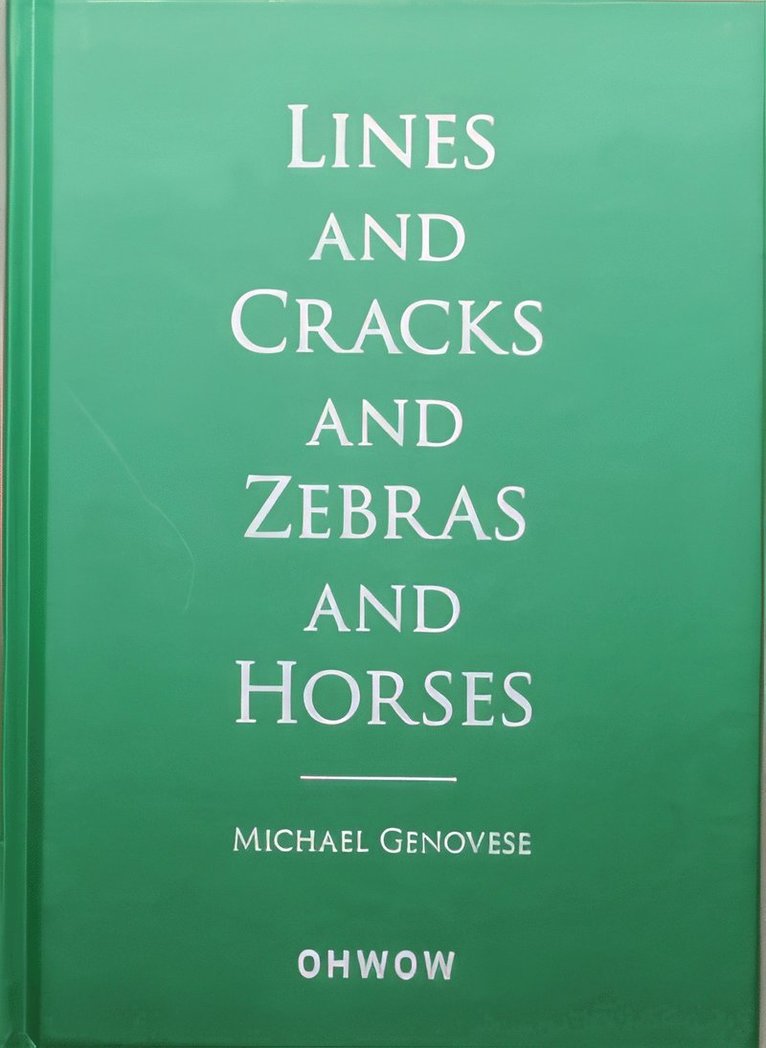
The title of Michael Genovese's exhibition, Lines and Cracks and Zebras and Horses, draws in part on a colloquial aphorism — “when you hear hoof beats behind you, don’t expect to see a zebra” or “when you hear hoof beats, think horses, not zebras” — which typically is understood to evolve from the principle of Occam’s (or Ockham's) razor. Attributed to the 14th century logician and Franciscan friar William of Ockham, the principle states, “Pluralitas non est ponendasine necessitate,” or “Entities should not be multiplied unnecessarily. ”Drawn from disparate, often familiar or banal moments oflines and cracks, the delicate, quiet sculptural interventions reconsider and combine occurrences as varied as a crack inthe artist’s kitchen floor, a damaged mihrab from 12th century Iran, a varicose vein, a line from a CAPTCHA (those computer tests that determine ahuman is using the site, not a machine), the seam line of an Ancient Greek horse head sculpture, and the stress fracture from a brick building in Compton. “Lines and Cracks and Zebras and Horses”: in that grammatical setup, seems to parallel lines with zebras, cracks with horses. Following the logic above, this would suggest that “lines” are the less empirically likely to be the right theory, while “cracks” the better assumption in similar situations. This is a reverse of expectation, combining the common connotations of all these, one would expect to find the zebras in the cracks, and let the horses follow the lines. However, the parallel is notstrictly correct; rather than a comma between the couplets, Genovese connects them with the same conjunction, “and,” making them technically a list of equivalent things. Perhaps lines aren’t the best or shortest ways between objects or places, perhaps they separate rather than connect parts. Perhaps cracks show richness formerly hidden, reveal depth where there was only surface, or function as a suture point that holds things together with true delicacy and vulnerability. Featuring an essay by Shamim Momin.