Georg Ruppelt – författare
Visar alla böcker från författaren Georg Ruppelt. Handla med fri frakt och snabb leverans.
11 produkter
11 produkter
Inbunden, Engelska, 2023
284 kr
Skickas
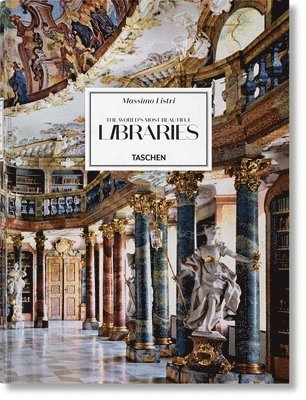
From the mighty halls of ancient Alexandria to the coffered ceilings of the Morgan Library in New York, human beings have had a long, enraptured relationship with libraries. Like no other concept and like no other space, the collection of knowledge, learning, and imagination offers a sense of infinite possibility. It’s the unrivaled realm of discovery, where every faded manuscript or mighty clothbound tome might reveal a provocative new idea, a far-flung fantasy, an ancient belief, a religious conviction, or a whole new way of being in the world.In this new photographic journey, Massimo Listri travels to some of the oldest and finest libraries to reveal their architectural, historical, and imaginative wonder. Through great wooden doors, up spiraling staircases, and along exquisite, shelf-lined corridors, he leads us through outstanding private, public, educational, and monastic libraries, dating as far back as 766. Between them, these medieval, classical, baroque, rococo, and 19th-century institutions hold some of the most precious records of human thought and deed, inscribed and printed in manuscripts, volumes, papyrus scrolls, and incunabula. In each, Listri’s poised images capture the library’s unique atmosphere, as much as their most prized holdings and design details.Featured libraries include the papal collections of the Vatican Apostolic Library and the Trinity College Library, home to the Book of Kells and Book of Durrow. With meticulous descriptions accompanying each featured library, we learn not only of the libraries’ astonishing holdings—from which highlights are illustrated—but also of their often lively, turbulent, or controversial pasts. Like the Franciscan monastery in Lima, Peru, with its horde of archival Inquisition documents.At once a bibliophile beauty pageant, an ode to knowledge, and an evocation of the particular magic of print, this compact edition of our best-selling XXL-title is above all a cultural-historical pilgrimage to the heart of our halls of learning, to the stories they tell, as much as those they gather in printed matter along polished shelves.
E-bok
PDF, Tyska, 20191 544 kr
Läs direkt efter köp
E-bok
PDF, Tyska, 20141 390 kr
Läs direkt efter köp
E-bok
PDF, Tyska, 2017552 kr
Läs direkt efter köp
Inbunden, Tyska, 2000
1 587 kr
Skickas inom 5-8 vardagar
Inbunden, Tyska, 2002
1 574 kr
Skickas inom 5-8 vardagar
Inbunden, Tyska
365 kr
Skickas inom 3-6 vardagar
Inbunden, Engelska, 2018
1 793 kr
Skickas inom 3-6 vardagar
From the mighty halls of ancient Alexandria to the coffered ceilings of the Morgan Library in New York, human beings have had a long, enraptured relationship with libraries. Like no other concept and like no other space, the collection of knowledge, learning, and imagination offers a sense of infinite possibility. It’s the unrivaled realm of discovery, where every faded manuscript or mighty clothbound tome might reveal a provocative new idea, a far-flung fantasy, an ancient belief, a religious conviction, or a whole new way of being in the world. In this new photographic journey, Massimo Listri travels to some of the oldest and finest libraries to reveal their architectural, historical, and imaginative wonder. Through great wooden doors, up spiraling staircases, and along exquisite, shelf-lined corridors, he leads us through outstanding private, public, educational, and monastic libraries, dating as far back as 766. Between them, these medieval, classical, baroque, rococo, and 19th-century institutions hold some of the most precious records of human thought and deed, inscribed and printed in manuscripts, volumes, papyrus scrolls, and incunabula. In each, Listri’s poised images capture the library’s unique atmosphere, as much as their most prized holdings and design details. Featured libraries include the papal collections of the Vatican Apostolic Library, Trinity College Library, home to the Book of Kells and Book of Durrow, and the holdings of the Laurentian Library in Florence, the private library of the powerful House of Medici, designed by Michelangelo. With meticulous descriptions accompanying each featured library, we learn not only of the libraries’ astonishing holdings—from which highlights are illustrated—but also of their often lively, turbulent, or controversial pasts. Like Altenburg Abbey in Austria, an outpost of imperial Catholicism repeatedly destroyed during the European wars of religion, or the Franciscan monastery in Lima, Peru, with its horde of archival Inquisition documents. At once a bibliophile beauty pageant, an ode to knowledge, and an evocation of the particular magic of print, Massimo Listri. The World’s Most Beautiful Libraries is above all a cultural-historical pilgrimage to the heart of our halls of learning, to the stories they tell, as much as those they gather in printed matter along polished shelves.
Del 35 - Geheimnisse der Heimat
Braunschweiger Geheimnisse
Häftad, Tyska, 2021
289 kr
Skickas inom 3-6 vardagar
Häftad, Tyska, 2017
186 kr
Skickas inom 3-6 vardagar
E-bok
PDF, Tyska, 2015460 kr
Läs direkt efter köp
Die Herrenhäuser Hofgärtner Johann Christoph Wendland (1755-1828), Heinrich Ludolph Wendland (1792-1869) und Hermann Wendland (1823-1903) waren über ein Jahrhundert für den Berggarten zuständig. Sie entwickelten ihn zu einem Botanischen Garten von internationalem Niveau, der in Bezug auf einzelne Pflanzenarten mit Kew Gardens durchaus ebenbürtig war. Reisen innerhalb Europas und nach Übersee, auf denen Pflanzen gesammelt werden konnten, spielten beim Aufbau und der Entwicklung des Pflanzenbestandes eine herausragende Rolle. Eine dieser Reisen führte Heinrich Ludolph Wendland im Jahr 1820 durch verschiedene deutsche Staaten nach Österreich und in die Schweiz. Hauptziele der Reise waren der Kontakt zu anderen Fachleuten wie Botanikern, Pflanzenhändlern und Gartenkünstlern und das Sammeln alpiner Pflanzen, um die Pflanzensammlungen des Berggartens entsprechend bereichern zu können.Seine mehrmonatige Reise hielt Heinrich Ludolph Wendland in einem mehr als 100 Seiten umfassenden Reisetagebuch fest. Solche Reiseberichte und Reisetagebücher sind für die gartenhistorische Forschung Quellen von herausragender Bedeutung. Dieses Dokument stellt wichtige Informationen zur Geschichte des Gartenbaus und der Botanik zur Verfügung, erweitert das Verständnis um die historische Entwicklung der Pflanzenbestände des Berggartens und liefert darüber hinaus am Beispiel eines Hofgärtners faszinierende Einblicke in die Sozial- und Gesellschaftsgeschichte des frühen 19. Jahrhunderts. Dank der finanziellen Förderung durch die VGH-Stiftung konnte das Reisetagebuch von Heinrich Ludolph Wendland, das in der Gottfried Wilhelm Leibniz Bibliothek aufbewahrt wird, transkribiert und mit zwei einführenden Beiträgen als Band 23 der CGL-Studies veröffentlicht werden.