George Sarton – författare
Visar alla böcker från författaren George Sarton. Handla med fri frakt och snabb leverans.
18 produkter
18 produkter
Inbunden, Engelska, 2022
372 kr
Skickas inom 5-8 vardagar
Häftad, Engelska, 2022
235 kr
Skickas inom 5-8 vardagar
Inbunden, Engelska, 2023
362 kr
Skickas inom 5-8 vardagar
Häftad, Engelska, 2023
228 kr
Skickas inom 5-8 vardagar
Inbunden, Engelska, 2026
565 kr
Skickas inom 5-8 vardagar
Inbunden, Engelska, 2026
565 kr
Skickas inom 5-8 vardagar
Häftad, Engelska, 2026
455 kr
Skickas inom 5-8 vardagar
Häftad, Engelska, 2026
455 kr
Skickas inom 5-8 vardagar
Inbunden, Engelska, 2018
2 158 kr
Skickas inom 10-15 vardagar
In this classic work, the foremost historian of science in our time, George Sarton, sums up his reflections on the role of science and of the humanities in our culture. Voicing his opposition to the old-fashioned humanists on the one hand, and to the 'uneducated' men of science and technicians on the other, Sarton points out to the former that the humanities without scientific are essentially incomplete. He warns the latter that without history, without philosophy, without arts and letters, without a living religion, human life on this planet would cease to be worthwhile.After outlining his 'Faith of a Humanist' in the opening section, Sarton goes on to analyze 'The History of Science and the History of Civilization,' to discuss the progress of scientific thought since ancient times in 'East and West,' and to propose the solution for the educational and cultural crisis of our time in 'The New Humanism' and in 'The History of Science and the Problems of Today.' He concludes not only that science is a source of technological development that has changed the face of the earth and has convulsed our lives for good and evil, but that it nonetheless affords the best means of understanding the world, its people, and the multitude of their relationships. 'Science is the conscience of mankind.'Included in this edition is Robert M. Merton's address before the Sarton Centennial meeting of November 1984. It is a stunning tour de force in its own right, providing insights into Sarton, teaching and research at Harvard in the 1930s, and the personal interaction between Sarton the mentor, and Merton the pupil. The essay supplements May Sarton's earlier 'Informal Portrait of George Sarton.'
Inbunden, Engelska
555 kr
Skickas inom 3-6 vardagar
E-bok
Engelska, 2018795 kr
Läs direkt efter köp
In this classic work, the foremost historian of science in our time, George Sarton, sums up his reflections on the role of science and of the humanities in our culture. Voicing his opposition to the old-fashioned humanists on the one hand, and to the ''uneducated'' men of science and technicians on the other, Sarton points out to the former that the humanities without scientific are essentially incomplete. He warns the latter that without history, without philosophy, without arts and letters, without a living religion, human life on this planet would cease to be worthwhile.After outlining his ''Faith of a Humanist'' in the opening section, Sarton goes on to analyze ''The History of Science and the History of Civilization,'' to discuss the progress of scientific thought since ancient times in ''East and West,'' and to propose the solution for the educational and cultural crisis of our time in ''The New Humanism'' and in ''The History of Science and the Problems of Today.'' He concludes not only that science is a source of technological development that has changed the face of the earth and has convulsed our lives for good and evil, but that it nonetheless affords the best means of understanding the world, its people, and the multitude of their relationships. ''Science is the conscience of mankind.''Included in this edition is Robert M. Merton''s address before the Sarton Centennial meeting of November 1984. It is a stunning tour de force in its own right, providing insights into Sarton, teaching and research at Harvard in the 1930s, and the personal interaction between Sarton the mentor, and Merton the pupil. The essay supplements May Sarton''s earlier ''Informal Portrait of George Sarton.''
E-bok
PDF, Engelska, 2018802 kr
Läs direkt efter köp
In this classic work, the foremost historian of science in our time, George Sarton, sums up his reflections on the role of science and of the humanities in our culture. Voicing his opposition to the old-fashioned humanists on the one hand, and to the ''uneducated'' men of science and technicians on the other, Sarton points out to the former that the humanities without scientific are essentially incomplete. He warns the latter that without history, without philosophy, without arts and letters, without a living religion, human life on this planet would cease to be worthwhile.After outlining his ''Faith of a Humanist'' in the opening section, Sarton goes on to analyze ''The History of Science and the History of Civilization,'' to discuss the progress of scientific thought since ancient times in ''East and West,'' and to propose the solution for the educational and cultural crisis of our time in ''The New Humanism'' and in ''The History of Science and the Problems of Today.'' He concludes not only that science is a source of technological development that has changed the face of the earth and has convulsed our lives for good and evil, but that it nonetheless affords the best means of understanding the world, its people, and the multitude of their relationships. ''Science is the conscience of mankind.''Included in this edition is Robert M. Merton''s address before the Sarton Centennial meeting of November 1984. It is a stunning tour de force in its own right, providing insights into Sarton, teaching and research at Harvard in the 1930s, and the personal interaction between Sarton the mentor, and Merton the pupil. The essay supplements May Sarton''s earlier ''Informal Portrait of George Sarton.''
Häftad, Engelska
445 kr
Skickas inom 3-6 vardagar
Inbunden, Engelska, 1955
1 073 kr
Skickas inom 10-15 vardagar
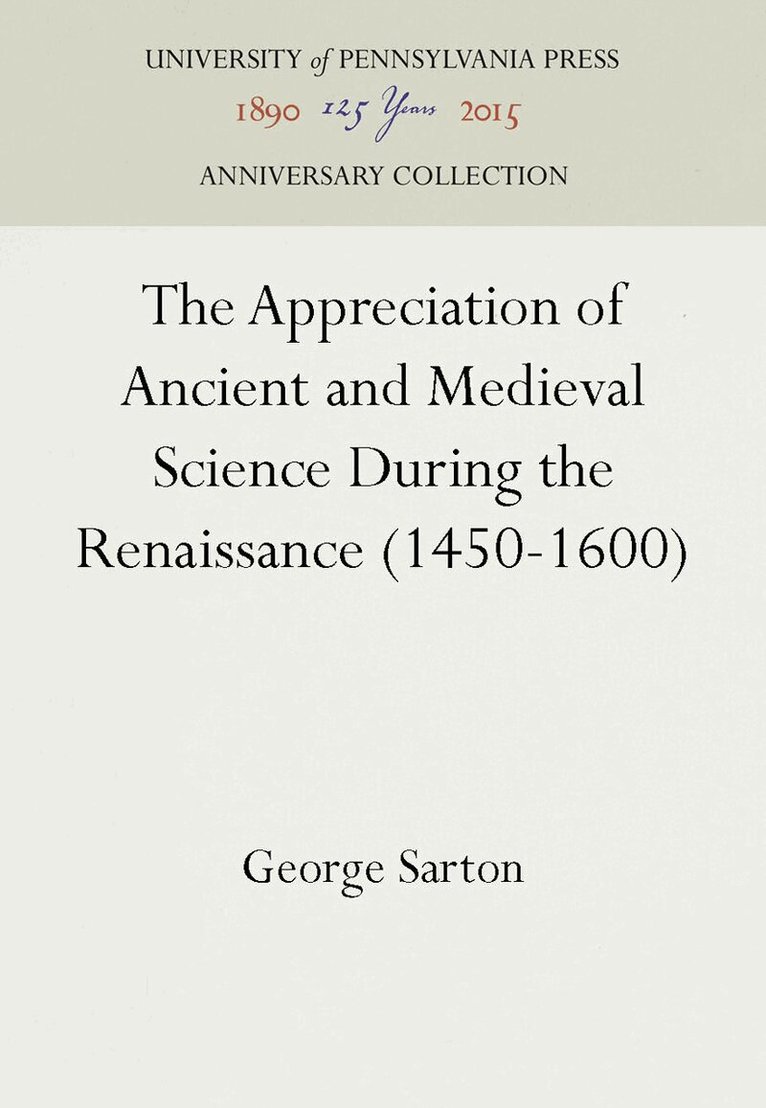
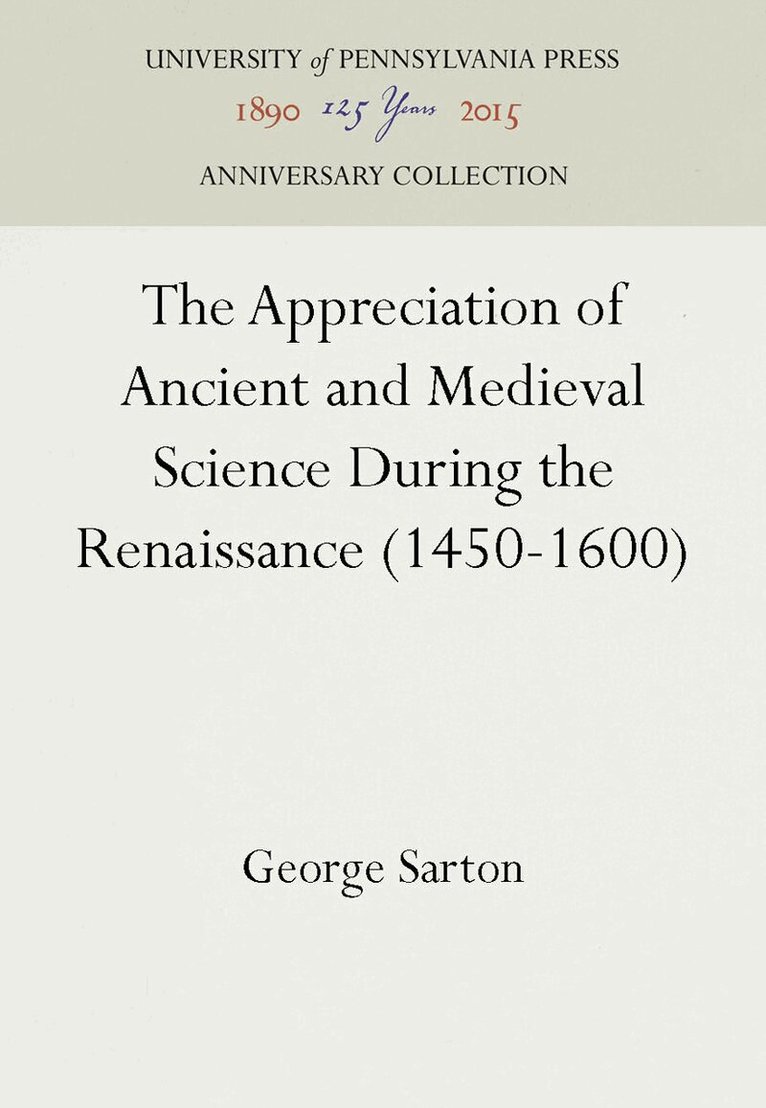
This book is a volume in the Penn Press Anniversary Collection. To mark its 125th anniversary in 2015, the University of Pennsylvania Press rereleased more than 1,100 titles from Penn Press's distinguished backlist from 1899-1999 that had fallen out of print. Spanning an entire century, the Anniversary Collection offers peer-reviewed scholarship in a wide range of subject areas.
E-bok
PDF, Engelska, 20161 494 kr
Läs direkt efter köp
This book is a volume in the Penn Press Anniversary Collection. To mark its 125th anniversary in 2015, the University of Pennsylvania Press rereleased more than 1,100 titles from Penn Press''s distinguished backlist from 1899-1999 that had fallen out of print. Spanning an entire century, the Anniversary Collection offers peer-reviewed scholarship in a wide range of subject areas.
Häftad, Engelska, 2003
270 kr
Tillfälligt slut
Inbunden, Engelska, 2014
854 kr
Tillfälligt slut
Häftad, Engelska, 1987
508 kr
Tillfälligt slut
In this classic work, the foremost historian of science in our time, George Sarton, sums up his reflections on the role of science and of the humanities in our culture. Voicing his opposition to the old-fashioned humanists on the one hand, and to the 'uneducated' men of science and technicians on the other, Sarton points out to the former that the humanities without scientific are essentially incomplete. He warns the latter that without history, without philosophy, without arts and letters, without a living religion, human life on this planet would cease to be worthwhile.After outlining his 'Faith of a Humanist' in the opening section, Sarton goes on to analyze 'The History of Science and the History of Civilization,' to discuss the progress of scientific thought since ancient times in 'East and West,' and to propose the solution for the educational and cultural crisis of our time in 'The New Humanism' and in 'The History of Science and the Problems of Today.' He concludes not only that science is a source of technological development that has changed the face of the earth and has convulsed our lives for good and evil, but that it nonetheless affords the best means of understanding the world, its people, and the multitude of their relationships. 'Science is the conscience of mankind.'Included in this edition is Robert M. Merton's address before the Sarton Centennial meeting of November 1984. It is a stunning tour de force in its own right, providing insights into Sarton, teaching and research at Harvard in the 1930s, and the personal interaction between Sarton the mentor, and Merton the pupil. The essay supplements May Sarton's earlier 'Informal Portrait of George Sarton.'