Georgios I. Papadimitriou - Böcker
Visar alla böcker från författaren Georgios I. Papadimitriou. Handla med fri frakt och snabb leverans.
5 produkter
5 produkter
1 318 kr
Skickas inom 7-10 vardagar
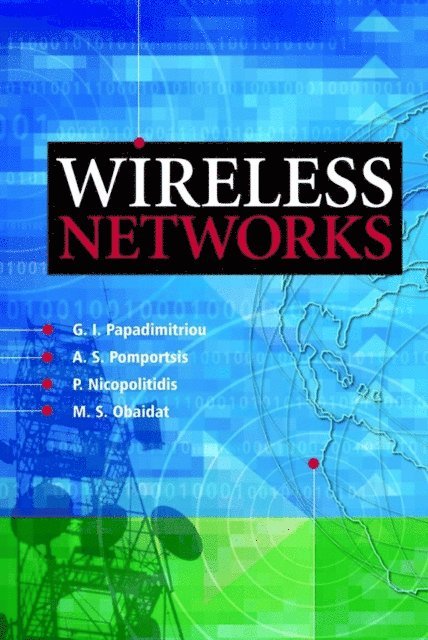
Wireless is a term used to describe telecommunications in which electromagnetic waves (rather than some form ofwire) carry the signal over part or all of the communication path and the network is the totality of switches, transmission links and terminals used for the generation, handling and receiving of telecoms traffic.Wireless networks are rapidly evolving, and are playing an increasing role in the lives of people throughout the world and ever-larger numbers of people are relying on the technology directly or indirectly. The area of wireless communications is an extremely rich field for research, due to the difficulties posed by the wireless medium and the increasing demand for better and cheaper services. As the wireless market evolves, it is likely to increase in size and possibly integrate with other wireless technologies, in order to offer support for mobile computing applications, of perceived performance equal to those of wired communication networks.Wireless Networks aims to provide an excellent introductory text covering the wireless technological alternatives offered today. It will include old analog cellular systems, current second generation (2G) systems architectures supporting voice and data transfer and also the upcoming world of third generation mobile networks. Moreover, the book features modern wireless technology topics, such as Wireless Local Loops (WLL), Wireless LANs, Wireless ATM and Personal Area Networks (such as Bluetooth).* Provides an easy to use reference which presents a clear set of technologies per chapter* Features modern wireless technology topics, such as Wireless Local Loops (WLL), Wireless LANs, Wireless ATM, Personal Area Networks (such as Bluetooth) and Ad-hoc wireless networks* Progresses through the developments of first, second, third, fourth generation cellular systems and beyond* Includes helpful simulation examples and examples of algorithms and systemsEssential reading for Senior undergraduate and graduate students studying computer science, telecommunications and engineering, engineers and researchers in the field of wireless communications and technical managers and consultants.
1 443 kr
Skickas inom 11-20 vardagar
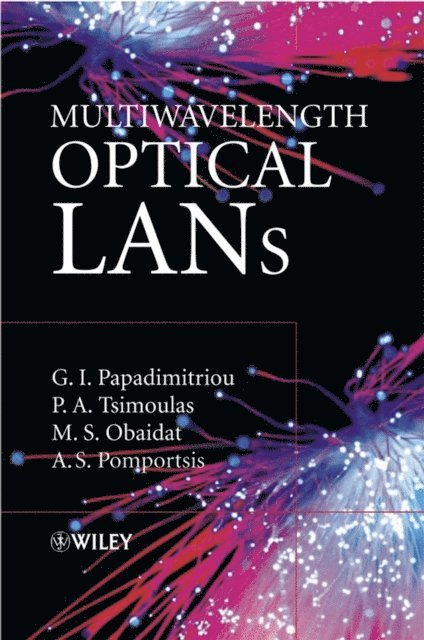
During the last thirty years or so it has been widely recognised in the research community that the key transmission medium seeming capable of serving both the ever-growing demand for bandwidth and the unceasing need for new services, is optical fibre. In this context, Wavelength Division Multiplexing (WDM) is the most popular technique for introducing concurrency among multiple user transmissions into the network and, thus, exploiting the huge amount of fibre bandwidth available under the severe limitations imposed by electronics speed on the maximum network access rate. This book extensively covers an important research area in optical networking, enabling readers to fully understand the concepts of optical LANs and learn details of architecture issues and control protocols.Through its careful focus on the local area, the book, covers the major architectural, topological and protocol issues regarding optical Local Area Networks (LANs) today. Considering that constant advances on optical component technology make all-optical WDM LANs all the more feasible for a wide commercial deployment, the book investigates thoroughly the crucial latter topic, i.e. the Media-Access Control (MAC) protocols that should be used. Besides introducing a noteworthy part of the vast literature on such protocols and providing some helpful distinguishing key protocol characteristics, the book is also innovative in focusing on a recent significant class of promising protocols whose operation is based on network feedback information. In this way, these adaptive protocols for optical LANs achieve an overall higher performance in comparison with many other non-adaptive schemes.Multiwavelength Optical LANs: Enables readers to understand the concepts of optical LANs and learn details of architecture issues and control protocolsFocuses on the major architectural, topological and protocol issues regarding optical local area networksPresents the important class of adaptive protocols for optical LANsNo Optical systems/network developers, or engineers and scientists working in optical networking should be without this book. The well considered approach also makes this recommended reading for undergraduate and graduate computer science, computer, electrical and telecommunications engineering students.
Del 172 - Wiley Series in Microwave and Optical Engineering
Optical Switching
Inbunden, Engelska, 2007
1 359 kr
Skickas inom 7-10 vardagar
While much has been published on the subject in individual articles, this text is the first to cohesively present optical switching in a single book. The three authors examine and discuss all the challenges involved in the commercialization of optical switching. Readers are brought up to date with the latest advances in research as well as the technological hurdles that researchers.
1 640 kr
Skickas inom 10-15 vardagar
This text provides state-of-the-art treatment of methodologies and applications of system simulation related to all disciplines that range from toll-plaza systems for highways and bridges, traffic light control in city planning and engineering, design of transistors, VLSI chips and computer systems and networks to the design and optimization of the operation of aerodynamic, air traffic control and space shuttle systems. In a series of structured and focused chapters written by international experts from academia, industry and government, the volume presents the fundamentals of system simulation along with the latest research results and applications. With its particular breadth and depth, "Applied System Simulation" is a useful reference work for practitioners and researchers working in all areas of modelling and simulation. Given its cohesive structure, it would also serve as a textbook for graduate and senior undergraduate level courses on modelling and simulation for all disciplines.
1 593 kr
Skickas inom 10-15 vardagar
Simulation and molding are efficient techniques that can aid the city and regional planners and engineers in optimizing the operation of urban systems such as traffic light control, highway toll automation, consensus building, public safety, and environmental protection. When modeling transportation systems such as freeway systems, arterial or downtown grid systems, the city planner and engineer is concerned with capturing the varied interactions between drivers, automobiles, and the infrastructure. Modeling and simulation are used to effectively optimize the design and operation of all of these urban systems. It is possible that in an urban simulation community workshop, citizens can work interactively in front of computers and be able using the click of the mouse to walk up to their own front porch, looking at the proposed shopping mall alternatives across the street from virtually any angle and proposed bridge or tunnel and see how it can reduce traffic congestion. Buildings can be scaled down or taken out, their orientation can be changed in order to check the view and orientation in order to have better site with efficient energy-conservation. The stone or brick material on a building can be replaced by colored concrete, or more trees and lampposts can be placed on the site. Such flexibility in simulation and animation allows creative ideas in the design and orientation of urban sites to be demonstrated to citizens and decision makers before final realization.