Gerhard Jäger – författare
Visar alla böcker från författaren Gerhard Jäger. Handla med fri frakt och snabb leverans.
13 produkter
13 produkter
Inbunden, Engelska, 2005
1 659 kr
Skickas inom 10-15 vardagar
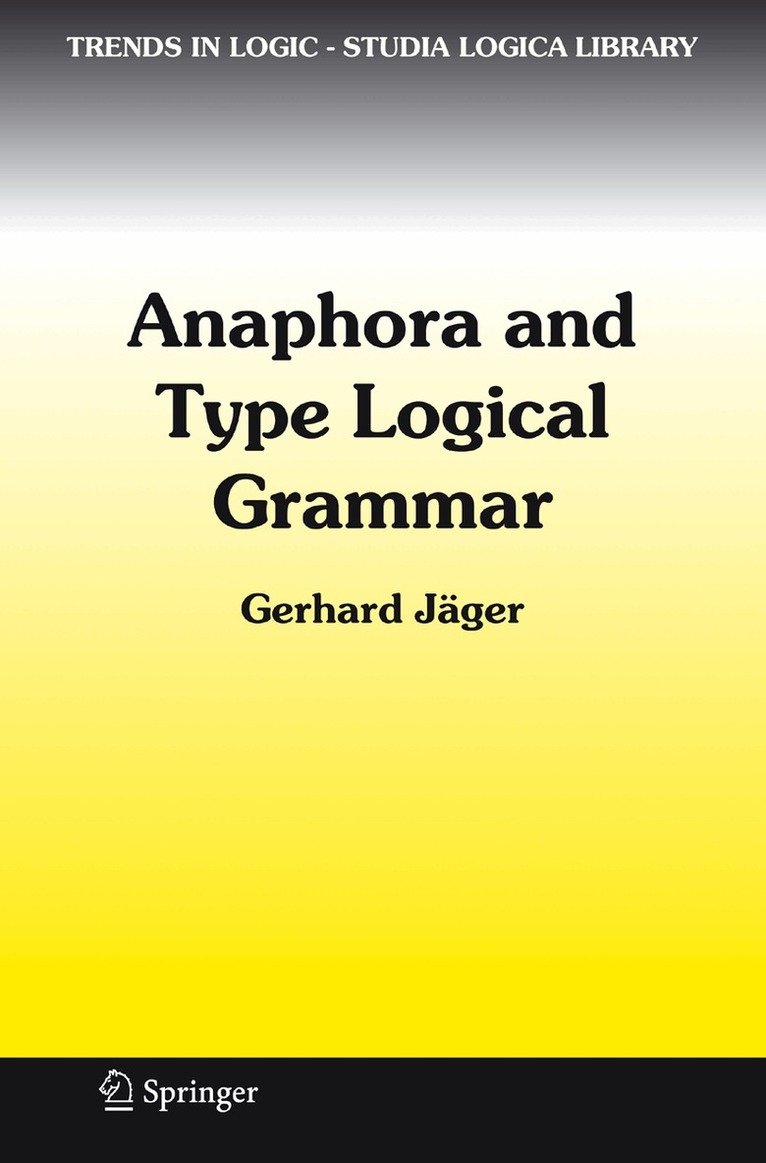
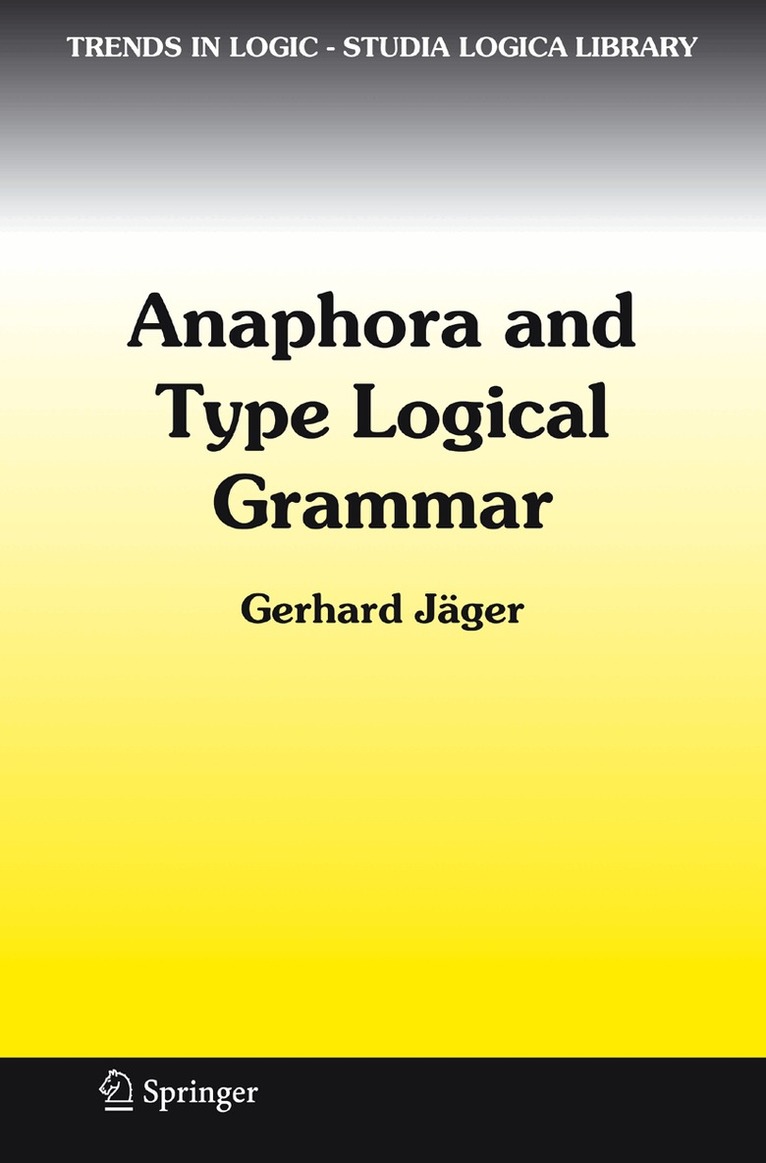
ThisbookdiscusseshowTypeLogicalGrammarcanbemodi?edinsuch awaythatasystematictreatmentofanaphoraphenomenabecomesp- sible without giving up the general architecture of this framework. By Type Logical Grammar, I mean the version of Categorial Grammar that arose out of the work of Lambek, 1958 and Lambek, 1961. There Ca- gorial types are analyzed as formulae of a logical calculus. In particular, the Categorial slashes are interpreted as forms of constructive impli- tion in the sense of Intuitionistic Logic. Such a theory of grammar is per se attractive for a formal linguist who is interested in the interplay between formal logic and the structure of language. What makes L- bekstyleCategorialGrammarevenmoreexcitingisthefactthat(asvan Benthem,1983pointsout)theCurry-Howardcorrespondence-acentral part of mathematical proof theory which establishes a deep connection betweenconstructivelogicsandthe?-calculus-suppliesthetypelogical syntax with an extremely elegant and independently motivated interface to model-theoretic semantics. Prima facie, anaphora does not ?t very well into the Categorial picture of the syntax-semantics interface.The Curry-Howard based composition of meaning operates in a local way, and meaning ass- bly is linear, i.e., every piece of lexical meaning is used exactly once. Anaphora, on the other hand, is in principle unbounded, and it involves by de?nition the multiple use of certain semantic resources. The latter problem has been tackled by several Categorial grammarians by ass- ing su?ciently complex lexical meanings for anaphoric expressions, but the locality problem is not easy to solve in a purely lexical way.
Del 13 - Outstanding Contributions to Logic
Feferman on Foundations
Logic, Mathematics, Philosophy
Häftad, Engelska, 2018
2 145 kr
Skickas inom 10-15 vardagar
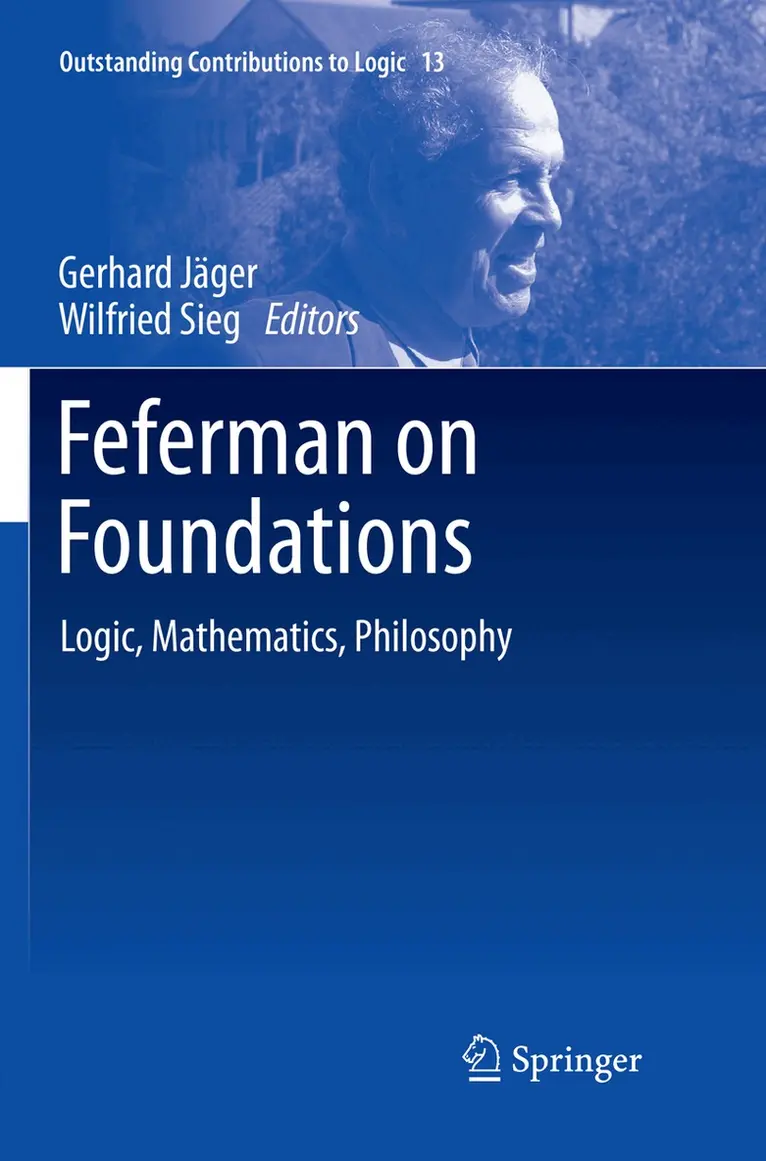
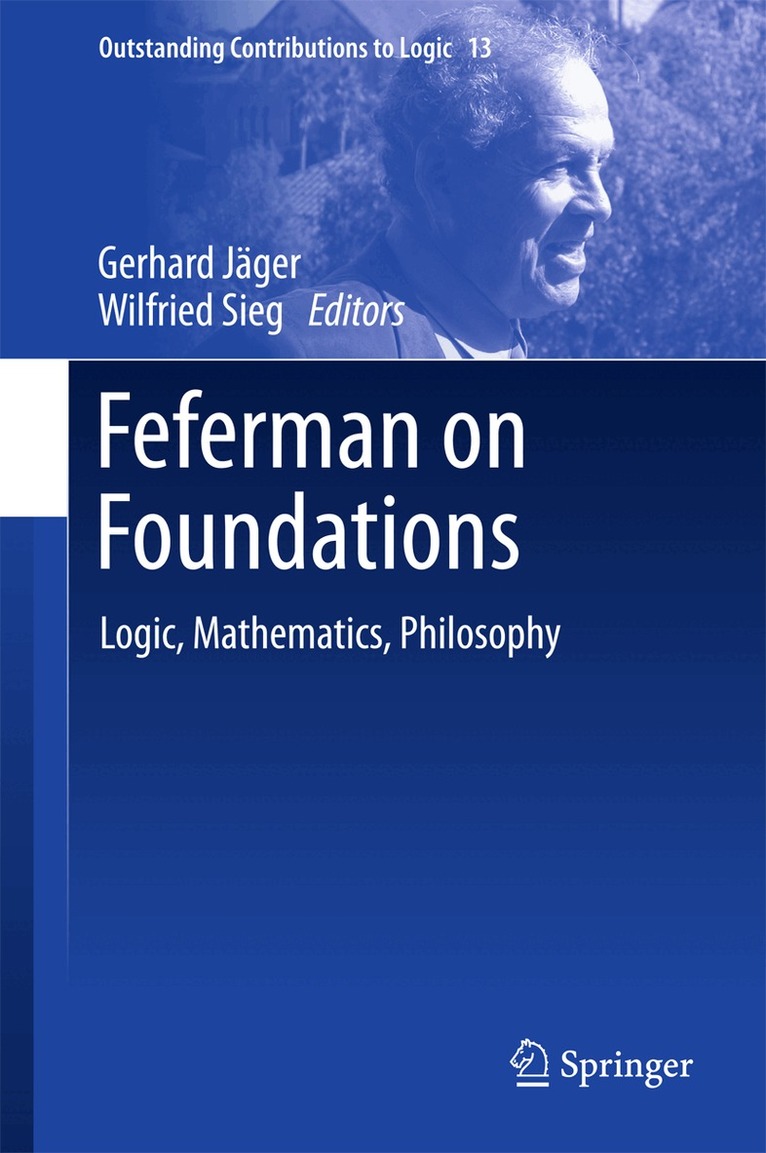
This volume honours the life and work of Solomon Feferman, one of the most prominent mathematical logicians of the latter half of the 20th century. In the collection of essays presented here, researchers examine Feferman’s work on mathematical as well as specific methodological and philosophical issues that tie into mathematics. Feferman’s work was largely based in mathematical logic (namely model theory, set theory, proof theory and computability theory), but also branched out into methodological and philosophical issues, making it well known beyond the borders of the mathematics community.With regard to methodological issues, Feferman supported concrete projects. On the one hand, these projects calibrate the proof theoretic strength of subsystems of analysis and set theory and provide ways of overcoming the limitations imposed by Gödel’s incompleteness theorems through appropriate conceptual expansions. On the other, they seek to identify novel axiomatic foundations for mathematical practice, truth theories, and category theory.In his philosophical research, Feferman explored questions such as “What is logic?” and proposed particular positions regarding the foundations of mathematics including, for example, his “conceptual structuralism.” The contributing authors of the volume examine all of the above issues. Their papers are accompanied by an autobiography presented by Feferman that reflects on the evolution and intellectual contexts of his work. The contributing authors critically examine Feferman’s work and, in part, actively expand on his concrete mathematical projects. The volume illuminates Feferman’s distinctive work and, in the process, provides an enlightening perspective on the foundations of mathematics and logic.
Häftad, Engelska, 2011
1 076 kr
Skickas inom 10-15 vardagar
Ernst Specker has made decisive contributions towards shaping direc tions in topology, algebra, mathematical logic, combinatorics and algorith mic over the last 40 years. We have derived great pleasure from marking his seventieth birthday by editing the majority of his scientific publications, and thus making his work available in a unified form to the mathematical community. In order to convey an idea of the richness of his personality, we have also included one of his sermons. Of course, the publication of these Selecta can pay tribute only to the writings of Ernst Specker. It cannot adequately express his originality and wisdom as a person nor the fascination he exercises over his students, colleagues and friends. We can do no better than to quote from Hao Wang in the 'Festschrift' Logic and Algorithmic I: Specker was ill for an extended period before completing his formal education. He had the leisure to think over many things. This experi ence may have helped cultivating his superiority as a person. In terms of traditional Chinese categories, I would say there is a taoist trait in him in the sense of being more detached, less competitive, and more under standing. I believe he has a better sense of what is important in life and arranges his life better than most logicians. We are grateful to Birkhauser Verlag for the production of this Selecta volume. Our special thanks go to Jonas Meon for sharing with us his intimate knowledge of his friend Ernst Specker.
Inbunden, Engelska, 2008
2 767 kr
Skickas inom 5-8 vardagar
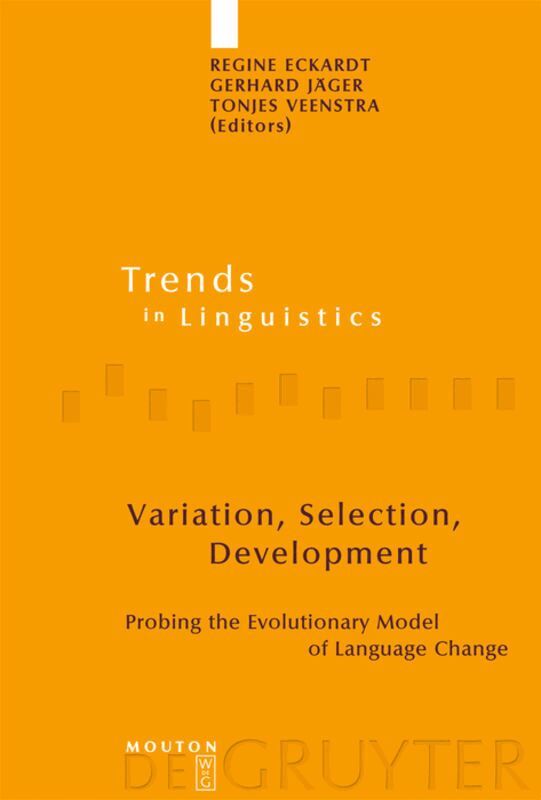
Can language change be modelled as an evolutionary process? Can notions like variation, selection and competition be fruitfully applied to facts of language development? The present volume ties together various strands of linguistic research which can bring us towards an answer to these questions.In one of the youngest and rapidly growing areas of linguistic research, mathematical models and simulations of competition based developments have been applied to instances of language change. By matching the predicted and observed developmental trends, researchers gauge existing models to the needs of linguistic applications and evaluate the fruitfulness of evolutionary models in linguistics. The present volume confronts these studies with more empirically-based studies in creolization and historical language change which bear on key concepts of evolutionary models. What does it mean for a linguistic construction to survive its competitors? How do the interacting factors in phases of creolization differ from those in ordinary language change, and how - consequently - might Creole languages differ structurally from older languages? Some of the authors, finally, also address the question how different aspects of our linguistic competence tie in with our more elementary cognitive capacities. The volume contains contributions by Brady Clark et al., Elly van Gelderen, Alain Kihm, Manfred Krifka, Wouter Kusters, Robert van Rooij, Anette Rosenbach, John McWhorter, Teresa Satterfield, Michael Tomasello and Elizabeth C. Traugott. The book brings together contributions from two areas of research: the study of language evolution by means of methods from artifical intelligence/artificial life (like computer simulations and analytic mathematical methods) on the one hand, and empirically oriented research from historical linguistics and creolisation studies that uses concepts from evolutionary theory as a heuristic tool in a qualitative way. The book is thus interesting for readers from both traditions because it supplies them with information about relevant ongoing research and useful methods and data from the other camp.
Del 10185 - Lecture Notes in Computer Science
Theory and Applications of Models of Computation
14th Annual Conference, TAMC 2017, Bern, Switzerland, April 20-22, 2017, Proceedings
Häftad, Engelska, 2017
558 kr
Skickas inom 10-15 vardagar
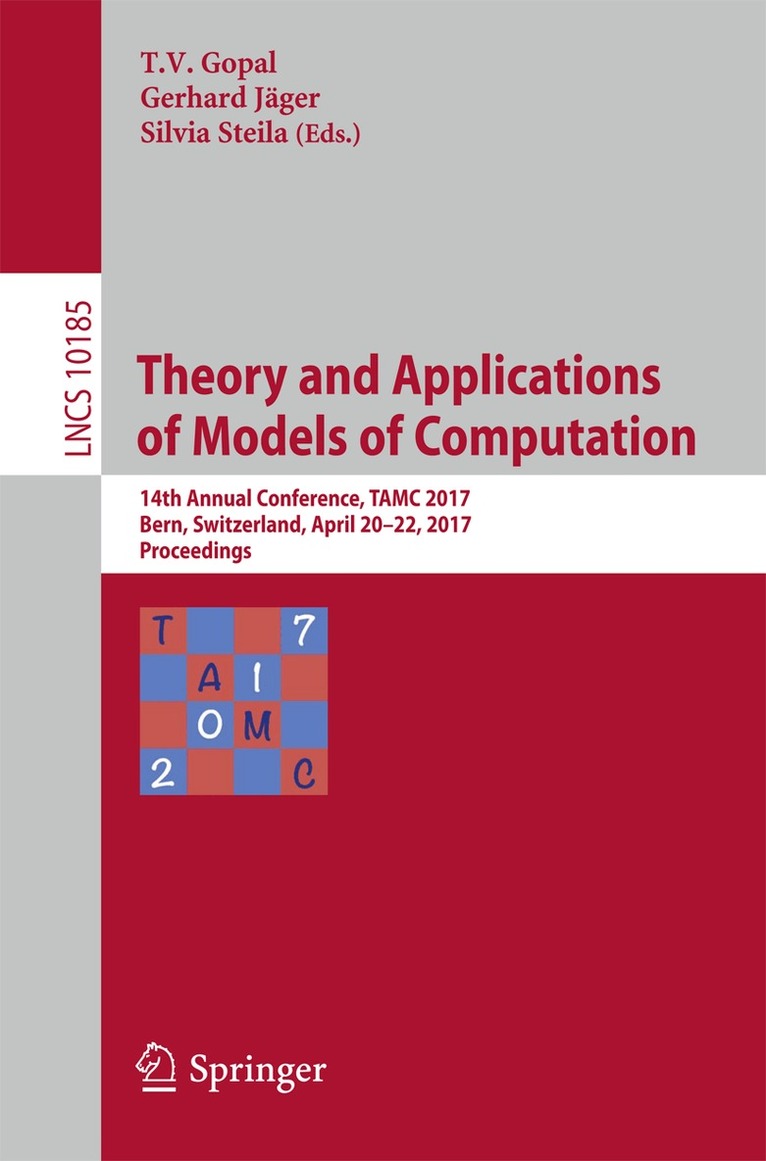
This book constitutes the refereed proceedings of the 14th Annual Conference on Theory and Applications of Models of Computation, TAMC 2017, held in Bern, Switzerland, in April 2017. The main themes of TAMC 2017 have been computability, computer science logic, complexity, algorithms, and models of computation and systems theory.
Del 13 - Outstanding Contributions to Logic
Feferman on Foundations
Logic, Mathematics, Philosophy
Inbunden, Engelska, 2018
2 145 kr
Skickas inom 10-15 vardagar
This volume honours the life and work of Solomon Feferman, one of the most prominent mathematical logicians of the latter half of the 20th century. In the collection of essays presented here, researchers examine Feferman’s work on mathematical as well as specific methodological and philosophical issues that tie into mathematics. Feferman’s work was largely based in mathematical logic (namely model theory, set theory, proof theory and computability theory), but also branched out into methodological and philosophical issues, making it well known beyond the borders of the mathematics community.With regard to methodological issues, Feferman supported concrete projects. On the one hand, these projects calibrate the proof theoretic strength of subsystems of analysis and set theory and provide ways of overcoming the limitations imposed by Gödel’s incompleteness theorems through appropriate conceptual expansions. On the other, they seek to identify novel axiomatic foundations for mathematical practice, truth theories, and category theory.In his philosophical research, Feferman explored questions such as “What is logic?” and proposed particular positions regarding the foundations of mathematics including, for example, his “conceptual structuralism.” The contributing authors of the volume examine all of the above issues. Their papers are accompanied by an autobiography presented by Feferman that reflects on the evolution and intellectual contexts of his work. The contributing authors critically examine Feferman’s work and, in part, actively expand on his concrete mathematical projects. The volume illuminates Feferman’s distinctive work and, in the process, provides an enlightening perspective on the foundations of mathematics and logic.
Häftad, Engelska, 1992
542 kr
Skickas inom 10-15 vardagar
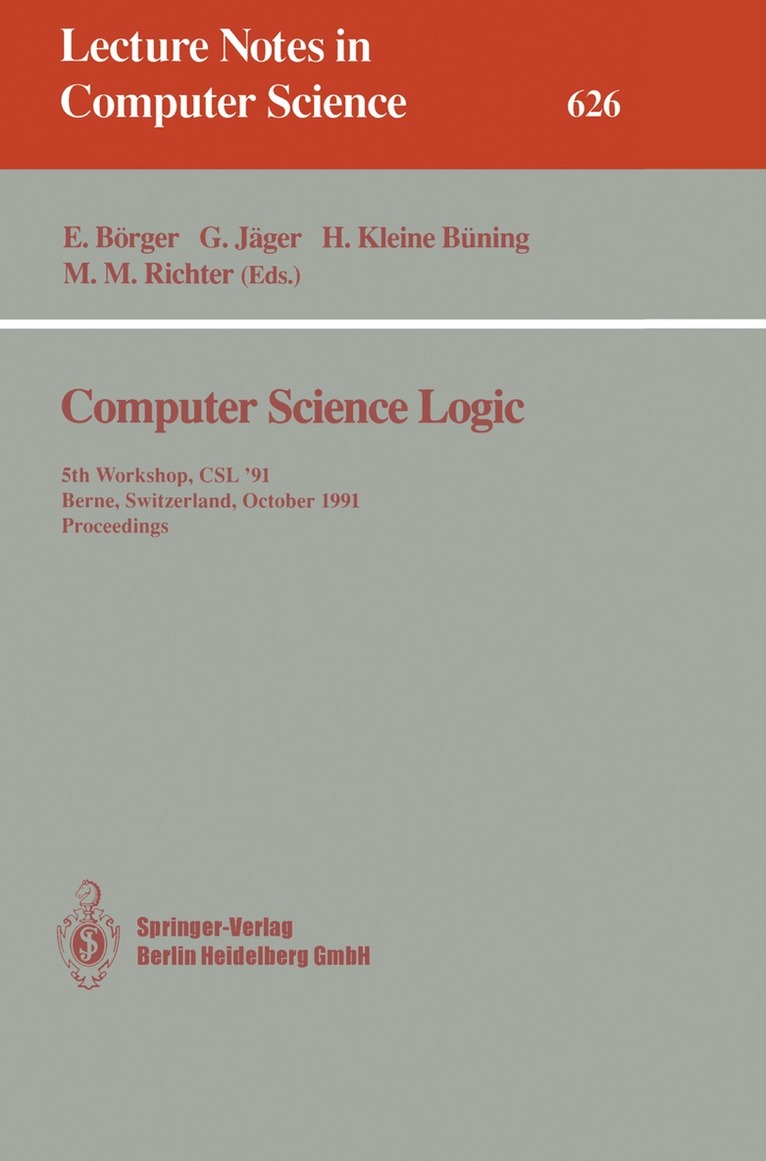
This volume presents the proceedings of the workshop CSL '91(Computer Science Logic) held at the University of Berne,Switzerland, October 7-11, 1991. This was the fifth in aseries of annual workshops on computer sciencelogic (thefirst four are recorded in LNCS volumes 329, 385, 440, and533). The volume contains 33 invited and selected papers on avariety of logical topics in computer science, includingabstract datatypes, bounded theories, complexity results,cut elimination, denotational semantics, infinitary queries,Kleene algebra with recursion, minimal proofs, normal formsin infinite-valued logic, ordinal processes, persistentPetri nets, plausibility logic, program synthesis systems,quantifier hierarchies, semantics of modularization, stablelogic, term rewriting systems, termination of logicprograms, transitive closure logic, variants of resolution,and many others.
Häftad, Engelska, 1993
542 kr
Skickas inom 10-15 vardagar
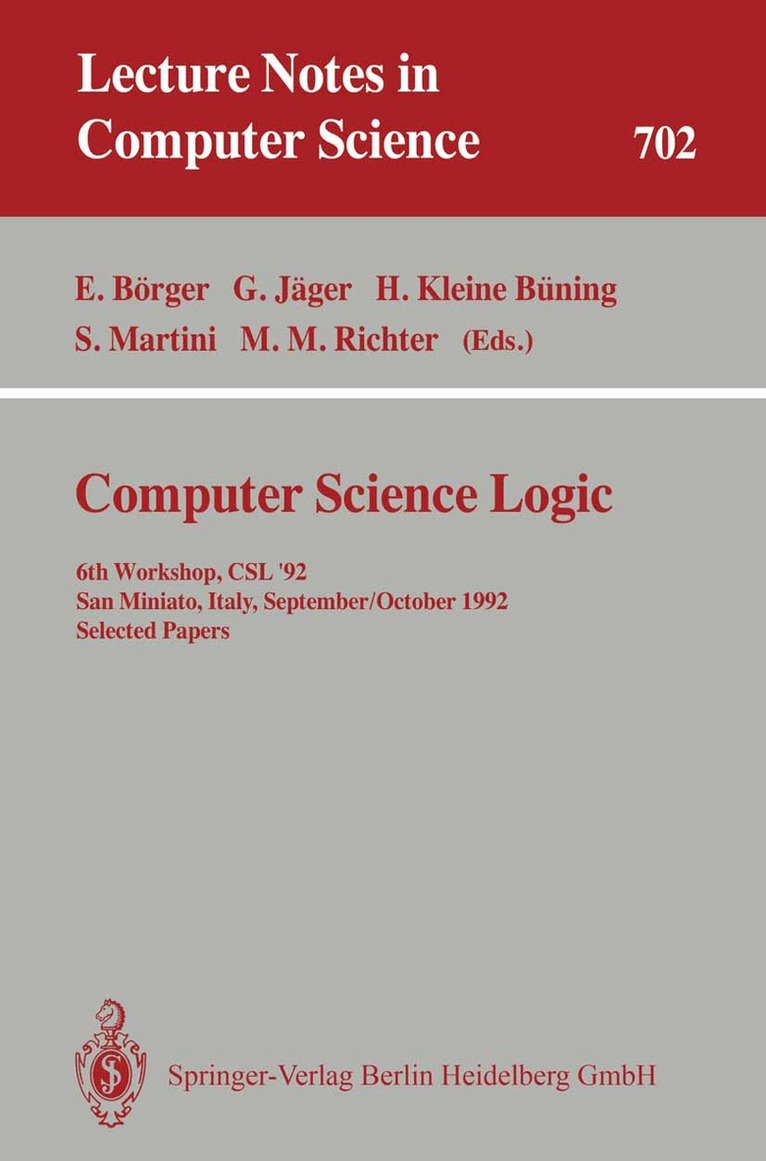
This volume presents the proceedings of the Computer ScienceLogic Workshop CSL '92, held in Pisa, Italy, inSeptember/October 1992. CSL '92 was the sixth of the seriesand the first one held as Annual Conference of the EuropeanAssociation for Computer Science Logic (EACSL). Fullversions of the workshop contributions were collected aftertheir presentation and reviewed. On the basis of 58 reviews,26 papers were selected for publication, and appear here inrevised final form. Topics covered in the volume include: Turing machines,linear logic, logic of proofs, optimization problems, lambdacalculus, fixpoint logic, NP-completeness, resolution,transition system semantics, higher order partial functions,evolving algebras, functional logic programming, inductivedefinability, semantics of C, classes for a functionallanguage, NP-optimization problems, theory of types andnames, sconing and relators, 3-satisfiability, Kleene'sslash, negation-complete logic programs, polynomial-timeoracle machines, and monadic second-order properties.
Häftad, Engelska, 2010
558 kr
Skickas inom 10-15 vardagar
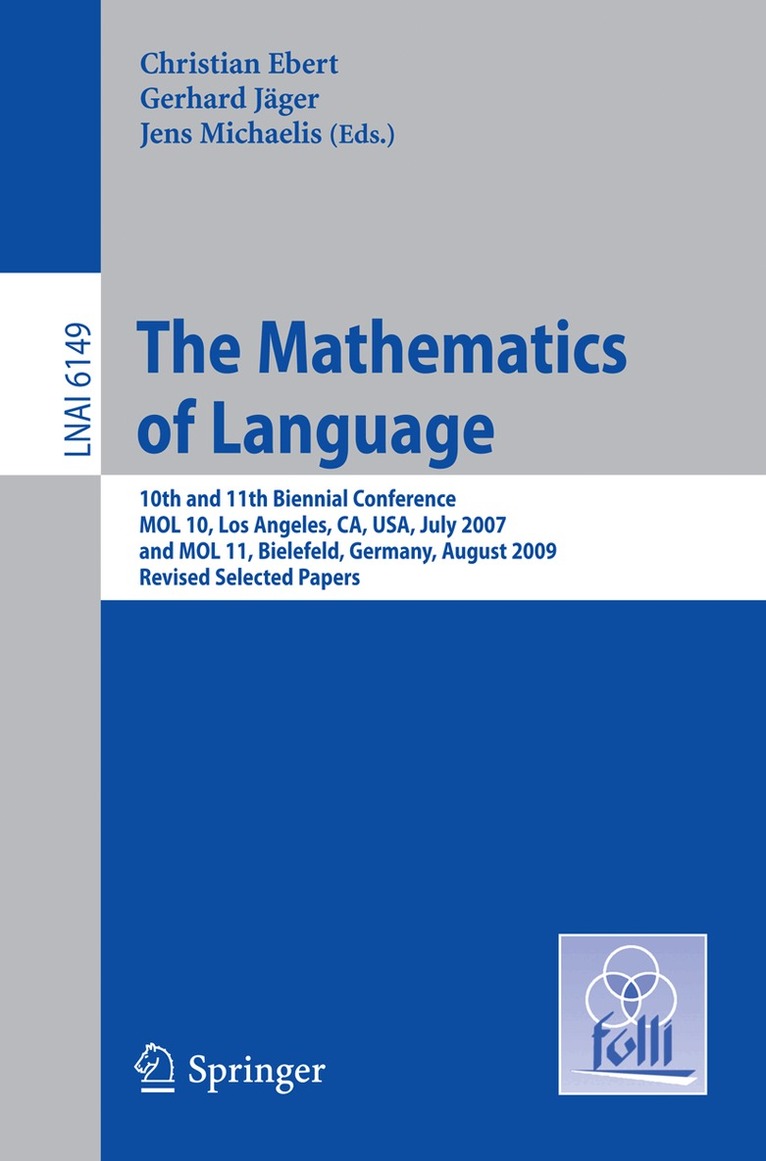
TheAssociationforMathematicsofLanguage(MOL)istheACLspecialinterest groupdedicated to the study of MathematicalLinguistics. After its ?rst meeting in 1984, the association has been organizing meetings on a biennial basis since 1991, with locations usually alternating between Europe and the USA. This volume contains a selection of 19 papers that were presented in c- tributed talks at the 10th meeting at UCLA, Los Angeles, in 2007 and the 11th meetingattheUniversityofBielefeld,Germany,in2009. Itfurthermorecontains threepapersofinvitedspeakersfromthesemeetings. LikeeachMOLproceedings volume, this collection re?ects studies in a wide range of theoretical topics rel- ing to language and computation that the association is devoted to supporting, including papers on the intersection of computational complexity, formal l- guage theory, proof-theory, and logic as well as phonology, lexical semantics, syntax, and typology. This volume is hence of interest not only to mathem- ical linguists but to logicians, theoretical and computational linguists, and to computer scientists alike. It therefore ?ts very well in the Springer FoLLI/LNAI series and we are grateful to Michael Moortgat for suggesting this series as a place of publication.We would furthermore like to thank everyone who played a role in making thesemeetingspossibleandhelpedtomakethemasuccess,suchasthereviewers, the invited speakers,the contributors,and the people who were involvedin local organization. May 2010 Christian Ebert Gerhard Jager .. Jens Michaelis Organization MOL10washeldattheUniversityofCalifornia,LosAngeles,duringJuly28-30, 2007. LocalOrganizers Marcus Kracht University of California, Los Angeles Gerald Penn University of Toronto Edward P.
Häftad, Engelska, 2011
558 kr
Skickas inom 10-15 vardagar
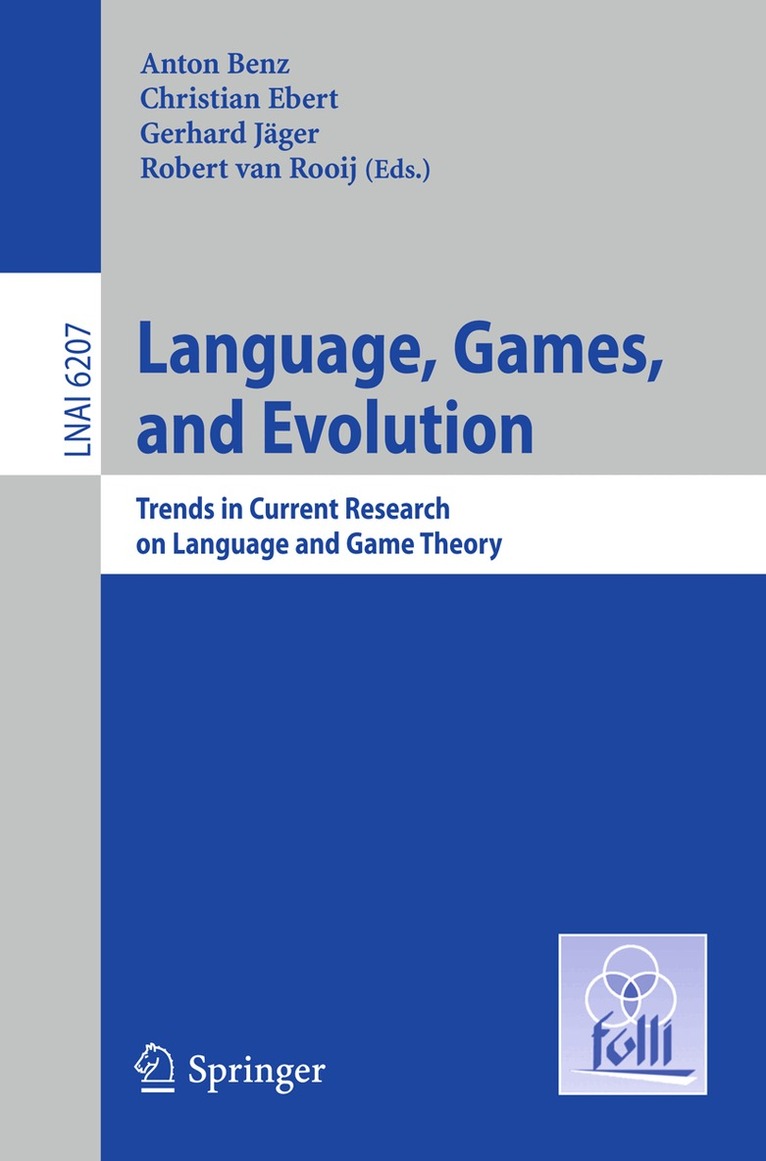
Recent years witnessed an increased interest in formal pragmatics and especially the establishment of game theory as a new research methodology for the study of language use. Game and Decision Theory (GDT) are natural candidates if we look for a theoretical foundation of linguistic pragmatics. Over the last decade, a firm research community has emerged with a strong interdisciplinary character, where economists,philosophers, and social scientists meet with linguists. Within this field of research, three major currents can be distinguished: one is closely related to the Gricean paradigm and aims at a precise foundationof pragmatic reasoning, the second originates in the economic literature and is concerned with the role of game theory in the context of language use, and the third aims at language evolution seen either from abiological or from a cultural perspective. Edited in collaboration with FoLLI, the Association of Logic, Languageand Information, this volume is based on a selection of papers of two international conferences, one organised at ESSLLI in 2007 on language, games, and evolution, and the other organised at the ZAS in Berlin ongames and decisions in pragmatics in 2008. This volume is rounded off by additional invited papers and now contains eight articles of leading researchers in the field which together provide a state-of-the-art survey of current research on language evolution and game theoretic approaches to pragmatics.
Inbunden, Tyska
273 kr
Skickas inom 3-6 vardagar
Inbunden, Engelska, 1990
1 179 kr
Skickas inom 10-15 vardagar
Ernst Specker has made decisive contributions towards shaping direc tions in topology, algebra, mathematical logic, combinatorics and algorith mic over the last 40 years. We have derived great pleasure from marking his seventieth birthday by editing the majority of his scientific publications, and thus making his work available in a unified form to the mathematical community. In order to convey an idea of the richness of his personality, we have also included one of his sermons. Of course, the publication of these Selecta can pay tribute only to the writings of Ernst Specker. It cannot adequately express his originality and wisdom as a person nor the fascination he exercises over his students, colleagues and friends. We can do no better than to quote from Hao Wang in the 'Festschrift' Logic and Algorithmic I: Specker was ill for an extended period before completing his formal education. He had the leisure to think over many things. This experi ence may have helped cultivating his superiority as a person. In terms of traditional Chinese categories, I would say there is a taoist trait in him in the sense of being more detached, less competitive, and more under standing. I believe he has a better sense of what is important in life and arranges his life better than most logicians. We are grateful to Birkhauser Verlag for the production of this Selecta volume. Our special thanks go to Jonas Meon for sharing with us his intimate knowledge of his friend Ernst Specker.
Häftad, Engelska, 2010
1 611 kr
Skickas inom 10-15 vardagar
ThisbookdiscusseshowTypeLogicalGrammarcanbemodi?edinsuch awaythatasystematictreatmentofanaphoraphenomenabecomesp- sible without giving up the general architecture of this framework. By Type Logical Grammar, I mean the version of Categorial Grammar that arose out of the work of Lambek, 1958 and Lambek, 1961. There Ca- gorial types are analyzed as formulae of a logical calculus. In particular, the Categorial slashes are interpreted as forms of constructive impli- tion in the sense of Intuitionistic Logic. Such a theory of grammar is per se attractive for a formal linguist who is interested in the interplay between formal logic and the structure of language. What makes L- bekstyleCategorialGrammarevenmoreexcitingisthefactthat(asvan Benthem,1983pointsout)theCurry-Howardcorrespondence-acentral part of mathematical proof theory which establishes a deep connection betweenconstructivelogicsandthe?-calculus-suppliesthetypelogical syntax with an extremely elegant and independently motivated interface to model-theoretic semantics. Prima facie, anaphora does not ?t very well into the Categorial picture of the syntax-semantics interface.The Curry-Howard based composition of meaning operates in a local way, and meaning ass- bly is linear, i.e., every piece of lexical meaning is used exactly once. Anaphora, on the other hand, is in principle unbounded, and it involves by de?nition the multiple use of certain semantic resources. The latter problem has been tackled by several Categorial grammarians by ass- ing su?ciently complex lexical meanings for anaphoric expressions, but the locality problem is not easy to solve in a purely lexical way.