Giorgio Israel – författare
Visar alla böcker från författaren Giorgio Israel. Handla med fri frakt och snabb leverans.
8 produkter
Determinism, Holism, and Complexity
Av Claudio Pellegrini, Paola Cerrai m. fl.
Inbunden, 2003
2189 kr
Lägg i varukorg
Determinism, holism and complexity: three epistemological attitudes that have easily identifiable historical origins and developments. Galileo believed that it was necessary to "prune the impediments" to extract the mathematical essence of physical phenomena, to identify the math ematical …
Determinism, Holism, and Complexity
Av Claudio Pellegrini, Paola Cerrai m. fl.
Häftad, 2010
2189 kr
Lägg i varukorg
Determinism, holism and complexity: three epistemological attitudes that have easily identifiable historical origins and developments. Galileo believed that it was necessary to "prune the impediments" to extract the mathematical essence of physical phenomena, to identify the math ematical …
Determinism, Holism, and Complexity
Av Giorgio Israel, Vieri Benci m. fl.
E-bok, 2013
2741 kr
Lägg i varukorg
Determinism, holism and complexity: three epistemological attitudes that have easily identifiable historical origins and developments. Galileo believed that it was necessary to "prune the impediments" to extract the mathematical essence of physical phenomena, to identify the math ematical …
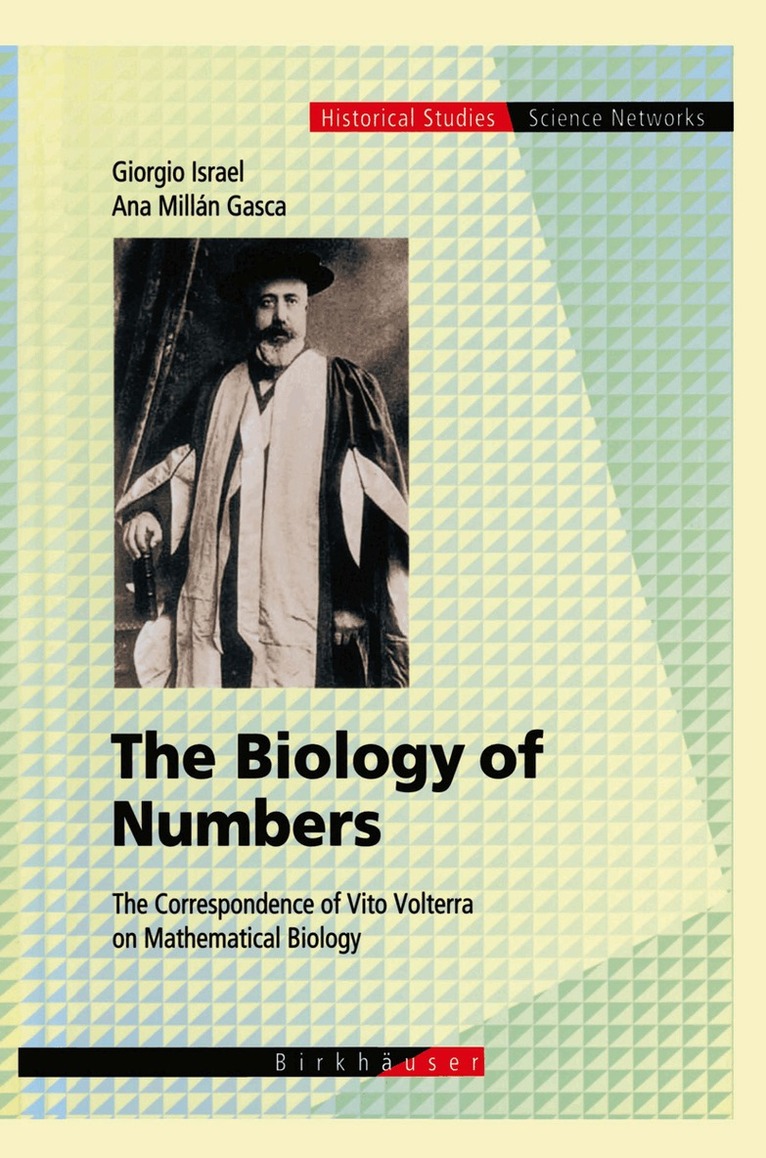
Biology of Numbers
The Correspondence of Vito Volterra on Mathematical Biology
Av Ana M. Gasca, Giorgio Israel
E-bok, 2013
1622 kr
Lägg i varukorg
Foreword The modern developments in mathematical biology took place roughly between 1920 and 1940, a period now referred to as the "Golden Age of Theoretical Biology". The eminent Italian mathematician Vito Volterra played a decisive and widely acknowledged role in these developments. Volterra''s …
Biology of Numbers
The Correspondence of Vito Volterra on Mathematical Biology
Av Giorgio Israel, Ana M. Gasca
Häftad, 2012
1207 kr
Lägg i varukorg
Foreword The modern developments in mathematical biology took place roughly between 1920 and 1940, a period now referred to as the "Golden Age of Theoretical Biology". The eminent Italian mathematician Vito Volterra played a decisive and widely acknowledged role in these developments. Volterra's …
Biology of Numbers
The Correspondence of Vito Volterra on Mathematical Biology
Av Giorgio Israel, Ana M. Gasca
Inbunden, 2002
1207 kr
Lägg i varukorg
Foreword The modern developments in mathematical biology took place roughly between 1920 and 1940, a period now referred to as the "Golden Age of Theoretical Biology". The eminent Italian mathematician Vito Volterra played a decisive and widely acknowledged role in these developments. Volterra's …
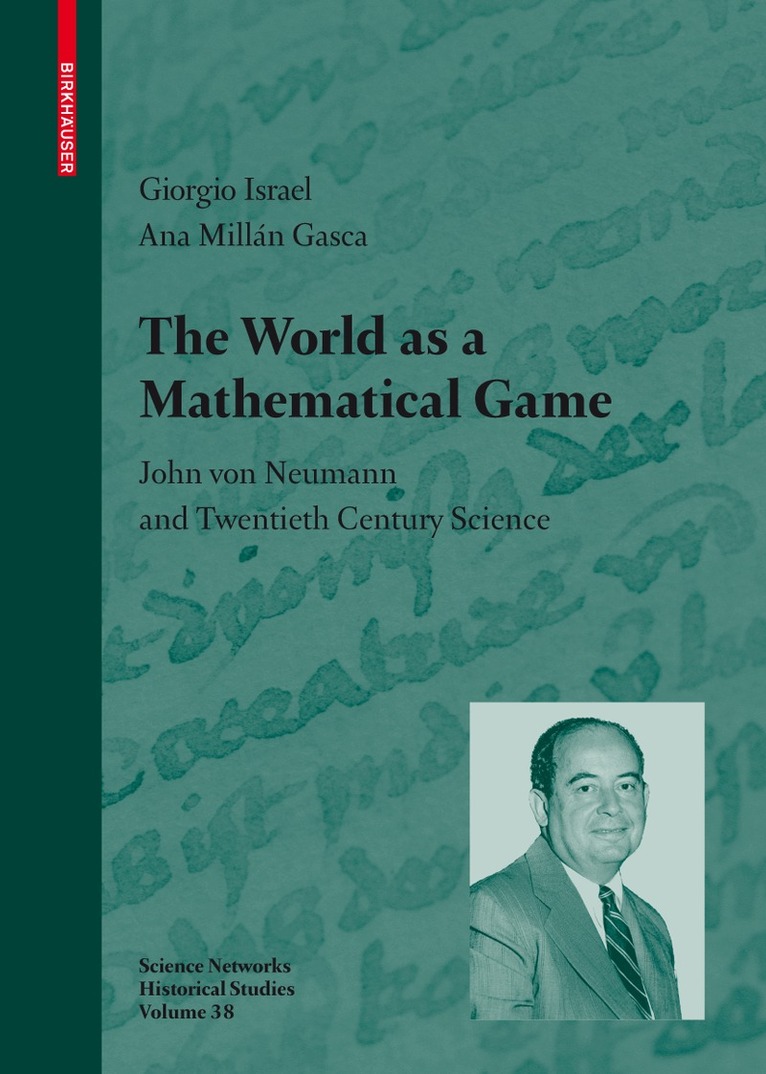
World as a Mathematical Game
John von Neumann and Twentieth Century Science
Av Giorgio Israel, Ana Millán Gasca
Inbunden, 2009
1207 kr
Lägg i varukorg
Galileo and Newton’s work towards the mathematisation of the physical world; Leibniz’s universal logical calculus; the Enlightenment’s mathématique sociale. John von Neumann inherited all these aims and philosophical intuitions, together with an idea that grew up around the Vienna Circle of an …
World as a Mathematical Game
John von Neumann and Twentieth Century Science
Av Ana Millan Gasca, Giorgio Israel
E-bok, 2009
1573 kr
Lägg i varukorg
Galileo and Newton’s work towards the mathematisation of the physical world; Leibniz’s universal logical calculus; the Enlightenment’s mathématique sociale. John von Neumann inherited all these aims and philosophical intuitions, together with an idea that grew up around the Vienna Circle of an …