Giuseppe Munda – författare
Visar alla böcker från författaren Giuseppe Munda. Handla med fri frakt och snabb leverans.
5 produkter
5 produkter
Inbunden, Engelska, 2007
1 091 kr
Skickas inom 10-15 vardagar
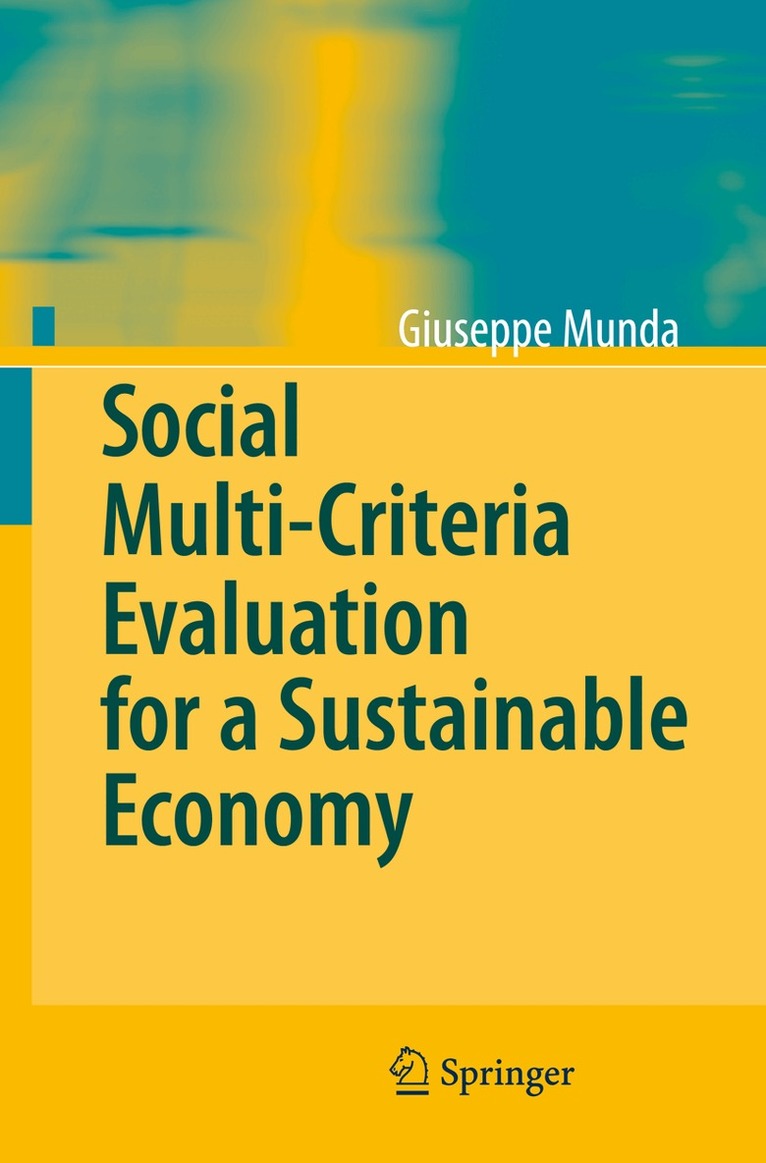
The real world is characterized by deep complexity. May be a rather unremarkable observation, yet it has important implications on the manner policy problems are represented and decision-making is framed. Is contemporary democracy compatible with science in real-world policy-making? This book gives answers in the affirmative. It also asserts that this congruence can have positive implications not only in terms of economic prosperity but also when dealing with the difficult sustainability policy problems of our millennium. To address contemporary issues economic science will have to expand its empirical relevance by introducing more and more realistic assumptions to its models. One of the most interesting research orientations in recent times in the field of public economics is the explicit attempt to take account of political constraints, interest groups and collusion effects. One of the main novelties of this book is its establishment of a clear relationship between social and public choice theories on one hand, and multiple criteria decision analysis on the other. The pioneering research developed by Arrow and Raynaud (1986) has shown that the relationships between multi-criteria decision theory and social choice are clear and relevant. The main directions of cross-fertilization between these research fields are twofold: 1. Multi-criteria decision theory can be an adequate framework for applied social (and public) choice. 2. Social choice can produce interesting theoretical results for ensuring the ax- matic consistency needed by multi-criterion aggregation conventions.
E-bok
PDF, Engelska, 20071 408 kr
Läs direkt efter köp
The real world is characterized by deep complexity. May be a rather unremarkable observation, yet it has important implications on the manner policy problems are represented and decision-making is framed. Is contemporary democracy compatible with science in real-world policy-making? This book gives answers in the affirmative. It also asserts that this congruence can have positive implications not only in terms of economic prosperity but also when dealing with the difficult sustainability policy problems of our millennium. To address contemporary issues economic science will have to expand its empirical relevance by introducing more and more realistic assumptions to its models. One of the most interesting research orientations in recent times in the field of public economics is the explicit attempt to take account of political constraints, interest groups and collusion effects. One of the main novelties of this book is its establishment of a clear relationship between social and public choice theories on one hand, and multiple criteria decision analysis on the other. The pioneering research developed by Arrow and Raynaud (1986) has shown that the relationships between multi-criteria decision theory and social choice are clear and relevant. The main directions of cross-fertilization between these research fields are twofold: 1. Multi-criteria decision theory can be an adequate framework for applied social (and public) choice. 2. Social choice can produce interesting theoretical results for ensuring the ax- matic consistency needed by multi-criterion aggregation conventions.
Häftad, Engelska, 2010
1 123 kr
Skickas inom 10-15 vardagar
The real world is characterized by deep complexity. May be a rather unremarkable observation, yet it has important implications on the manner policy problems are represented and decision-making is framed. Is contemporary democracy compatible with science in real-world policy-making? This book gives answers in the affirmative. It also asserts that this congruence can have positive implications not only in terms of economic prosperity but also when dealing with the difficult sustainability policy problems of our millennium. To address contemporary issues economic science will have to expand its empirical relevance by introducing more and more realistic assumptions to its models. One of the most interesting research orientations in recent times in the field of public economics is the explicit attempt to take account of political constraints, interest groups and collusion effects. One of the main novelties of this book is its establishment of a clear relationship between social and public choice theories on one hand, and multiple criteria decision analysis on the other. The pioneering research developed by Arrow and Raynaud (1986) has shown that the relationships between multi-criteria decision theory and social choice are clear and relevant. The main directions of cross-fertilization between these research fields are twofold: 1. Multi-criteria decision theory can be an adequate framework for applied social (and public) choice. 2. Social choice can produce interesting theoretical results for ensuring the ax- matic consistency needed by multi-criterion aggregation conventions.
E-bok
PDF, Engelska, 2012708 kr
Läs direkt efter köp
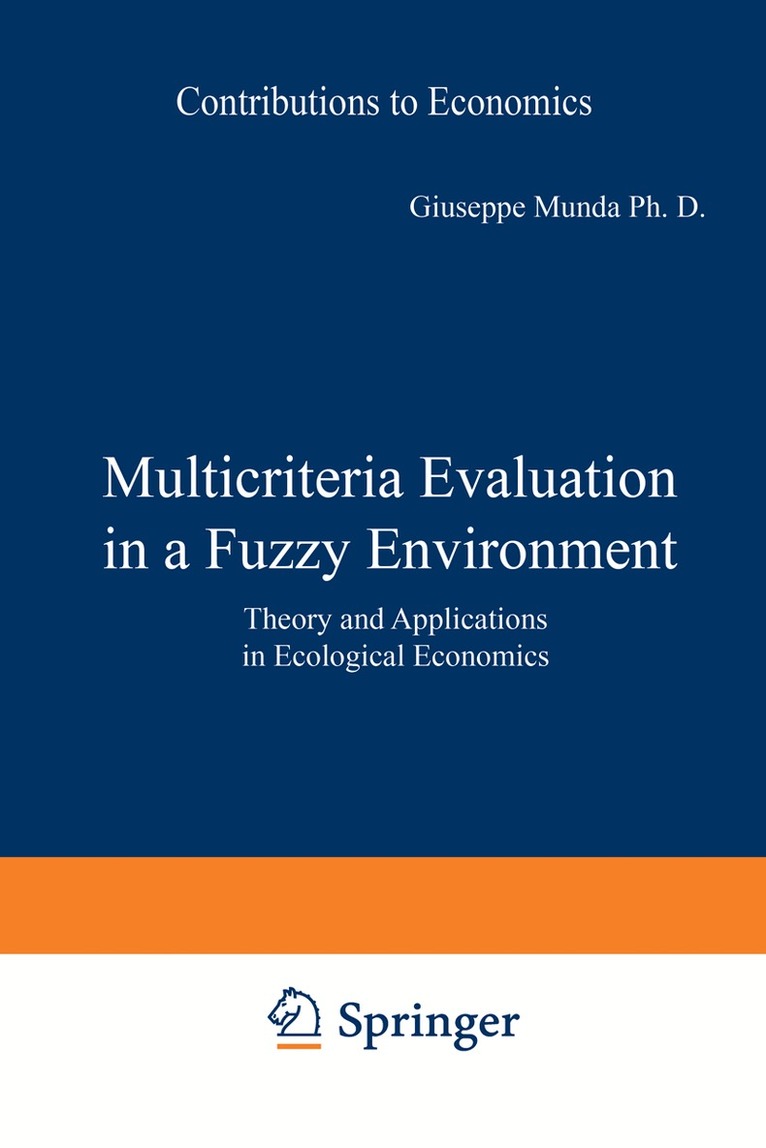
This book is the result of some years of research carried out at the Vrije Universiteit of Amsterdam and at the Joint Research Centre of the European Commission. The awareness of actual and potential conflicts between economic progress in production, consumption, and technology and the environment has led to the concept of "sustainable development", implying that economic and ecological values are well balanced in evaluation and decision making. The linkages between ecosystems and economic systems are the focus of ecological economics. In ecological economics, a multidimensional approach to economic and policy-making is emphasised. In this book, the introduction of multicriteria decision aid techniques in the framework of ecological economics is widely discussed. Since such techniques are based on a "constructive" rationality and allow one to take into account conflictual, multidimensional, incommensurable and uncertain effects of decisions, they can be considered perfectly consistent with the methodological foundations of ecological economics. Since here the assumption is accepted that efficiency, equity and sustainability are the three conflictual values of economics, a mathematical procedure able to deal with these issues in an operational framework is developed, with a particular view on imprecise information in a practical environmental planning context. Given the problem of the differences in the measurement levels of the variables used for economic-ecological modelling, multicriteria methods able to deal with mixed information (both qualitative and quantitative measurements) can be considered particularly useful. Another problem related to the available information concerns the uncertainty (stochastic and/or fuzzy) contained in this information.
Häftad, Engelska, 1995
549 kr
Skickas inom 10-15 vardagar
This book is the result of some years of research carried out at the Vrije Universiteit of Amsterdam and at the Joint Research Centre of the European Commission. The awareness of actual and potential conflicts between economic progress in production, consumption, and technology and the environment has led to the concept of "sustainable development", implying that economic and ecological values are well balanced in evaluation and decision making. The linkages between ecosystems and economic systems are the focus of ecological economics. In ecological economics, a multidimensional approach to economic and policy-making is emphasised. In this book, the introduction of multicriteria decision aid techniques in the framework of ecological economics is widely discussed. Since such techniques are based on a "constructive" rationality and allow one to take into account conflictual, multidimensional, incommensurable and uncertain effects of decisions, they can be considered perfectly consistent with the methodological foundations of ecological economics. Since here the assumption is accepted that efficiency, equity and sustainability are the three conflictual values of economics, a mathematical procedure able to deal with these issues in an operational framework is developed, with a particular view on imprecise information in a practical environmental planning context. Given the problem of the differences in the measurement levels of the variables used for economic-ecological modelling, multicriteria methods able to deal with mixed information (both qualitative and quantitative measurements) can be considered particularly useful. Another problem related to the available information concerns the uncertainty (stochastic and/or fuzzy) contained in this information.