Givon T. Givon – författare
Visar alla böcker från författaren Givon T. Givon. Handla med fri frakt och snabb leverans.
23 produkter
23 produkter
E-bok
Engelska, 20211 195 kr
Läs direkt efter köp
Adpositions are used, universally, to mark the roles of nominal participants in the verbal clause, most commonly indirect object roles. Practically all languages seem to have such markers, which begin their diachronic life as lexical words -- in this case either serial verbs or positional nouns. In many languages, however, adpositions also seem to have extended their diachronic life one step further, becoming verbal affixes. The main focus of this book is the tail-end of the diachronic life cycle of adpositions. That is, the process by which, having arisen first as nominal-attached prepositions or post-positions, they wind up attaching themselves to verbs. Our core puzzle is thus fairly transparent: How and why should morphemes that pertain functionally to nominals, and begin their diachronic life-cycle as nominal grammatical operators, wind up as verbal morphology? While the core five chapters of this book focus on the rise of verb-attached prepositions in Homeric Greek, its theoretical perspective is broader, perched at the intersection of three closely intertwined core components of the study of human language: (a) the communicative function of grammar; (b) the balance between universality and cross-language diversity of grammars; and (c) the diachrony of grammatical constructions, how they mutate over time. While paying well-deserved homage to the traditional Classical scholarship, this study is firmly wedded to the assumption, indeed presupposition, that Homeric Greek is just another natural language, spoken before written, designed as an instrument of communication, and subject to the same universal constraints as all human languages. And further, that those constraints--so-called language universals--express themselves most conspicuously in diachronic change. Lastly, in analyzing the synchronic variation and text distribution of prepositional constructions in Homeric Greek, this study relies primarily on the theory-laden method of Internal Reconstruction.
E-bok
Engelska, 20201 279 kr
Läs direkt efter köp
Coherence, connectivity and the fitting together of smaller parts into larger structures and a coherent whole is the hallmark of complex biologically-based systems. As a structure-internal constraint, coherence makes it possible for the parts to work together as a whole. As an external constraint, it lets complex system evolve and adapt to novel contexts. As a constraint on information processing, it makes new knowledge accessible to the maturing, learning or evolving mind-brain. As a constraint on cultures, it enables members of social groups to be empathic and cooperative. As a constraint on language and communication, lastly, it allows the mind of speakers to be accessible to the mind of hearers.Part I explores first the role of coherence in the evolution of complex biological design, from precellular to mono-cellular to multi-cellular to multi-organ sentient beings. The complex hierarchic design of the mind-brain is explored next, probing the coherent organization of major brain systems-perception, attention, motor control, memory and language. In surveying the coherence of cultures next, the first-evolved Society of Intimates is viewed as the model for social cohesion, empathy, trust and cooperation. Part II deals with language and communication, touching upon the coherent organization of semantic memory, event clauses and clause chains, and the central role of grammar in coherent communication. Part III deals with three general issues. First, the role of coherence in organized science. Second, the eternal seesaw of selfish vs. social motivation in coherently functioning cultures. And last, the frail balance between homogeneity and diversity in large-scale Societies of Strangers.
E-bok
Engelska, 20191 062 kr
Läs direkt efter köp
This book is a new English translation of the two shortest, most controversial and perhaps most vibrant books in the Hebrew Old Testament - Song of Songs (Song of Solomon) and Qohelet (Ecclesiastes). The two books slipped into the Jewish - and eventually Christian - Canon by a series of misrepresentations. The first, Song of Songs, is linguistically the latest book along the Biblical Hebrew dialect continuum, perhaps as late as 300-100 BC to judge by its language, which closely resembles Mishnaic Hebrew (2nd Cent. AD). The book is a lush, carnal poetic account of an illicit love affair, where lusty exchanges between the female beloved and her male lover are interspersed with rustic love songs. The ultimate provenance of the text may be older than the time it was recruited into the Canon, or the time suggested by its late dialect.The second book, Qohelet, is linguistically earlier on the Biblical Hebrew dialect continuum, though still following the return from the Babylonian exile (ca. 550 BC). Unlike Song of Songs, which is linguistically coherent and bears all the marks of having been produced by a native speaker (or speakers), Qohelet is replete with non-native lexical and grammatical usage, and was most likely produced by a speaker (or speakers) of Aramaic, the lingua franca of the Persian empire and the returning exiles. Multiple English translations of the two books exist. Nonetheless, in one way or another all previous translations suffer from two main drawbacks: First, their interpretation of the grammar - and on occasion also the vocabulary - of Biblical Hebrew is sometimes questionable. And second, the poetic quality of their English leaves much to be desired, paling in comparison with the stark beauty of the Hebrew original.This book attempts to do justice to both the contents and form of these two magnificent, deliciously subversive poetic works. The Hebrew texts and their English translation are preceded by two scholarly chapters, the first about the Biblical Hebrew dialect continuum , the second about the science and art of translation.
E-bok
Engelska, 20181 305 kr
Läs direkt efter köp
In his foreword to the original edition of this classic of functionalism, typology and diachrony, Dwight Bolinger wrote: "e;I foresee it as one of the truly prizes statements of our current knowledge...a book about understanding done with deep understanding - of language and its place in Nature and in the nature of humankind... The book is rich in insights, even for those who have been with linguistics for a long time. And beginners could be thankful for having it as a starting point, from which so many past mistakes have been shed"e;. Thoroughly revised, corrected and updated, On Understanding Grammar remains, as its author intended it in 1979, a book about trying to make sense of human language and of doing linguistics. Language is considered here from multiple perspectives, intersecting with cognition and communication, typology and universals, grammaticalization, development and evolution. Within such a broad cross-disciplinary context, grammar is viewed as an automated, structured language-processing device, assembled through evolution, diachrony and use. Cross-language diversity is not arbitrary, but rather is tightly constrained and adaptively motivated, with the balance between universality and diversity mediated through development, be it evolutionary or diachronic. The book's take on language harkens back to the works of illustrious antecedents such as F. Bopp, W. von Humbold, H. Paul, A. Meillet, O. Jespersen and G. Zipf, offering a coherent alternative to the methodological and theoretical strictures of Saussure, Bloomfield and Chomsky.
E-bok
PDF, Engelska, 20171 305 kr
Läs direkt efter köp
The zero coding of referents or other clausal constituents is one of the most natural, communicatively and cognitively-transparent grammatical devices in human language. Together with its functional equivalent, obligatory pronominal agreement, zero is both extremely widespread cross-linguistically and highly frequent in natural text. In the domain of reference, zero represents, somewhat paradoxically, either anaphorically-governed high continuity or cataphorically-governed low topicality. And whether in conjoined/chained or syntactically-subordinate clauses, zero is extremely well-governed, at a level approaching 100% in natural text. The naturalness, cross-language ubiquity and well-governedness of zero have been largely obscured by an approach that, for 30-odd years, has considered it a typological exotica, the so-called "pro-drop" associated with a dubious "non-configurational" language type. The main aim of this book is to reaffirm the naturalness, universality and well-governedness of zero by studying it from four closely related perspectives: (i) cognitive and communicative function; (ii) natural-text distribution; (iii) cross-language typological distribution; and (iv) the diachronic rise of referent coding devices. The latter is particularly central to our understanding the functional interplay between zero anaphora, pronominal agreement and related referent-coding devices.
E-bok
PDF, Engelska, 20161 447 kr
Läs direkt efter köp
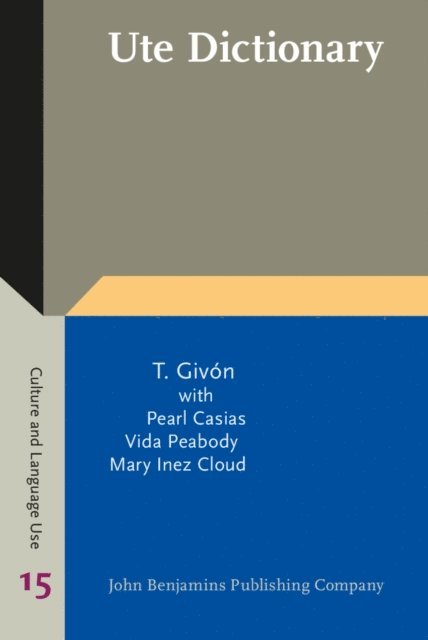
This third volume of our Ute language collection contains the Ute dictionary. It opens with several introductory chapters that link the dictionary to our Ute Reference Grammar (2011) and explain the structure and use of the dictionary. The bulk of the information on the meaning and usage of Ute words is then given in the Ute-English part. The English-Ute part, next, serves primarily as a search-and-reference tool. A short section on traditional semantic-cultural fields follows. Ute is a Northern Uto-Aztecan language of the Numic sub-family. Together with its northern dialects (Southern Paiute, Uintah, White River), it should be considered a single language, Núuchi ("of the people") or Núu-''apaghapi ("the people''s speech"). While our work was done primarily in the southern dialects (Southern Ute, Ute Mountain, Uncompaghre), we have included as many words as could be safely extracted from Powel''s and Smith''s work on the northern dialects, as well as some from Sapir''s work (1931) on Northern Ute, adjusting them to Southern-dialect pronunciation. This brings the work as close as one could hope, at this time, to a comprehensive all-Ute dictionary, a task that yet remains to be done. We have tried to emphasize in the Ute-English entries the historical and derivational connectivity of Ute vocabulary and its gradual growth and expansion. This is also underscored in the introductory chapter on word derivation. While this work remains incomplete, we hope it can be some day expanded into an all-inclusive Ute dictionary, and will help the people – Núuchiu – preserve their language and culture.
E-bok
PDF, Engelska, 20151 999 kr
Läs direkt efter köp
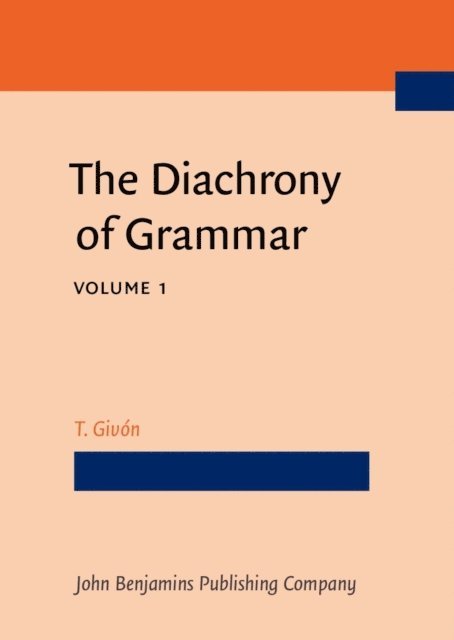
The case-studies assembled in these two volumes span a lifetime of research into the diachrony of grammar. That is, into the rise and fall of syntactic constructions and their attendant grammatical morphology. While focused squarely on the data, the studies are nonetheless cast in an explicit theoretical perspective – adaptive, developmental, variationist. Taken as a whole, this work constitutes a frontal assault on Ferdinand de Saussure''s corrosive legacy in linguistics. Over the years, reviewers slapped the author''s wrist periodically for having dared to commit that most heinous of sins against de Saussure''s hallowed legacy – panchronic grammar. In this work he pleads guilty, having never seen a piece of synchronic data that didn''t reek, to high heaven, of the diachrony that gave it rise. Reek in two distinct ways: first with the frozen relics of the past that prompt us to reconstruct prior diachronic states; and second with the synchronic variation that hints at ongoing change. Conversely, the author confesses to having never seen a diachronic explanation that did not hinge on the synchronic principles – Carnap''s general propositions – that govern language behavior. The synchrony and diachrony of grammar are twin faces of the same coin. To study one without the other is to gut both. By understanding how synchronic grammars come into being we also understand the cognitive, communicative, neurological and developmental universals that constrain diachronic change – and through it synchronic typology.
E-bok
PDF, Engelska, 19931 258 kr
Läs direkt efter köp
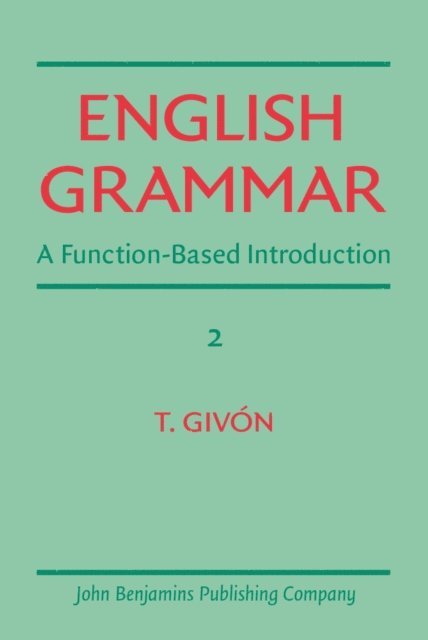
The approach to language and grammar that motivates this book is unabashedly functional; grammar is not just a system of empty rules, it is a means to an end, an instrument for constructing concise coherent communication. In grammar as in music, good expression rides on good form. Figuratively and literally, grammar like musical form must make sense. But for the instrument to serve its purpose, it must first exist; the rules must be real, they can be explicitly described and taught. This book is intended for both students and teachers, at college level, for both native and nonnative speakers. With the guidance of a teacher this book will serve as a thorough introduction to the grammar of English. Volume II continues with syntactic and communicative complexity: embedded clauses – verb complements, relative clauses; detransitive voice – passive, anti-passive, impersonal and middle voice, reflexive and reciprocal constructions; focus and topic constructions; nondeclarative speech acts. It closes with interclausal connectivity: conjoined and subordinate clauses, the grammar of discourse coherence, clause chains and thematic paragraphs.
E-bok
PDF, Engelska, 19931 305 kr
Läs direkt efter köp
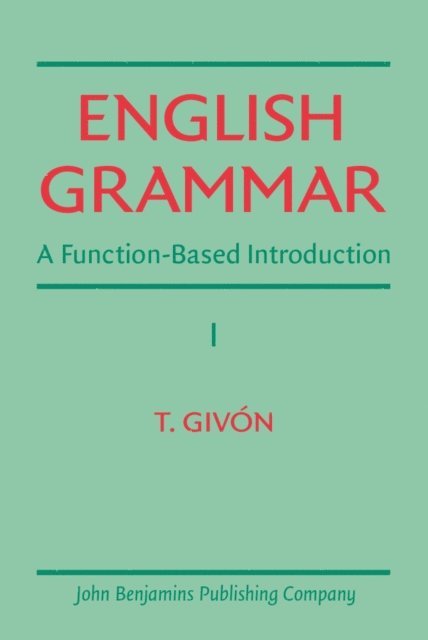
The approach to language and grammar that motivates this book is unabashedly functional; grammar is not just a system of empty rules, it is a means to an end, an instrument for constructing concise coherent communication. In grammar as in music, good expression rides on good form. Figuratively and literally, grammar like musical form must make sense. But for the instrument to serve its purpose, it must first exist; the rules must be real, they can be explicitly described and taught. This book is intended for both students and teachers, at college level, for both native and nonnative speakers. With the guidance of a teacher this book will serve as a thorough introduction to the grammar of English. Volume I begins with words and their meanings, then on to propositions and simple state or event clauses – participant roles, verb types, transitivity, subjects and objects. It then covers the grammatical sub systems commonly found in simple clauses: Verbal inflections, auxiliaries and the grammar of tense-aspect modality and negation; articles determiners, pronouns and the grammar of referential coherence; the variety of noun phrases and noun modifiers.
E-bok
PDF, Engelska, 19951 714 kr
Läs direkt efter köp
This book is Prof. Givón''s long-awaited critical examination of the fundamental theoretical and methodological underpinnings of the functionalist approach to grammar. It challenges functionalists to take their own medicine and establish non-circular empirical definitions of both ''function'' and ''structure''. Ideological hand-waving, however fervent and right-thinking, is seldom an adequate substitute for analytic rigor and empirical responsibility. If the reductionist extremism of the various structuralist schools is to be challenged on solid intellectual grounds, the challenge cannot itself be equally extreme in its reductionism.The book is divided into nine chapters: 1. Prospectus, somewhat jaundiced (overview)2. Markedness as meta-iconicity: Distributional and cognitive correlates of syntactic structure3. The functional basis of grammatical typology4. Modal prototypes of truth and action5. Taking structure seriously: Constituency and the VP node6. Taking structure seriously II: Grammatical relations and clause union7. The distribution of grammar in text: On interpreting conditional associations8. Coming to terms with cognition: Coherence in text vs. coherence in mind9. On the co-evolution of language, mind and brain.
E-bok
PDF, Engelska, 19971 714 kr
Läs direkt efter köp
This volume presents a functional perspective on grammatical relations (GRs) without neglecting their structural correlates. Ever since the 1970s, the discussion of RGs by functionally-oriented linguists has focused primarily on their functional aspects, such as reference, cognitive accessibility and discourse topicality. With some exceptions, functionalists have thus ceded the discussion of the structural correlates of GRs to various formal schools.Ever since Edward Keenan’s pioneering work on subject properties (1975, 1976), it has been apparent that subjecthood and objecthood can only be described properly by a basket of neither necessary nor sufficient properties — thus within a framework akin to Rosch’s theory of Prototype. Some GR properties are functional (reference, topicality, accessibility); others involve overt coding (word-order, case marking, verb agreement). Others yet are more abstract, involving control of grammatical processes (rule-governed behavior).Building on Keenan’s pioneering work, this volume concentrates on the structural aspects of GRs within a functionalist framework. Following a theoretical introduction, the papers in the volume deal primarily with recalcitrant typological issues: The dissociation between overt coding properties of GRs and their behavior-and-control properties; GRs in serial verb constructions; GRs in ergative languages; The impact of clause union and grammaticalization on GRs.
E-bok
PDF, Engelska, 19971 651 kr
Läs direkt efter köp
The papers in this volume were originally presented at the Symposium on Conversation, held at the University of New Mexico in July 1995. The symposium brought together scholars who work on face-to-face communication from a variety of perspectives: social, cultural, cognitive and communicative. Our aim for both the symposium and this volume has been to challenge some of the prevailing dichotomies in discourse studies: First, the cleavage between the study of information flow and the study of social interaction. Second, the theoretical division between speech-situation models and cognitive models. Third, the methodological split between the study of spontaneous conversation in natural context and the study of speech production and comprehension under controlled experimental conditions. And fourth, the rigid genre distinction between narrative and conversational discourse.All four dichotomies have been useful either methodologically or historically. But important as they may have been in the past, the time has perhaps come to work toward an integrated approach to the study of human communication, one that will be less dependent on narrow reductions.Both the ontological primacy and the methodological challenge of natural face-to-face communication are self evident. Human language has evolved, is acquired, and is practiced most commonly in the context of face-to-face communication. Most past theory-building in either linguistics or psychology has not benefited from the study of face-to-face communication, a fact that is regrettable and demands rectification. We hope that this volume tilts in the right direction.
E-bok
PDF, Engelska, 19951 588 kr
Läs direkt efter köp
The main theme running through this volume is that coherence is a mental phenomenon rather than a property of the spoken or written text, or of the social situation. Coherence emerges during speech production-and-comprehension, allowing the speech receiver to form roughly the same episodic representation as the speech producer had in mind. In producing and comprehending a text, be it spoken or written, the interlocutors collaborate towards coherence. They negotiate for a common ground of shared topicality, reference and thematic structure — thus toward a similar mental representation of the text. In conversation, the negotiation takes place between the present participants. In writing or oral narrative, the negotiation takes place in the mind of the text producer, between the text producer and his/her mental representation of the mind of the absent or inactive interlocutor. The cognitive mechanisms that underlie face-to-face communication thus continue to shape text production and comprehension in non-interactive contexts.Most of the papers in this volume were originally presented at the Symposium on Coherence in Spontaneous Text, held at the University of Oregon in the spring of 1992.
E-bok
PDF, Engelska, 19941 777 kr
Läs direkt efter köp
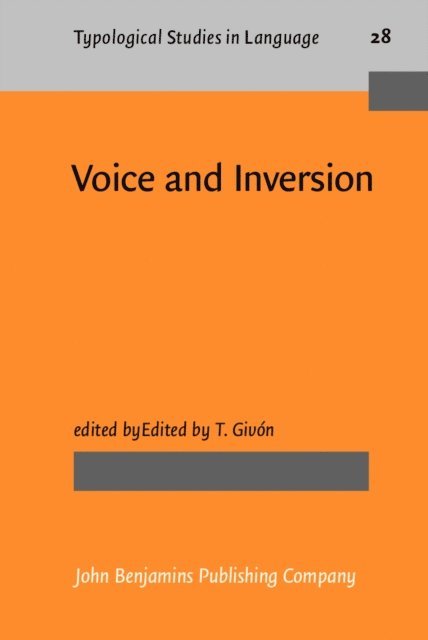
This collection aims first to establish a structure-independent, language-independent definition of pragmatic voice, and more specifically then a universal functional definition of “inverse”. The grammar and pragmatic function of the four major voice constructions — direct-active, inverse, passive, antipassive — are surveyed using narrative texts from 14 languages: Koyukon (Athabascan), Plains Cree (Algonquian), Chepang (Tibeto-Burman), Squamish and Bella Coola (Salish), Sahaptin (Sahaptian), Kutenai (isolate), Surinam Carib (Carib), Spanish and Greek (Indo-European), Korean, Maasai (Nilotic), Cebuano and Karao (Philippine). The comparative quantified study of pragmatic voice functions tests the validity of a universal functional definition of voice and in particular of “inverse”. The cross-language comparison of grammatical structures that code the various voice functions then lays down the foundation for a non-trivial cross-language typology of “inverse”.
E-bok
PDF, Engelska, 19831 856 kr
Läs direkt efter köp
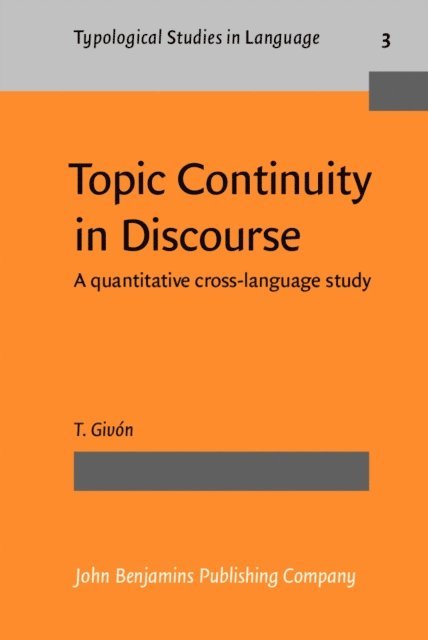
The functional notion of “topic” or “topicality” has suffered, traditionally, from two distinct drawbacks. First, it has remained largely ill defined or intuitively defined. And second, quite often its definition boiled down to structure-dependent circularity. This volume represents a major departure from past practices, without rejecting both their intuitive appeal and the many good results yielded by them. First, “topic” and “topicality” are re-analyzed as a scalar property, rather than as an either/or discrete prime. Second, the graded property of “topicality” is firmly connected with sensible cognitive notions culled from gestalt psychology, such as “predictability” or “continuity”. Third, we develop and utilize precise measures and quantified methods by which the property of “topicality” of clausal arguments can be studied in connected discourse, and thus be properly hinged in its rightful context, that of topic identification, maintenance and recoverability in discourse. Fourth, we show that many grammatical phenomena which used to be studied by linguists in isolation, all partake in one functional domain of grammar, that of topic identification. Finally, we demonstrate the validity of this new approach to the study of “topic” and “topicality” by applying the same text-based quantifying method to a number of typologically-diverse languages, in studying actual texts. Languages studied here are: Written and spoken English, spoken Spanish, Biblical Hebrew, Amharic, Hausa, Japanese, Chamorro and Ute.
E-bok
PDF, Engelska, 19951 588 kr
Läs direkt efter köp
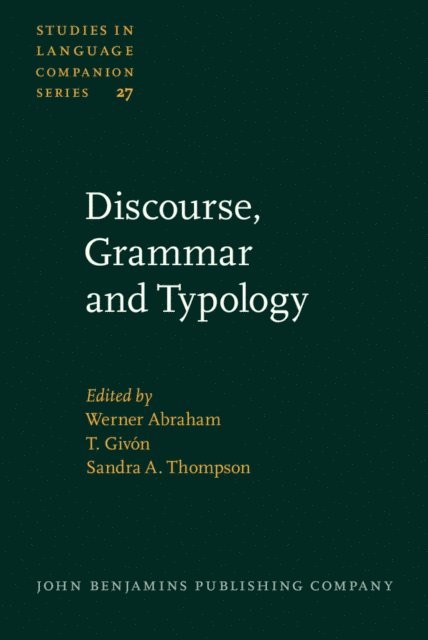
This volume combines papers selected for their affinity with work on discourse analysis and language typology. The methodological platform is the authors'' conviction that all linguistic work needs to be empirical in the sense that (1) generalizations are to be made on the basis of spoken texts in larger contexts, (2) generalizations are correct only as long as pertinent linguistic material does not contradict them, and (3) that linguistic categories and rules are of a temporal nature. In this sense, the contributions represent ''functional typological'' comparison, often of languages not frequently investigated.The papers are arranged in 5 groups: Transitivity and voice; Clausal modality; Typology and discourse categories; Language and Culture; Functionality.
E-bok
PDF, Engelska, 20091 447 kr
Läs direkt efter köp
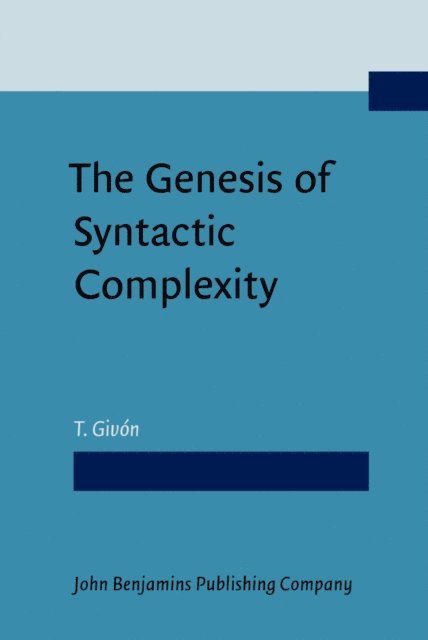
Complex hierarchic syntax is a hallmark of human language. The highest level of syntactic complexity, recursive-embedded clauses, has been singled out by some for a special status as the evolutionary apex of the uniquely - human language faculty - evolutionary yet mysteriously immune to Darwinian adaptive selection. Prof. Givón''s book treats syntactic complexity as an integral part of the evolutionary rise of human communication. The book first describes grammar as an adaptive instrument of communication, assembled upon the pre-existing platform of pre-linguistic object- and-event cognition and mental representation. It then surveys the two grand developmental trends of human language: diachrony, the communal enterprise directly responsible for fashioning synchronic morpho-syntax and cross-language diversity; and ontogeny, the individual endeavor directly responsible for acquiring the competent use of grammar. The genesis of syntactic complexity along these two developmental trends is compared with second language acquisition, pre-grammatical pidgin and pre-human communication. The evolutionary relevance of language diachrony, language ontogeny and pidginization is argued for on general bio-evolutionary grounds: It is the organism''s adaptive on-line behavior- invention, learning and skill acquisition - that is the common thread running through all three developmental trends. The neuro-cognitive circuits that underlie language, and their evolutionary underpinnings, are described and assessed. Recursive embedding turns out to be not an adaptive target on its own, but the by-product of two distinct adaptive moves: (i) the recruitment of conjoined clauses as modal operators on, or referential specifiers of, other clauses; and (ii) the subsequent condensation of paratactic into syntactic structures.
E-bok
PDF, Engelska, 20091 460 kr
Läs direkt efter köp
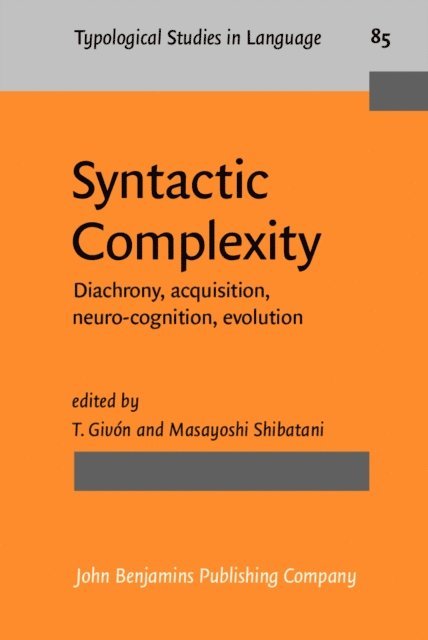
Complex hierarchic syntax is considered one of the hallmarks of human language. The highest level of syntactic complexity, recursive-embedded clauses, has been singled out by some for a special status as the apex of the uniquely-human language faculty – evolutionary but somehow immune to adaptive selection. This volume, coming out of a symposium held at Rice University in March 2008, tackles syntactic complexity from multiple developmental perspectives. We take it for granted that grammar is an adaptive instrument of communication, assembled upon the pre-existing platform of pre-linguistic cognition. Most of the papers in the volume deal with the two grand developmental trends of human language: diachrony, the communal enterprise directly responsible for fashioning synchronic morpho-syntax; and ontogeny, the individual endeavor directly responsible for the acquisition of competent grammatical performance. The genesis of syntactic complexity along these two developmental trends is considered alongside with the cognition and neurology of grammar and of syntactic complexity, and the evolutionary relevance of diachrony, ontogeny and pidginization is argued on general bio-evolutionary grounds. Lastly, several of the contributions to the volume suggest that recursive embedding is not in itself an adaptive target, but rather the by-product of two distinct adaptive gambits: the recruitment of conjoined clauses as modal operators on other clauses and the subsequent condensation of paratactic into syntactic structures.
E-bok
PDF, Engelska, 20051 525 kr
Läs direkt efter köp
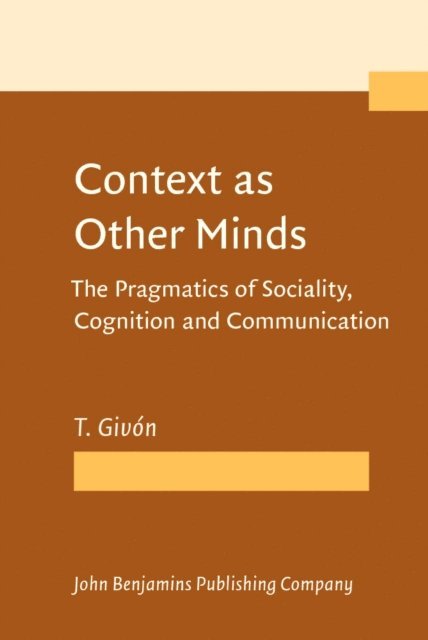
Givon''s new book re-casts pragmatics, and most conspicuously the pragmatics of sociality and communication, in neuro-cognitive, bio-adaptive, evolutionary terms. The fact that context, the core notion of pragmatics, is a framing operation undertaken on the fly through judgements of relevance, has been well known since Aristotle, Kant and Peirce. But the context that is relevant to the pragmatics of sociality and communication is a highly specific mental operation — the mental modeling of the interlocutor''s current, rapidly shifting belief-and-intention states. The construed context of social interaction and communication is thus a mental representation of other minds. Following a condensed intellectual history of pragmatics, the book investigates the adaptive pragmatics of lexical-semantic categories — the 1st-order framing of “reality", what cognitive psychologists call “semantic memory”. Utilizing the network model, the book then takes a fresh look at the adaptive underpinnings of metaphoric meaning. The core chapters of the book outline the re-interpretation of “communicative context” as the systematic, on-line construction of mental models of the interlocutor’s current, rapidly-shifting states of belief and intention. This grand theme is elaborated through examples from the grammar of referential coherence, verbal modalities and clause-chaining. In its final chapters, the book pushes pragmatics beyond its traditional bounds, surveying its interdisciplinary implications for philosophy of science, theory of personality, personality disorders and the calculus of social interaction.
E-bok
PDF, Engelska, 20021 714 kr
Läs direkt efter köp
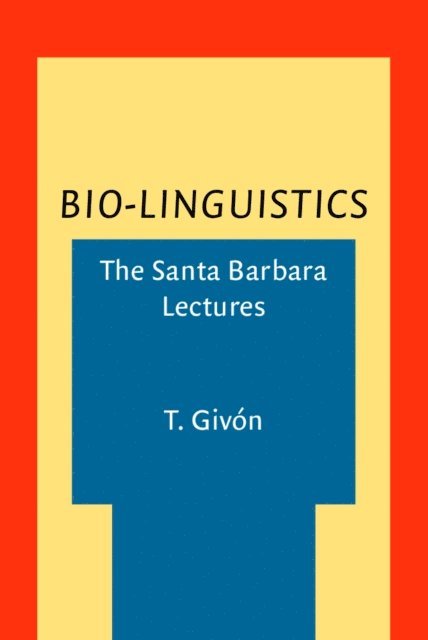
Is human language an evolutionary adaptation? Is linguistics a natural science? These questions have bedeviled philosophers, philologists and linguists from Plato through Chomsky. Prof. Givón suggests that the answers fall naturally within an integrated study of living organisms.In this new work, Givón points out that language operates between aspects of both complex biological design and adaptive behavior. As in biology, the whole is an adaptive compromise to competing demands. Variation is the indispensable tool of learning, change and adaptation. The contrast between innateness and input-driven emergence is an interaction between genetically-coded and behaviorally-coded experience.In enlarging the cross-disciplinary domain, the book examines the parallels between language evolution and language diachrony. Sociality, cooperation and communication are shown to be rooted in a common evolutionary source, the kin-based hunting-and-gathering society of intimates.The book pays homage to the late Joseph Greenberg and his visionary integration of functional motivation, typological diversity and diachronic change.
E-bok
PDF, Engelska, 20021 777 kr
Läs direkt efter köp
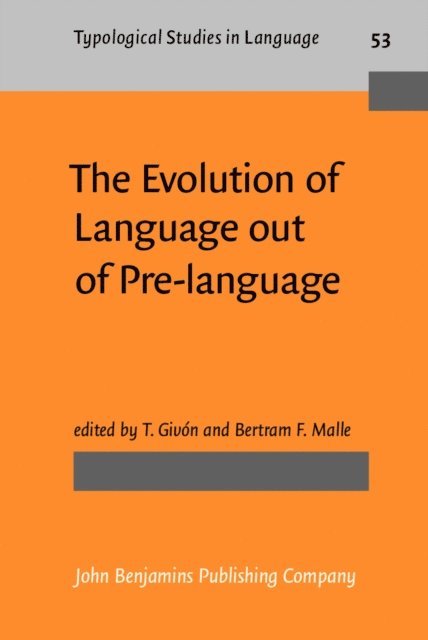
The contributors to this volume are linguists, psychologists, neuroscientists, primatologists, and anthropologists who share the assumption that language, just as mind and brain, are products of biological evolution. The rise of human language is not viewed as a serendipitous mutation that gave birth to a unique linguistic organ, but as a gradual, adaptive extension of pre-existing mental capacities and brain structures. The contributors carefully study brain mechanisms, diachronic change, language acquisition, and the parallels between cognitive and linguistic structures to weave a web of hypotheses and suggestive empirical findings on the origins of language and the connections of language to other human capacities. The chapters discuss brain pathways that support linguistic processing; origins of specific linguistic features in temporal and hierarchical structures of the mind; the possible co-evolution of language and the reasoning about mental states; and the aspects of language learning that may serve as models of evolutionary change.
E-bok
PDF, Engelska, 20011 588 kr
Läs direkt efter köp
This new edition of Syntax: A functional-typological introduction is at many points radically revised. In the previous edition (1984) the author deliberately chose to de-emphasize the more formal aspects of syntactic structure, in favor of a more comprehensive treatment of the semantic and pragmatic correlates of syntactic structure. With hindsight the author now finds the de-emphasis of the formal properties a somewhat regrettable choice, since it creates the false impression that one could somehow be a functionalist without being at the same time a structuralist. To redress the balance, explicit treatment is given to the core formal properties of syntactic constructions, such as constituency and hierarchy (phrase structure), grammatical relations and relational control, clause union, finiteness and governed constructions. At the same time, the cognitive and communicative underpinning of grammatical universals are further elucidated and underscored, and the interplay between grammar, cognition and neurology is outlined. Also the relevant typological database is expanded, now exploring in greater precision the bounds of syntactic diversity. Lastly, Syntax treats synchronic-typological diversity more explicitly as the dynamic by-product of diachronic development or grammaticalization. In so doing a parallel is drawn between linguistic diversity and diachrony on the one hand and biological diversity and evolution on the other. It is then suggested that — as in biology — synchronic universals of grammar are exercised and instantiated primarily as constraints on development, and are thus merely the apparent by-products of universal constraints on grammaticalization.
E-bok
PDF, Engelska, 20011 651 kr
Läs direkt efter köp
This new edition of Syntax: A functional-typological introduction is at many points radically revised. In the previous edition (1984) the author deliberately chose to de-emphasize the more formal aspects of syntactic structure, in favor of a more comprehensive treatment of the semantic and pragmatic correlates of syntactic structure. With hindsight the author now finds the de-emphasis of the formal properties a somewhat regrettable choice, since it creates the false impression that one could somehow be a functionalist without being at the same time a structuralist. To redress the balance, explicit treatment is given to the core formal properties of syntactic constructions, such as constituency and hierarchy (phrase structure), grammatical relations and relational control, clause union, finiteness and governed constructions. At the same time, the cognitive and communicative underpinning of grammatical universals are further elucidated and underscored, and the interplay between grammar, cognition and neurology is outlined. Also the relevant typological database is expanded, now exploring in greater precision the bounds of syntactic diversity. Lastly, Syntax treats synchronic-typological diversity more explicitly as the dynamic by-product of diachronic development or grammaticalization. In so doing a parallel is drawn between linguistic diversity and diachrony on the one hand and biological diversity and evolution on the other. It is then suggested that — as in biology — synchronic universals of grammar are exercised and instantiated primarily as constraints on development, and are thus merely the apparent by-products of universal constraints on grammaticalization.