
Glenn Ledder – författare
916 kr
Läs direkt efter köp
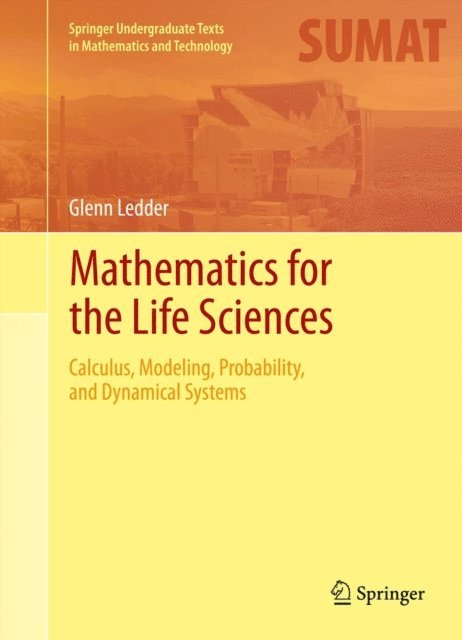
Mathematics for the Life Sciences provides present and future biologists with the mathematical concepts and tools needed to understand and use mathematical models and read advanced mathematical biology books. It presents mathematics in biological contexts, focusing on the central mathematical ideas, and providing detailed explanations. The author assumes no mathematics background beyond algebra and precalculus. Calculus is presented as a one-chapter primer that is suitable for readers who have not studied the subject before, as well as readers who have taken a calculus course and need a review. This primer is followed by a novel chapter on mathematical modeling that begins with discussions of biological data and the basic principles of modeling. The remainder of the chapter introduces the reader to topics in mechanistic modeling (deriving models from biological assumptions) and empirical modeling (using data to parameterize and select models). The modeling chapter contains a thorough treatment of key ideas and techniques that are often neglected in mathematics books. It also provides the reader with a sophisticated viewpoint and the essential background needed to make full use of the remainder of the book, which includes two chapters on probability and its applications to inferential statistics and three chapters on discrete and continuous dynamical systems.
The biological content of the book is self-contained and includes many basic biology topics such as the genetic code, Mendelian genetics, population dynamics, predator-prey relationships, epidemiology, and immunology. The large number of problem sets include some drill problems along with a large number of case studies. The latter are divided into step-by-step problems and sorted into the appropriate section, allowing readers to gradually develop complete investigations from understanding the biological assumptions to a complete analysis.
765 kr
Skickas inom 10-15 vardagar
657 kr
Skickas inom 10-15 vardagar
840 kr
Läs direkt efter köp
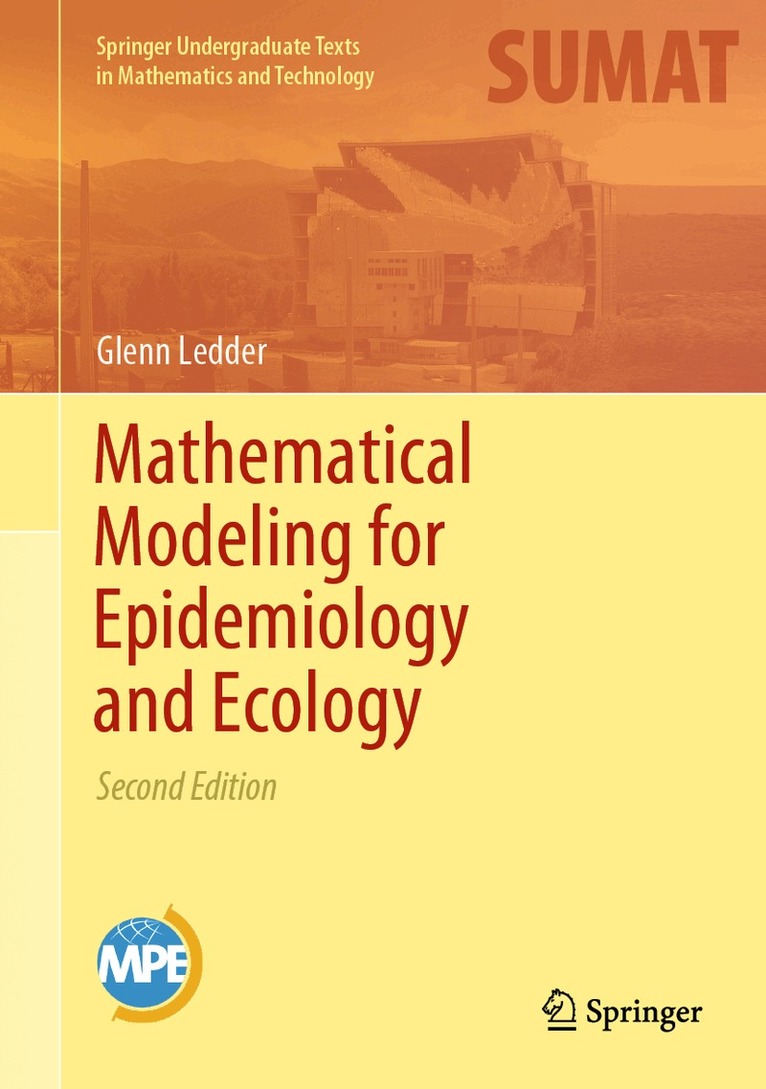
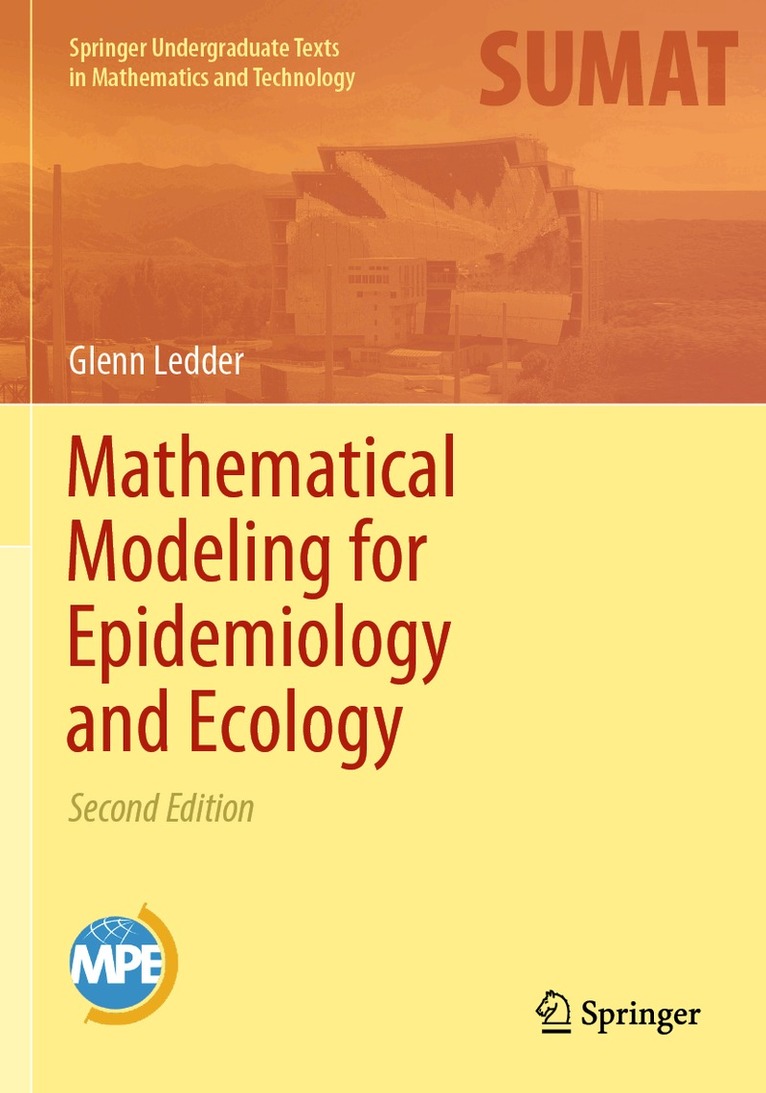
Mathematical Modeling for Epidemiology and Ecology provides readers with the mathematical tools needed to understand and use mathematical models and read advanced mathematical biology books. It presents mathematics in biological contexts, focusing on the central mathematical ideas and the biological implications, with detailed explanations. The author assumes no mathematics background beyond elementary differential calculus.
An introductory chapter on basic principles of mathematical modeling is followed by chapters on empirical modeling and mechanistic modeling. These chapters contain a thorough treatment of key ideas and techniques that are often neglected in mathematics books, such as the Akaike Information Criterion. The second half of the book focuses on analysis of dynamical systems, emphasizing tools to simplify analysis, such as the Routh-Hurwitz conditions and asymptotic analysis. Courses can be focused on either half of the book or thematically chosen material from both halves, such as a course on mathematical epidemiology.
The biological content is self-contained and includes many topics in epidemiology and ecology. Some of this material appears in case studies that focus on a single detailed example, and some is based on recent research by the author on vaccination modeling and scenarios from the COVID-19 pandemic.
The problem sets feature linked problems where one biological setting appears in multi-step problems that are sorted into the appropriate section, allowing readers to gradually develop complete investigations of topics such as HIV immunology and harvesting of natural resources. Some problems use programs written by the author for Matlab or Octave; these combine with more traditional mathematical exercises to give students a full set of tools for model analysis. Each chapter contains additional case studies in the form of projects with detailed directions. New appendices contain mathematical details on optimization, numerical solution of differential equations, scaling, linearization, and sophisticated use of elementary algebra to simplify problems.

625 kr
Skickas inom 5-8 vardagar
657 kr
Skickas inom 10-15 vardagar