Gonzalo Julio A Gonzalo – författare
Visar alla böcker från författaren . Handla med fri frakt och snabb leverans.
10 produkter
10 produkter
E-bok
Engelska, 2016445 kr
Läs direkt efter köp
World Population: Past, Present, & Future uses a multidisciplinary approach to investigate in depth on important aspects of the evolution of world population not well addressed previously. The authors from the Universidad Autonoma, Madrid (Spain), professors Julio A Gonzalo, Manuel Alfonseca, and Félix-Fernando Muñoz, point out that the recent pronounced growth in world population (accompanied by an even more pronounced growth in agricultural production) was due mainly to the increase of life expectancy and not to the (inexistent) growth in fertility rate. Using a ''rate equations'' approach for the first time, they describe population trends and forecast the possibility of steps up (or down) in population rather than the exponential growth predicted by UN demographers around 1985 and thereafter. This book provides a new perspective that our planet is not overpopulated and could, in fact, house a considerably larger population.
E-bok
Engelska, 2017475 kr
Läs direkt efter köp
Beginning with the famous Olber's paradox, paradoxes such as the missing mass, dark energy, baryon to photon ratio and cosmic zero-point energy are examined in detail. The Heisenberg-Lemaitre's units, based on the total enormous but finite mass of the Universe, are introduced and rigorous solutions of Einstein's cosmological equations for an open Universe with cosmological constant are obtained. Energy conservation after the Big Bang is consistently required.This book discusses such paradoxes in depth with physical and logical content and historical perspective, and has not too technical content in order to serve a wide audience. In the second edition, the content is updated and new sections are added.
E-bok
Engelska, 2013238 kr
Läs direkt efter köp
This book provides realistic answers to hotly debated scientific topics: Science is about quantitative aspects of natural realities (physical, chemical, biological) but it is the result of human intellectual inquiry and therefore not “per se” materialistic.This book, with contributions from experts in physics, cosmology, mathematics, engineering, biology and genetics, covers timely and relevant topics such as the origin of the universe, the origin of life on Earth, the origin of man (intelligent life) and the origin of science.
E-bok
PDF, Engelska, 2008698 kr
Läs direkt efter köp
This interesting book reviews WMAP''s main results (2003) and discusses in detail how the accurate qualitative results for the “age” of the universe and the Hubble constant were anticipated in an article published five years before in Acta Cosmologica, Krakow. In the final chapter on “Cosmic Numbers”, it is shown that, as a result of the coincidence at decoupling time between atom formation and matter/radiation equality, a reasonable cosmic justification for the mass ratio of protons and electrons is obtained. /remove
E-bok
PDF, Engelska, 2006890 kr
Läs direkt efter köp
This book begins by introducing the effective field approach, the simplest approach to phase transitions. It provides an intuitive approximation to the physics of such diverse phenomena as liquid-vapor transitions, ferromagnetism, superconductivity, order-disorder in alloys, ferroelectricity, superfluidity and ferroelasticity. The connection between the effective field approach and Landau''s theory is stressed.The main coverage is devoted to specific applications of the effective field concept to ferroelectric systems, both hydrogen bonded ferroelectrics, like those in the TGS family, and oxide ferroelectrics, like pure and mixed perovskites.
E-bok
PDF, Engelska, 2005445 kr
Läs direkt efter köp
Scientific Cosmology is clearly one of the most active physics research fields at present, and likely to remain so in the near future. Shortly after the pioneering cosmological work of Einstein, Georges Lemaitre proposed a model which some years later to be known as the big-bang model. In the early fifties an alternative proposal, the so called steady-state (expansion at constant density) model, became the fashionable model in prominent academic circles. The discovery of the cosmic background microwave radiation (Penzias & Wilson, 1965) made the steady-state model almost untenable. A quarter of a century later the inflationary model was proposed, becoming extraordinarily popular almost immediately. For some it seemed to combine attractive features of both the steady-state and the big-bang models, by postulating a very early violent (constant density) expansion during a very tiny fraction of a second.The book makes use of the best and most recent observational data, from the Cosmic Background Explorer (COBE, 1992) to the Microwave Anisotropy Probe (WMAP, 2003), to discuss the merits and demerits of inflationary cosmology for a general readership acquainted with the basic facts of scientific cosmology. A complete Glossary and a detailed Index help the reader to follow controversial topics, such as dark matter, dark energy, cosmic flatness and accelerated expansion.
E-bok
PDF, Engelska, 2003683 kr
Läs direkt efter köp
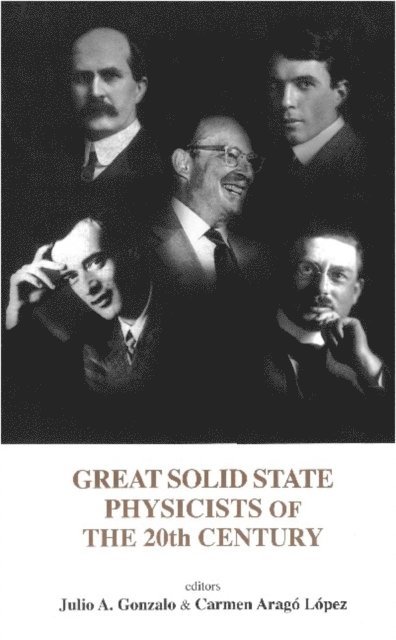
The 20th Century has been called the Century of Physics. It could be even more appropriate to call it the Century of Solid State Physics. All the technological developments which had changed the world by the end of the century had been based upon previous scientific developments in Solid State Physics.The Braggs, Debye, Bardeen, Landau were certainly at the forefront of all those revolutionary changes.
E-bok
PDF, Engelska, 2002490 kr
Läs direkt efter köp
Materials physics is a very active research field at present and it is expected to remain so in the foreseeable future. Different spectroscopies are currently used to investigate the structure and dynamics of crystalline materials. Some traditional spectroscopies are presented in this book: optical, magnetic resonance, ultrasonic, brillouin, neutron scattering, soft mode and dielectric response spectroscopies. For all of them, the presentation is complemented with some reference material for more modern or sophisticated spectroscopies.This book should be useful as an introductory textbook for a short course on solid state spectroscopies. A number of exercises are worked out throughout the text. Ferro- and piezoelectric materials and their phase transitions are paid special attention.
E-bok
Engelska, 2011327 kr
Läs direkt efter köp
Beginning with the famous Olber's paradox, a number of cosmological paradoxes, such as the missing mass, dark energy, and the baryon-to-photon ratio, have been and are today the subject of many scientific controversies. The Big Bang model, anticipated by Lemaitre in 1927 and reformulated twenty years later by Gamow, Alpher and Herman, is one of the most spectacular successes in the entire history of physics. It remains today surrounded by considerable theoretical speculation without sufficient observational support.This book discusses such paradoxes in depth with physical and logical content and historical perspective, and has not too technical content in order to serve a wide audience.
E-bok
Engelska, 2015342 kr
Läs direkt efter köp
The aim of this book is to analyze the all important implications of Heisenberg''s Uncertainty Principle for a finite universe with very large mass-energy content such as ours. The earlier and main contributors to the formulation of Quantum Mechanics are briefly reviewed regarding the formulation of Heisenberg''s Principle. After discussing “indeterminacy” versus ”uncertainty”, the universal constants of physics are reviewed and Planck''s units are given. Next, a novel set of units, Heisenberg-Lemaitre units, are defined in terms of the large finite mass of the universe. With the help of Heisenberg''s principle, the time evolution of the finite zero-point energy for the universe is investigated quantitatively. Next, taking advantage of the rigorous solutions of Einstein''s cosmological equation for a flat, open and mixed universe of finite mass, the most recent and accurate data on the “age” (to) and the expansion rate (Ho) of the universe and their implications are reconsidered.