Gordon Slade – författare
Visar alla böcker från författaren Gordon Slade. Handla med fri frakt och snabb leverans.
11 produkter
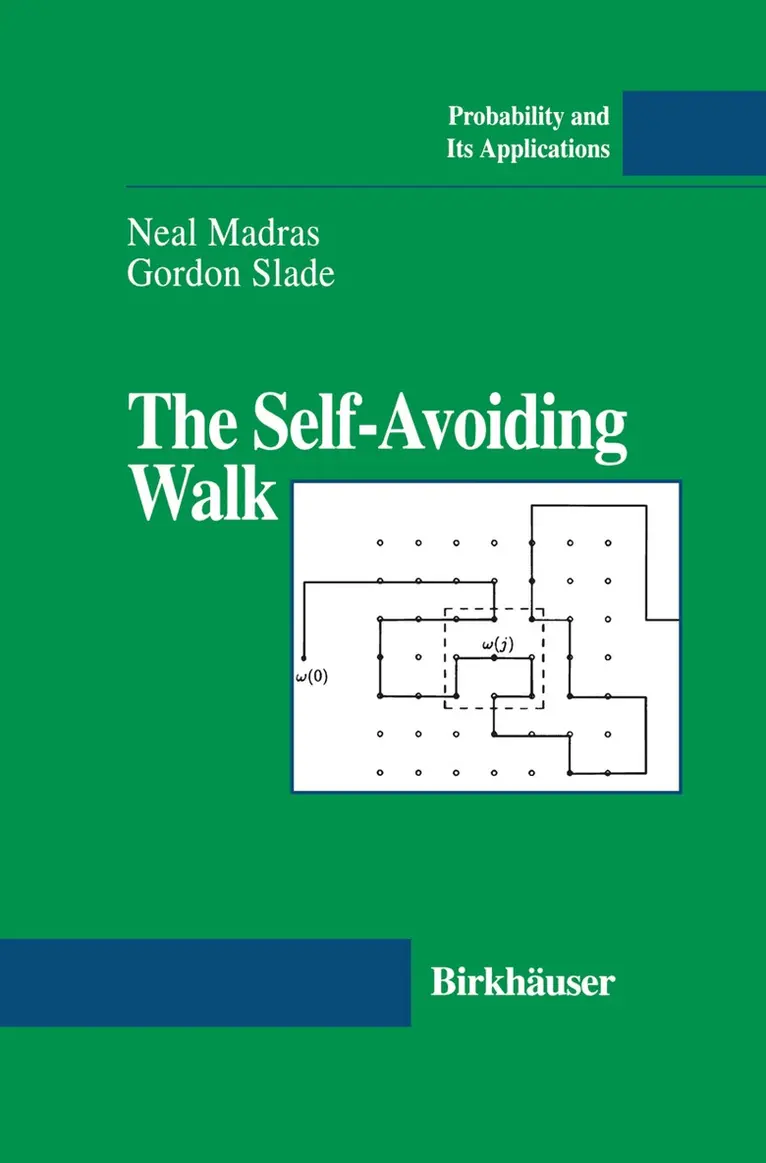
Self-Avoiding Walk
Häftad, 1996
1094 kr
Lägg i varukorg
A self-avoiding walk is a path on a lattice that does not visit the same site more than once. In spite of this simple definition, many of the most basic questions about this model are difficult to resolve in a mathematically rigorous fashion. In particular, we do not know much about how far an n …
Self-Avoiding Walk
E-bok, 2013
1459 kr
Lägg i varukorg
A self-avoiding walk is a path on a lattice that does not visit the same site more than once. In spite of this simple definition, many of the most basic questions about this model are difficult to resolve in a mathematically rigorous fashion. In particular, we do not know much about how far an n …
Self-Avoiding Walk
Häftad, 2012
877 kr
Lägg i varukorg
The self-avoiding walk is a mathematical model that has important applications in statistical mechanics and polymer science. In spite of its simple definition—a path on a lattice that does not visit the same site more than once—it is difficult to analyze mathematically. The Self-Avoiding Walk …
Self-Avoiding Walk
E-bok, 2012
1141 kr
Lägg i varukorg
The self-avoiding walk is a mathematical model that has important applications in statistical mechanics and polymer science. In spite of its simple definition—a path on a lattice that does not visit the same site more than once—it is difficult to analyze mathematically. The Self-Avoiding Walk …
Random Graphs, Phase Transitions, and the Gaussian Free Field
PIMS-CRM Summer School in Probability, Vancouver, Canada, June 5–30, 2017
Av Martin T. Barlow, Gordon Slade
Inbunden, 2019
1965 kr
Lägg i varukorg
The 2017 PIMS-CRM Summer School in Probability was held at the Pacific Institute for the Mathematical Sciences (PIMS) at the University of British Columbia in Vancouver, Canada, during June 5-30, 2017. It had 125 participants from 20 different countries, and featured two main courses, three …
Random Graphs, Phase Transitions, and the Gaussian Free Field
PIMS-CRM Summer School in Probability, Vancouver, Canada, June 5–30, 2017
Av Gordon Slade, Martin T. Barlow
E-bok, 2019
2517 kr
Lägg i varukorg
The 2017 PIMS-CRM Summer School in Probability was held at the Pacific Institute for the Mathematical Sciences (PIMS) at the University of British Columbia in Vancouver, Canada, during June 5-30, 2017. It had 125 participants from 20 different countries, and featured two main courses, three …
Random Graphs, Phase Transitions, and the Gaussian Free Field
PIMS-CRM Summer School in Probability, Vancouver, Canada, June 5–30, 2017
Av Martin T. Barlow, Gordon Slade
Häftad, 2021
1965 kr
Lägg i varukorg
The 2017 PIMS-CRM Summer School in Probability was held at the Pacific Institute for the Mathematical Sciences (PIMS) at the University of British Columbia in Vancouver, Canada, during June 5-30, 2017. It had 125 participants from 20 different countries, and featured two main courses, three …
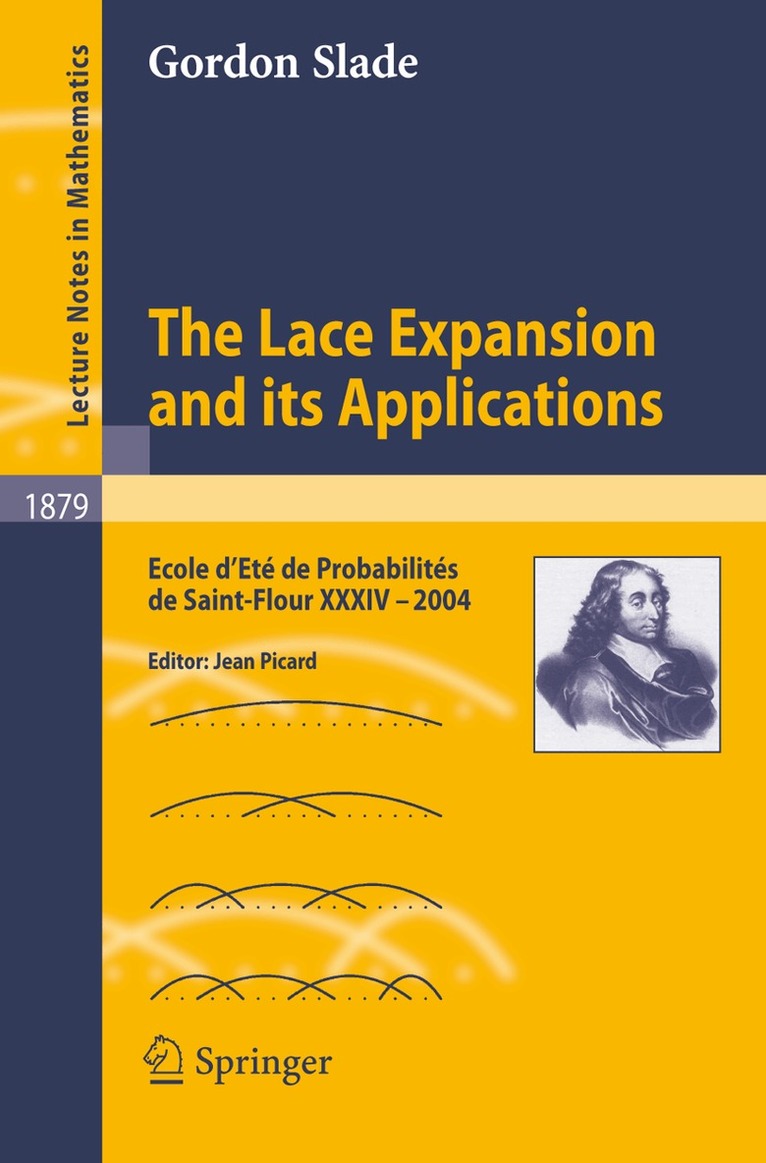
Lace Expansion and its Applications
Ecole d'Eté de Probabilités de Saint-Flour XXXIV - 2004
Häftad, 2006
714 kr
Lägg i varukorg
Three series of lectures were given at the 34th Probability Summer School in Saint-Flour (July 6–24, 2004), by the Professors Cerf, Lyons and Slade. We have decided to publish these courses separately. This volume contains the course of Professor Slade. We cordially thank the author for his …
Lace Expansion and its Applications
Ecole d''Eté de Probabilités de Saint-Flour XXXIV - 2004
E-bok, 2006
877 kr
Lägg i varukorg
Three series of lectures were given at the 34th Probability Summer School in Saint-Flour (July 6–24, 2004), by the Professors Cerf, Lyons and Slade. We have decided to publish these courses separately. This volume contains the course of Professor Slade. We cordially thank the author for his …
Introduction to a Renormalisation Group Method
Av Roland Bauerschmidt, David C. Brydges m. fl.
Häftad, 2019
660 kr
Lägg i varukorg
This is a primer on a mathematically rigorous renormalisation group theory, presenting mathematical techniques fundamental to renormalisation group analysis such as Gaussian integration, perturbative renormalisation and the stable manifold theorem. It also provides an overview of fundamental models …
Introduction to a Renormalisation Group Method
Av Gordon Slade, David C. Brydges m. fl.
E-bok, 2019
897 kr
Lägg i varukorg
This is a primer on a mathematically rigorous renormalisation group theory, presenting mathematical techniques fundamental to renormalisation group analysis such as Gaussian integration, perturbative renormalisation and the stable manifold theorem. It also provides an overview of fundamental models …