Govind Agrawal – författare
Visar alla böcker från författaren Govind Agrawal. Handla med fri frakt och snabb leverans.
2 produkter
2 produkter
E-bok
PDF, Engelska, 2012672 kr
Läs direkt efter köp
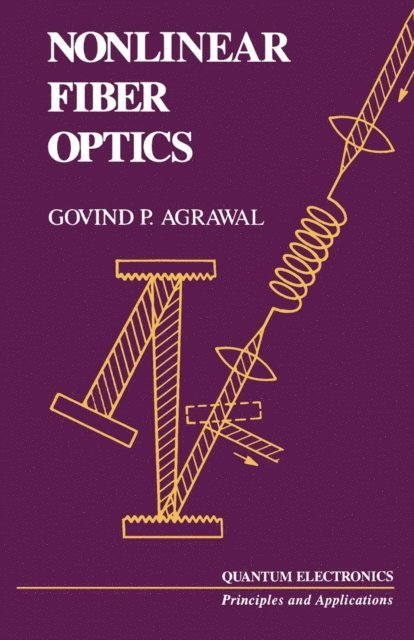
Nonlinear Fiber Optics deals with various nonlinear phenomena in optical fibers, including wave propagation, group-velocity dispersion, self-phase modulation, optical pulse compression, cross-phase modulation, stimulated Raman scattering and Brillouin scattering, and parametric processes. The implications of various nonlinear effects on the performance of light-wave systems are emphasized throughout. This book consists of 10 chapters and begins with an overview of the fiber characteristics that are important for understanding nonlinear effects in optical fibers. A brief historical perspective of the progress in the field of fiber optics is provided. Fiber properties such as optical loss, chromatic dispersion, and birefringence are discussed. Particular attention is paid to chromatic dispersion because of its importance in the study of nonlinear effects probed by using ultrashort optical pulses. The chapters that follow focus on wave propagation in optical fibers, along with group-velocity dispersion and self-phase modulation. A chapter is devoted to pulse propagation in the region of anomalous group-velocity dispersion, with emphasis on solitons. The book concludes with a discussion of parametric processes such as harmonic generation, four-wave mixing, and parametric amplification. This book is intended for researchers already engaged in or wishing to enter the field of nonlinear fiber optics, for scientists and engineers interested in optical fiber communications, and for graduate students enrolled in courses dealing with nonlinear optics, fiber optics, or optical communications.
Häftad, Engelska, 2012
1 073 kr
Skickas inom 10-15 vardagar
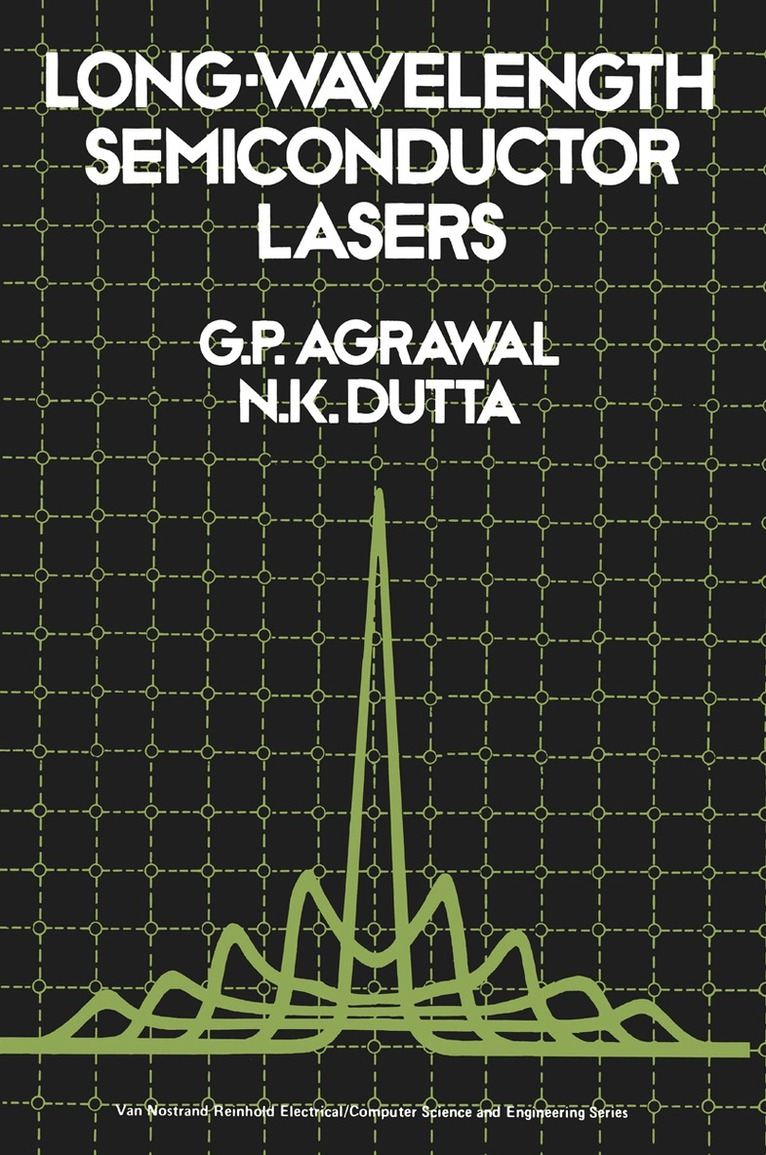
Since its invention in 1962, the semiconductor laser has come a long way. Advances in material purity and epitaxial growth techniques have led to a variety of semiconductor lasers covering a wide wavelength range of 0. 3- 100 ILm. The development during the 1970s of GaAs semiconductor lasers, emitting in the near-infrared region of 0. 8--0. 9 ILm, resulted in their use for the first generation of optical fiber communication systems. However, to take advantage of low losses in silica fibers occurring around 1. 3 and 1. 55 ILm, the emphasis soon shifted toward long-wavelength semiconductor lasers. The material system of choice in this wavelength range has been the quaternary alloy InGaAsP. During the last five years or so, the intense development effort devoted to InGaAsP lasers has resulted in a technology mature enough that lightwave transmission systems using InGaAsP lasers are currently being deployed throughout the world. This book is intended to provide a comprehensive account of long-wave length semiconductor lasers. Particular attention is paid to InGaAsP lasers, although we also consider semiconductor lasers operating at longer wave lengths. The objective is to provide an up-to-date understanding of semicon ductor lasers while incorporating recent research results that are not yet available in the book form. Although InGaAsP lasers are often used as an example, the basic concepts discussed in this text apply to all semiconductor lasers, irrespective of their wavelengths.