Graciela Tonon – Författare
Visar alla böcker från författaren Graciela Tonon. Handla med fri frakt och snabb leverans.
11 produkter
11 produkter
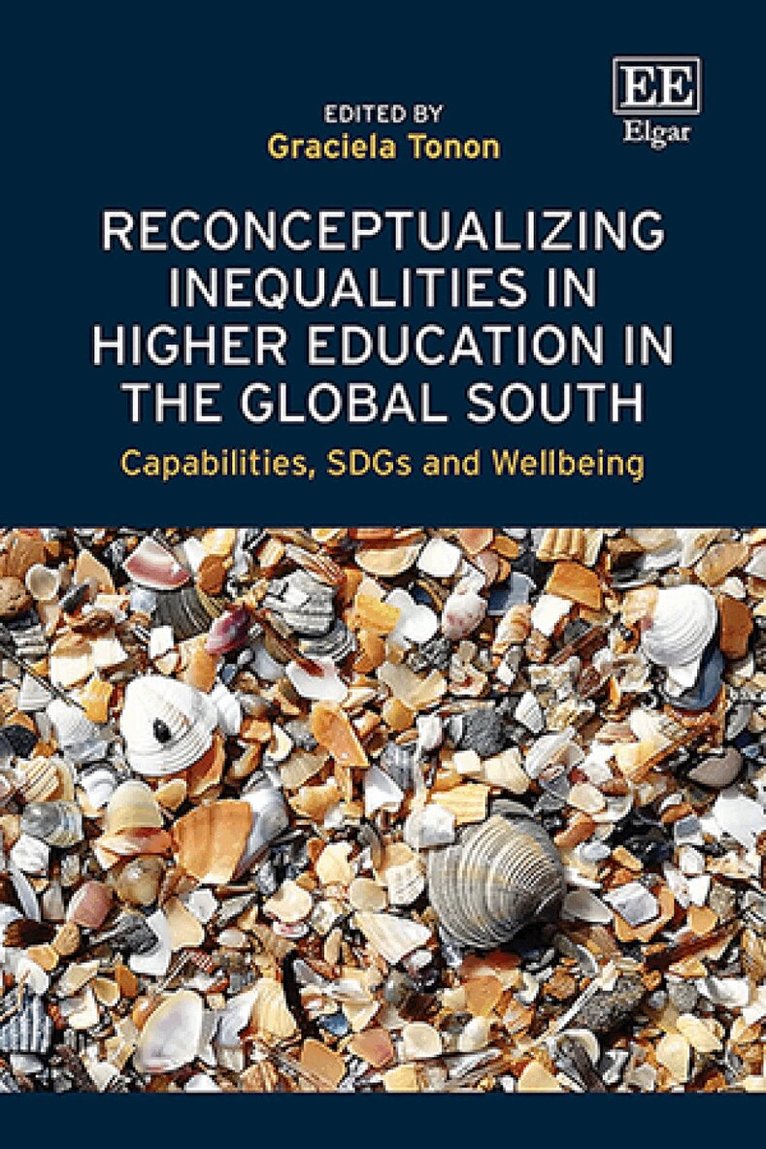
Reconceptualizing Inequalities in Higher Education in the Global South
Capabilities, SDGs and Wellbeing
Inbunden, Engelska, 2026
1 505 kr
Skickas inom 7-10 vardagar
This perceptive book addresses the changing dynamics of inequality in higher education in the Global South. Focusing on the lived experiences of university students, expert contributors explore how inequality is defined and navigated in higher education institutions.Providing new conceptualizations alongside qualitative and quantitative research, the book explores the realities faced by universities in developing economies, considering case studies from Argentina, Brazil, Ethiopia, India, Peru, Vietnam, South Africa and Türkiye. Chapters examine key topics such as the relationship between higher education in the Global South and the UN Sustainable Development Goals, insecurity in public transport, wellbeing inequality and the capability approach, as well as the roles of gender and ethnicity in crystallizing inequalities. Reconceptualizing Inequalities in Higher Education in the Global South investigates how public policies which aim to overcome inequalities sometimes paradoxically consolidate them.This book is an essential resource for academics and researchers in the sociology of education, global education policy and development studies, particularly those investigating educational inequalities in low-income countries. It is also crucial for practitioners and policymakers in international education and development.
Key Actors in Public Policy-making for Quality of Life
Facilitators and Obstacles
Inbunden, Engelska, 2022
1 094 kr
Skickas inom 10-15 vardagar
This book analyzes how quality of life research results can be transferred to policy making, and considers the role of actors in this process---researchers, policy makers, and citizens---as well as their interrelationships.
Key Actors in Public Policy-making for Quality of Life
Facilitators and Obstacles
Häftad, Engelska, 2023
713 kr
Skickas inom 10-15 vardagar
This book analyzes how quality of life research results can be transferred to policy making, and considers the role of actors in this process---researchers, policy makers, and citizens---as well as their interrelationships.
Del 55 - Social Indicators Research Series
Qualitative Studies in Quality of Life
Methodology and Practice
Inbunden, Engelska, 2015
550 kr
Skickas inom 10-15 vardagar
This volume explores the use and relevance of qualitative methods for the study of quality of life. It analyzes the role of qualitative researcher and the role of the context and the culture in quality of life studies. It presents the use of qualitative methods in real projects carried out in specific fields: geography, health, community studies, labor life and yoga. Finally, the book proposes the use of mixed methods that are considered as the third methodological approach in social research.The main purpose of using qualitative methods is to understand what it means for participants to be involved in certain events, situations and actions. Such methods help understand the context in which participants act and the influence of that context on their actions. The decision to use a particular methodology implies a philosophic, theoretical and political decision. Qualitative methodology constitutes an approach that is essential for understanding people’s experiences of well-being and discovering new issues related to quality of life.
1 094 kr
Skickas inom 10-15 vardagar
This volume sheds new light on the use of quantitative, qualitative and synthetic indicators for the measurement of quality of life in different countries of Latin America.
Del 55 - Social Indicators Research Series
Qualitative Studies in Quality of Life
Methodology and Practice
Häftad, Engelska, 2016
550 kr
Skickas inom 10-15 vardagar
This volume explores the use and relevance of qualitative methods for the study of quality of life.
1 094 kr
Skickas inom 10-15 vardagar
This book presents a reconfiguration of the concepts of community in Latin countries as well as the community quality of life and well-being of different groups: children, young people, older adults, migrants. The traditional concept of community has changed together with the way people participate in community spaces. Community nowadays is more than a geographic concentration; it is related to social support, inter-subjectivity, participation, consensus, common beliefs, joint effort aiming at a major objective, and intense and extensive relationships. This volume presents unique experiences about culture, social development, health, water, armed conflicts, the digital media, and sports within communities, written by authors from Latin countries. This volume is a valuable resource for researchers, students, and policy makers in quality of life studies.
1 401 kr
Skickas inom 5-8 vardagar
This volume sheds new light on the use of quantitative, qualitative and synthetic indicators for the measurement of quality of life in different countries of Latin America.
1 451 kr
Skickas inom 5-8 vardagar
This book presents a reconfiguration of the concepts of community in Latin countries as well as the community quality of life and well-being of different groups: children, young people, older adults, migrants. The traditional concept of community has changed together with the way people participate in community spaces.
600 kr
Skickas
The focus of this book is centered on the participation of children in countries of the South. In this sense, it will review the possibilities of children's participation, as well as their forms of participation in different contexts of daily life.
519 kr
Skickas inom 10-15 vardagar
The study of quality of life refers to the material environment (social welfare) and psychosocial environment (wellbeing). It has been defined as a concept that implies the objective and subjective dimension that Cummins (1997) first studied in seven domains. The use of domains in the quality of life study allows a more precise measurement than the one that could have been reached through simple questions, since psychometric scales are used and if the addition of domains is equivalent to the totality of life satisfaction, then the group of domains is a valid measure of quality of life. In the case of young people, it has been observed that even if they live in negative physical, social and contextual conditions, they can nevertheless experience a relatively positive experience in relation to their quality of life, depending on the strategies and capabilities that they generate in relation to the context. Similarly, young people that live in favorable socioeconomic conditions and with a trouble free psychological situation may experience a relatively poor evaluation of their position in life (Patrick et al). oung people do not form a homogenous group and, in this sense, it is not possible to generalize about youth; they interact with the environment in which they live and they are a product of the history they happen to live, in this way they transit different vital scenarios in daily life that affect their quality of life. The social representations about youth that each population has, in each historical moment, are embedded in the social context in which young people live and develop, conditioning every-day life and /or creating related stereotypes. The concept of youth is a social construction built conjointly by all members of society in the historical moment in which they live. Young people interact with the environment in which they live and they are a product of the history they happen to live. Authors like Urresti (1999) define youth from a point ofview that takes into account the living together of different generations in different societies, thus being impossible to compare young people of today with those of two or three decades ago; in addition, he states that it is necessary to situate the understanding of youth within the historical and social moment in which they live. Nowadays the predominant adult model is based in individualism, and even if an intergenerational dialogue is necessary, it is difficult for young people to achieve this kind of communication with adults that, in some cases, are living “stages of youth” or that need to be “forever young”. Young people live in uncertainty, with a limited perspective for future action, assigning their own meaning to events and facts, according to their fundamental concerns that are significantly different from those of their parents’ generation. In the other side the process of globalization and the protagonist social role of the new informational and communicational technologies, produce that the possibilities to expand individual freedoms increase, but not all young people can manage with it (Lechner, 2002). What young people need in order to construct their citizenship and feel satisfied, varies according to the different societies, especially considering that most of them live a fragile situation. As Cortina (2003:7-9) states, the idea of citizenship always transcends individualism, because the citizen is somebody that exists together with others, and those others are equal to him before the city, is somebody that deliberates with others, that acts with others conjointly, that assumes the protagonist role of his own life, in this way citizen is not only that who the law protects, but that who participates in the public issues. Speaking about young people we propose to recognize them from their equal dignity because “recognition is not only a courtesy that we owe others: it is an essential human need” (Taylor, 1993:46). This recognition isbased in human dignity and tends to protect the basic rights of people as individuals and to recognize the particular needs of people as members of specific cultural groups (Gutman, 1993:20). This brief book is dedicated to analyze the relations between quality of life and construction of citizenship of young people in Argentina, considering two specific social scenarios: the community and the university. In the case of community it is important to note that it not imply uniformity, as community means the inclusion of diversity and the achievement of sharing within it, and in the case of university it will be necessary to recognize that as an educational institution the university has expanded his traditional role of production of knowledge, to be an institution of social reference and social support for students. To do this the author will show some of the results of a decade of research in quality of life and young people, using quantitative and qualitative methods.