Gregor Thurmair – författare
Visar alla böcker från författaren Gregor Thurmair. Handla med fri frakt och snabb leverans.
5 produkter
5 produkter
Inbunden, Engelska, 2025
1 904 kr
Skickas inom 10-15 vardagar
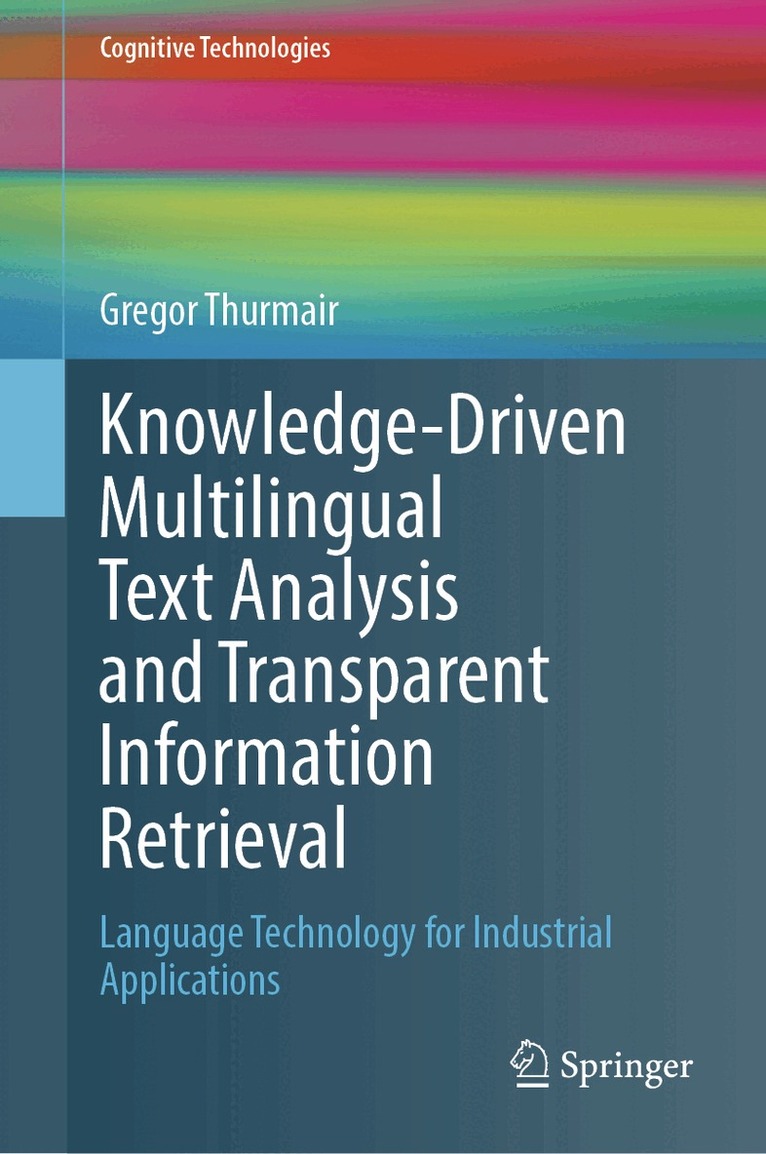
This book presents all components and knowledge sources required for Transparent Information Retrieval. Depending on the respective topic and taking care of their interoperability, both deep and shallow technology is used. The processing starts from the analysis of the text data and collects its results in a multilingual conceptual network, this way enabling Transparent Information Retrieval where users communicate with the system in their native language while the documents could be in a different language, transparent to the users. To do so, the author investigates all text analysis components required for multilingual indexing, starting from preparatory work like language and topic identification, continuing with sentence splitting and tokenization (including Chinese), and describing lexical analysis, also for multiword entries and Named Entities. Entries are then disambiguated both on syntactic (by a tagger) and semantic level (by multilingual word sense disambiguation). The analysis results are collected in a dynamic multilingual ConceptNet, which is an index structure extended by monolingual relations (like synonyms, or head-modifier links) as well as multilingual ones (translations). In addition to many European languages also Turkish, Arabic, Persian, and Chinese are treated. The book concludes with a description of components needed to build the required resources, like crawlers, bilingual term extraction, and tools for defaulting linguistic annotations. For each component, readers will find a technology overview, a discussion of its main challenges in computational treatment, a description of the technical solution selected, and evaluation information.
E-bok
Engelska, 20252 436 kr
Läs direkt efter köp
This book presents all components and knowledge sources required for Transparent Information Retrieval. Depending on the respective topic and taking care of their interoperability, both deep and shallow technology is used. The processing starts from the analysis of the text data and collects its results in a multilingual conceptual network, this way enabling Transparent Information Retrieval where users communicate with the system in their native language while the documents could be in a different language, transparent to the users. To do so, the author investigates all text analysis components required for multilingual indexing, starting from preparatory work like language and topic identification, continuing with sentence splitting and tokenization (including Chinese), and describing lexical analysis, also for multiword entries and Named Entities. Entries are then disambiguated both on syntactic (by a tagger) and semantic level (by multilingual word sense disambiguation). The analysis results are collected in a dynamic multilingual ConceptNet, which is an index structure extended by monolingual relations (like synonyms, or head-modifier links) as well as multilingual ones (translations). In addition to many European languages also Turkish, Arabic, Persian, and Chinese are treated. The book concludes with a description of components needed to build the required resources, like crawlers, bilingual term extraction, and tools for defaulting linguistic annotations. For each component, readers will find a technology overview, a discussion of its main challenges in computational treatment, a description of the technical solution selected, and evaluation information.
Del 1 - Research Reports Esprit
Translator’s Workbench
Tools and Terminology for Translation and Text Processing
Häftad, Engelska, 1995
565 kr
Skickas inom 10-15 vardagar
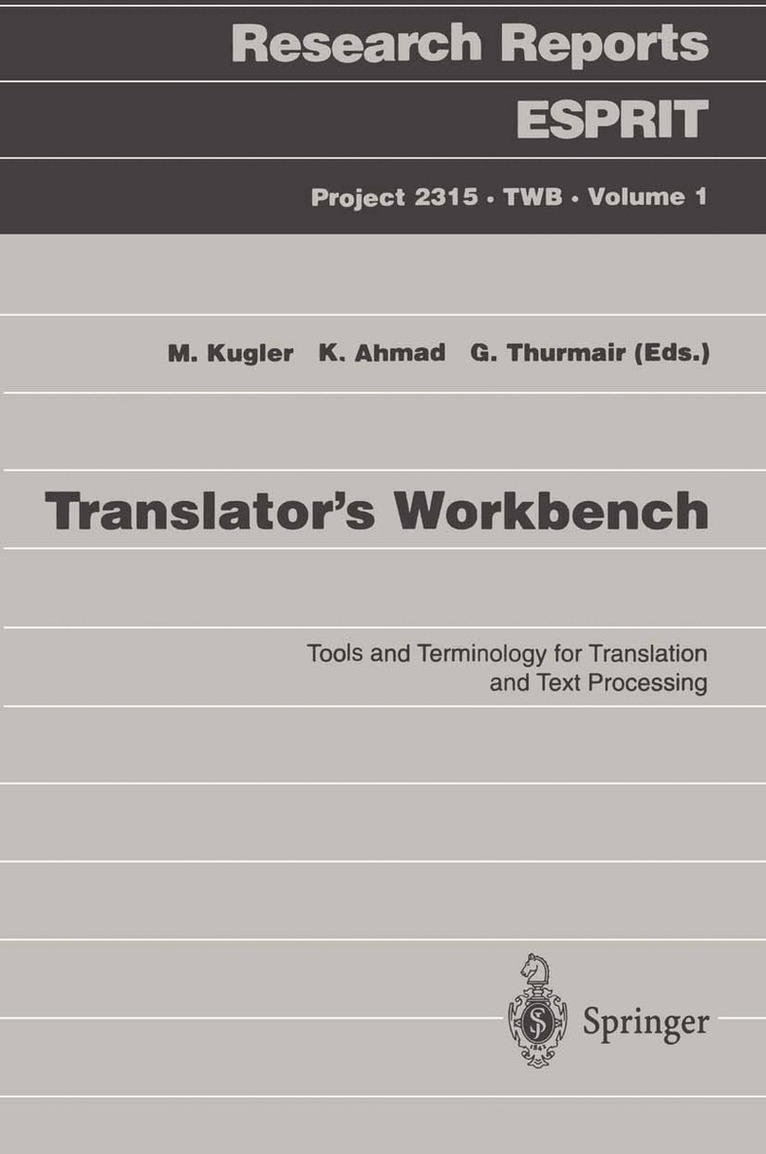
The Translator's Workbench Project was a European Community sponsored research and development project which dealt with issues in multi-lingual communication and docu mentation. This book presents an integrated toolset as a solution to problems in translation and docu mentation. Professional translators and teachers of translation were involved in the proc ess of software development, starting with a detailed study of the user requirements and ending with several evaluation-and-improvement cycles of the resulting toolset. English, German, Greek, and Spanish are addressed in the contributions, however, some of the techniques are inherently language-independent and can thus be extended to cover other languages as well. Translation can be viewed broadly as the execution of three cognitive processes, and this book has been structured along these lines: • First, the translation pre-process, understanding the target language text at a lexico semantic level on the one hand, and making sense of the source language document on the other hand. The tools for the pre-translation process include access to electronic networks, conversion of documents from one format to another, creation of terminol ogy data banks and access to existing data banks, and terminology dictionaries. • Second, the translation process, rendering sentences in the source language into equiva lent target sentences. The translation process refers to the potential of conventional machine translation systems, like METAL, and of the statistically oriented translation memory.
E-bok
PDF, Engelska, 2013708 kr
Läs direkt efter köp
The Translator''s Workbench Project was a European Community sponsored research and development project which dealt with issues in multi-lingual communication and docu mentation. This book presents an integrated toolset as a solution to problems in translation and docu mentation. Professional translators and teachers of translation were involved in the proc ess of software development, starting with a detailed study of the user requirements and ending with several evaluation-and-improvement cycles of the resulting toolset. English, German, Greek, and Spanish are addressed in the contributions, however, some of the techniques are inherently language-independent and can thus be extended to cover other languages as well. Translation can be viewed broadly as the execution of three cognitive processes, and this book has been structured along these lines: • First, the translation pre-process, understanding the target language text at a lexico semantic level on the one hand, and making sense of the source language document on the other hand. The tools for the pre-translation process include access to electronic networks, conversion of documents from one format to another, creation of terminol ogy data banks and access to existing data banks, and terminology dictionaries. • Second, the translation process, rendering sentences in the source language into equiva lent target sentences. The translation process refers to the potential of conventional machine translation systems, like METAL, and of the statistically oriented translation memory.
Inbunden, Engelska, 2023
588 kr
Skickas inom 3-6 vardagar