Guillermo Algaze – författare
Visar alla böcker från författaren Guillermo Algaze. Handla med fri frakt och snabb leverans.
5 produkter
5 produkter
Häftad, Engelska, 2014
332 kr
Skickas inom 5-8 vardagar
The alluvial lowlands of the Tigris and Euphrates rivers in southern Mesopotamia are widely known as the "cradle of civilization," owing to the scale of the processes of urbanization that took place in the area by the second half of the fourth millennium BCE. In Ancient Mesopotamia at the Dawn of Civilization, Guillermo Algaze draws on the work of modern economic geographers to explore how the unique river-based ecology and geography of the Tigris-Euphrates alluvium affected the development of urban civilization in southern Mesopotamia. He argues that these natural conditions granted southern polities significant competitive advantages over their landlocked rivals elsewhere in Southwest Asia, most importantly the ability to easily transport commodities. In due course, this resulted in increased trade and economic activity and higher population densities in the south than were possible elsewhere.As southern polities grew in scale and complexity throughout the fourth millennium, revolutionary new forms of labor organization and record keeping were created, and it is these socially created innovations, Algaze argues, that ultimately account for why fully developed city-states emerged earlier in southern Mesopotamia than elsewhere in Southwest Asia or the world.
Inbunden, Engelska, 2008
401 kr
Skickas inom 5-8 vardagar
The alluvial lowlands of the Tigris and Euphrates rivers in southern Mesopotamia are widely known as the 'cradle of civilization' owing to the scale of the processes of urbanization that had taken place in the area by the second half of the fourth millennium BC.In "Ancient Mesopotamia at the Dawn of Civilization", Guillermo Algaze draws on the work of modern economic geographers to explore how the unique river-based ecology and geography of the Tigris-Euphrates alluvium impacted the development of urban civilization in southern Mesopotamia. He argues that these natural conditions granted southern polities significant competitive advantages over their landlocked rivals elsewhere in Southwest Asia, most importantly the ability to easily transport commodities.In due course, this resulted in increased trade and economic activity and higher population densities in the south than were possible elsewhere.As southern polities grew in scale and complexity throughout the fourth millennium, revolutionary new forms of labor organization and record keeping were created, and it is these socially created innovations, Algaze argues, that ultimately account for why fully developed city-states emerged earlier in southern Mesopotamia than elsewhere in Southwest Asia or the world.
E-bok
PDF, Engelska, 2009695 kr
Läs direkt efter köp
The alluvial lowlands of the Tigris and Euphrates rivers in southern Mesopotamia are widely known as the “cradle of civilization,” owing to the scale of the processes of urbanization that took place in the area by the second half of the fourth millennium BCE. In Ancient Mesopotamia at the Dawn of Civilization, Guillermo Algaze draws on the work of modern economic geographers to explore how the unique river-based ecology and geography of the Tigris-Euphrates alluvium affected the development of urban civilization in southern Mesopotamia. He argues that these natural conditions granted southern polities significant competitive advantages over their landlocked rivals elsewhere in Southwest Asia, most importantly the ability to easily transport commodities. In due course, this resulted in increased trade and economic activity and higher population densities in the south than were possible elsewhere. As southern polities grew in scale and complexity throughout the fourth millennium, revolutionary new forms of labor organization and record keeping were created, and it is these socially created innovations, Algaze argues, that ultimately account for why fully developed city-states emerged earlier in southern Mesopotamia than elsewhere in Southwest Asia or the world.
Häftad, Engelska, 1993
426 kr
Skickas inom 5-8 vardagar
Most archaeologists and historians of the ancient Near East have focused on the internal transformations that led to the emergence of early cities and states. In The Uruk World System, Guillermo Algaze concentrates on the unprecedented and wide-ranging process of external expansion that coincided with the rapid initial crystallization of Mesopotamian civilization. In this extensive study, he contends that the rise of early Sumerian polities cannot be understood without also taking into account the developments in surrounding peripheral areas. This new edition includes a substantial new chapter that explores recent data and interpretations of the expansion of Uruk settlements across Syro-Mesopotamia.
Del 110 - Oriental Institute Publications
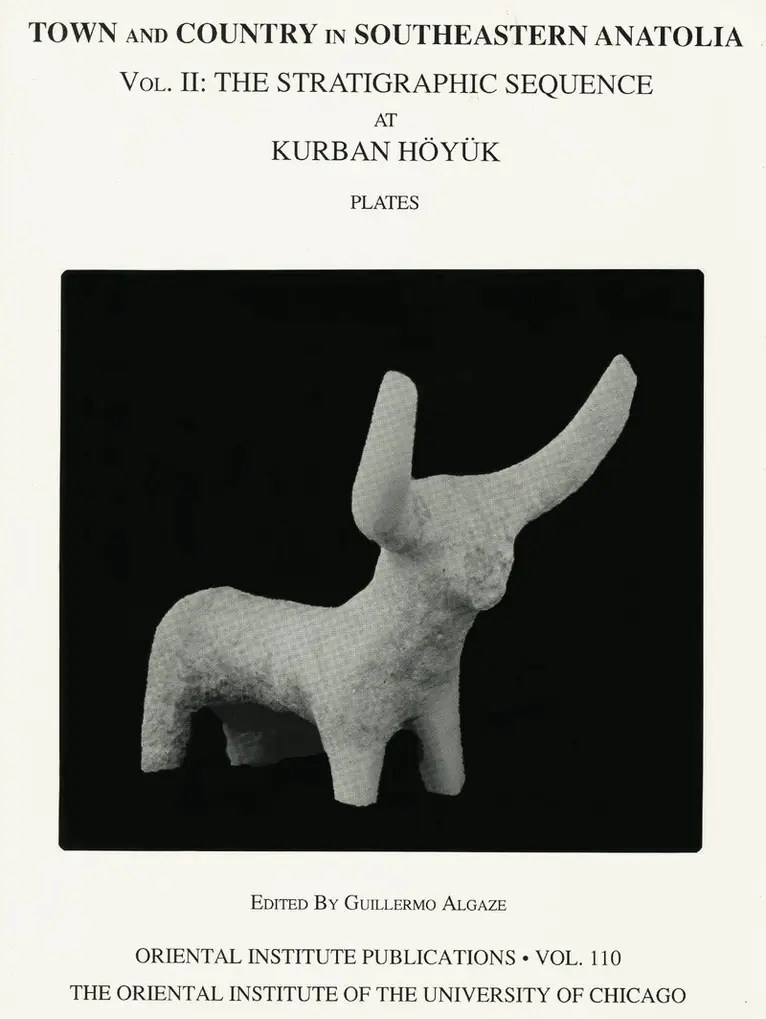
Town and Country in Southeastern Anatolia, Volume II
The Stratigraphic Sequence at Kurban Hoyuk
Inbunden, Engelska, 1990
2 009 kr
Tillfälligt slut
Until recently, the lower Euphrates basin in southeastern Turkey had remained closed to research. The region was virtually unexplored, an archaeological terra incognita. This situation was particularly regrettable since downstream in northern Syria recent archaeological work along the Euphrates basin had demonstrated beyond doubt the historical importance of the area. A dramatic change occurred in the second half of the 1970s as a result of the announcement of plans by the Turkish government to build two additional dams on the Euphrates river as part of its long-term development program for southeastern Anatolia, the Güneydo©u Anadolu Projesi. This allowed comprehensive surveys to be made of the areas and sites to be destroyed by the reservoirs of the dams in question, the Karakaya and Karababa (now Atatürk) dams, and ultimately for the start of an international archaeological salvage effort within the reservoir areas. As part of this effort a number of Turkish and foreign expeditions were fielded, and as a result of their work a much clearer picture than was heretofore possible of the archaeological history of an important region of the northern periphery of the Fertile Crescent has begun to emerge.It is in this context that the Chicago Euphrates Archaeological Project of the Oriental Institute of the University of Chicago should be understood. It conducted excavations at one of the threatened sites, Kurban Höyük, and carried out surveys of its immediate environs. The site is located in the lower portion of the Karababa reservoir area and is one of several sites that hold the key for understanding the archaeological sequence of the lower portion of the Euphrates basin in southeastern Turkey.