Gunnar Sjostedt – författare
732 kr
Läs direkt efter köp
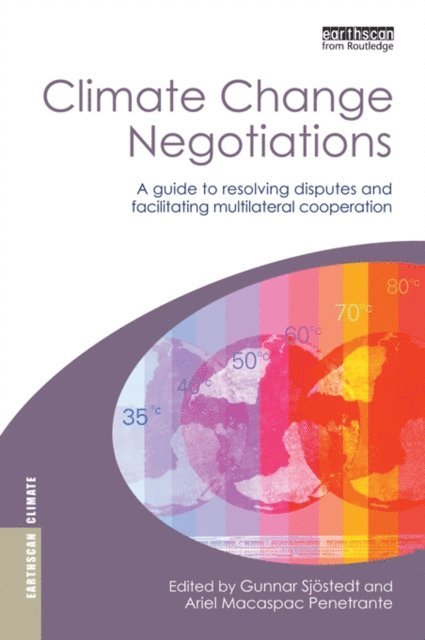
As the Kyoto Protocol limps along without the participation of the US and Australia, on-going climate negotiations are plagued by competing national and business interests that are creating stumbling blocks to success. Climate Change Negotiations: A Guide to Resolving Disputes and Facilitating Multilateral Cooperation asks how these persistent obstacles can be down-scaled, approaching them from five professional perspectives: a top policy-maker, a senior negotiator, a leading scientist, an international lawyer, and a sociologist who is observing the process.
The authors identify the major problems, including great power strategies (the EU, the US and Russia), leadership, the role of NGOs, capacity and knowledge-building, airline industry emissions, insurance and risk transfer instruments, problems of cost benefit analysis, the IPCC in the post-Kyoto situation, and verification and institutional design. A new key concept is introduced: strategic facilitation. ''Strategic facilitation'' has a long time frame, a forward-looking orientation and aims to support the overall negotiation process rather than individual actors.
This book is aimed at academics, university students and practitioners who are directly or indirectly engaged in the international climate negotiation as policy makers, diplomats or experts.
732 kr
Läs direkt efter köp
As the Kyoto Protocol limps along without the participation of the US and Australia, on-going climate negotiations are plagued by competing national and business interests that are creating stumbling blocks to success. Climate Change Negotiations: A Guide to Resolving Disputes and Facilitating Multilateral Cooperation asks how these persistent obstacles can be down-scaled, approaching them from five professional perspectives: a top policy-maker, a senior negotiator, a leading scientist, an international lawyer, and a sociologist who is observing the process.
The authors identify the major problems, including great power strategies (the EU, the US and Russia), leadership, the role of NGOs, capacity and knowledge-building, airline industry emissions, insurance and risk transfer instruments, problems of cost benefit analysis, the IPCC in the post-Kyoto situation, and verification and institutional design. A new key concept is introduced: strategic facilitation. ''Strategic facilitation'' has a long time frame, a forward-looking orientation and aims to support the overall negotiation process rather than individual actors.
This book is aimed at academics, university students and practitioners who are directly or indirectly engaged in the international climate negotiation as policy makers, diplomats or experts.
523 kr
Läs direkt efter köp
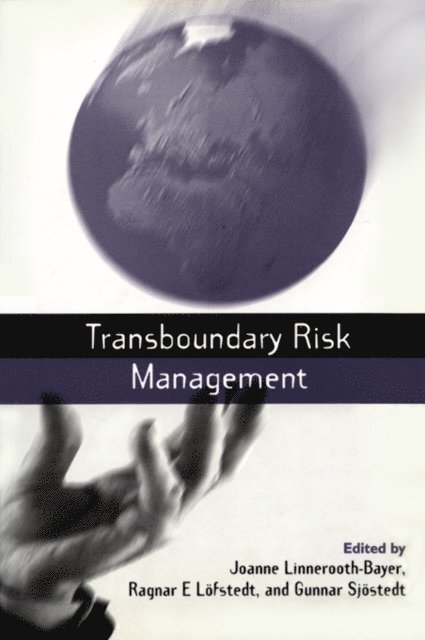
Environmental hazards do not respect international boundaries. In this volume, distinguished international researchers make a significant contribution to the understanding and management of transboundary environmental risks. The transboundary risk topics addressed highlight the key political, economic, social and cultural issues of our times, such as how transboundary risks are constructed, how they are communicated within and between countries, how the authorities can build trust in political management processes, and what forms of democratic risk management institutions are appropriate. Useful practical lessons on the management of transboundary risk at the national and international levels are drawn from the case studies. The volume provides valuable evidence and analysis for those working on international environmental issues and all aspects of risk management.
523 kr
Läs direkt efter köp
Environmental hazards do not respect international boundaries. In this volume, distinguished international researchers make a significant contribution to the understanding and management of transboundary environmental risks. The transboundary risk topics addressed highlight the key political, economic, social and cultural issues of our times, such as how transboundary risks are constructed, how they are communicated within and between countries, how the authorities can build trust in political management processes, and what forms of democratic risk management institutions are appropriate. Useful practical lessons on the management of transboundary risk at the national and international levels are drawn from the case studies. The volume provides valuable evidence and analysis for those working on international environmental issues and all aspects of risk management.
1 950 kr
Skickas inom 10-15 vardagar
941 kr
Läs direkt efter köp
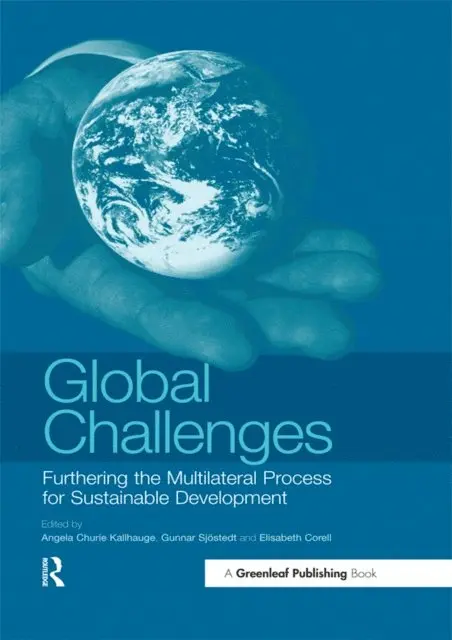
The World Summit on Sustainable Development (WSSD) in Johannesburg 2002 was the latest conference in an international process to manage environment and development issues that can be traced back to the late 1960s. Three milestones mark this 30-year process of social and political interaction: the United Nations Conference on the Human Environment (UNCHE), held in Stockholm in 1972, the first international meeting at a high political level convened to address environmental issues; the 1992 United Nations Conference on Environment and Development (UNCED), held in Rio de Janeiro; and the WSSD, which attempted to set policy goals and targets for the global environmental and developmental challenges previously identified.But what did the WSSD achieve? Following the summit there have been various opinions of its significance and its outputs, many of them negative. This book argues that there is a need to place the WSSD in its broader context. Understanding the connections between the WSSD and its precedents as well as those between this overall process and individual environmental decision-making processes (such as on climate change), and how they all contribute to the overall global policy process, adds a critical dimension to the analysis of the WSSD outcomes.
This book examines the challenges facing the global policy process for sustainable development as it continues beyond Johannesburg into the future. It combines a forward outlook with a historical perspective in tracing the evolution of selected cross-cutting themes on the agenda of the three conferences, the institutions and formal results of the process, and the actors and their patterns of interaction over time. The focus is on the decision-making dimension – the multilateral negotiations-which can be seen as the development over time of a pattern of interlinked political activities.Global Challenges has four operational objectives: first, to define the ongoing process that formally began with the Stockholm Conference in 1972 and evolved towards its latest major manifestation at the WSSD; second, to present some dynamics of the Stockholm–Rio–Johannesburg (SRJ) process by exploring the themes identified; third, to introduce an approach on how to consider the outcomes of this process as a way of reflecting on what the process has actually accomplished; and, finally, to discuss lessons learned for theory and practice from this exercise. The practical lessons include reflections on how the continued SRJ process should best be organised and supported into the future.
The book takes a uniquely broad outlook and interdisciplinary approach in addressing important lessons relating to the emergence of substantive issues as well as to process and institutional dynamics. It is a bridge-building exercise from academic analysis to long-term strategic thinking in environmental regime building.
Global Challenges provides a new perspective on the continuing and increasingly complex global environment and development policy process and analyses the interlinkages between the process, trends and cross-cutting issues that set the conditions for the global efforts to achieve sustainable development. It will be essential reading for academics and practitioners interested in seeing the big picture of the global challenges facing people and planet in the 21st century.
941 kr
Läs direkt efter köp
The World Summit on Sustainable Development (WSSD) in Johannesburg 2002 was the latest conference in an international process to manage environment and development issues that can be traced back to the late 1960s. Three milestones mark this 30-year process of social and political interaction: the United Nations Conference on the Human Environment (UNCHE), held in Stockholm in 1972, the first international meeting at a high political level convened to address environmental issues; the 1992 United Nations Conference on Environment and Development (UNCED), held in Rio de Janeiro; and the WSSD, which attempted to set policy goals and targets for the global environmental and developmental challenges previously identified.But what did the WSSD achieve? Following the summit there have been various opinions of its significance and its outputs, many of them negative. This book argues that there is a need to place the WSSD in its broader context. Understanding the connections between the WSSD and its precedents as well as those between this overall process and individual environmental decision-making processes (such as on climate change), and how they all contribute to the overall global policy process, adds a critical dimension to the analysis of the WSSD outcomes.
This book examines the challenges facing the global policy process for sustainable development as it continues beyond Johannesburg into the future. It combines a forward outlook with a historical perspective in tracing the evolution of selected cross-cutting themes on the agenda of the three conferences, the institutions and formal results of the process, and the actors and their patterns of interaction over time. The focus is on the decision-making dimension – the multilateral negotiations-which can be seen as the development over time of a pattern of interlinked political activities.Global Challenges has four operational objectives: first, to define the ongoing process that formally began with the Stockholm Conference in 1972 and evolved towards its latest major manifestation at the WSSD; second, to present some dynamics of the Stockholm–Rio–Johannesburg (SRJ) process by exploring the themes identified; third, to introduce an approach on how to consider the outcomes of this process as a way of reflecting on what the process has actually accomplished; and, finally, to discuss lessons learned for theory and practice from this exercise. The practical lessons include reflections on how the continued SRJ process should best be organised and supported into the future.
The book takes a uniquely broad outlook and interdisciplinary approach in addressing important lessons relating to the emergence of substantive issues as well as to process and institutional dynamics. It is a bridge-building exercise from academic analysis to long-term strategic thinking in environmental regime building.
Global Challenges provides a new perspective on the continuing and increasingly complex global environment and development policy process and analyses the interlinkages between the process, trends and cross-cutting issues that set the conditions for the global efforts to achieve sustainable development. It will be essential reading for academics and practitioners interested in seeing the big picture of the global challenges facing people and planet in the 21st century.
1 367 kr
Läs direkt efter köp
490 kr
Skickas inom 5-8 vardagar
1 367 kr
Läs direkt efter köp