Guy Olivier Faure - Böcker
Visar alla böcker från författaren Guy Olivier Faure. Handla med fri frakt och snabb leverans.
10 produkter
10 produkter
2 171 kr
Skickas inom 10-15 vardagar
This edited volume addresses the important issue of negotiating with terrorists, and offers recommendations for best practice and processes. Hostage negotiation is the process of trying to align two often completely polarised parties. Authorities view hostage taking as unacceptable demands made by unacceptable means. However terrorists view their actions as completely justified, even on moral and religious grounds. If they are to try and reconcile these two sides, it is essential for hostage negotiators to understand terrorist culture, the hostage takers’ profiles, their personality, their view of the world and also the authorities, their values and their framing of the problem raised by the taking of hostages.Although not advocating negotiating with terrorists, the volume seeks to analyse when, why, and how it is done. Part I deals with the theory and quantifiable data produced from analysis of hostage situations, while Part II explores several high profile case studies and the lessons that can be learnt from them.This volume will be of great interest to students of terrorism studies, conflict management, negotiation, security studies and IR in general. I William Zartman is the Jacob Blaustein Distinguished Professor Emeritus of International Organization and Conflict Resolution and former Director of the Conflict Management and African Studies Programs, at the Paul H. Nitze School of Advanced International Studies, Johns Hopkins University, Washington, DC. He is a member of the Steering Committee of the Processes of International Negotiation (PIN) Program at the International Institute of Applied Systems Analysis (IIASA) in Laxenburg, Austria. He is author/editor of over 20 books on negotiation, conflict and mediation. Guy Olivier Faure is Professor of Sociology at the Sorbonne University, Paris I, and a member of the Steering Committee of the Processes of International Negotiation (PIN) Program at the International Institute of Applied Systems Analysis (IIASA) in Laxenburg, Austria. He has served as an advisor to French government on hostage negotiations.
670 kr
Skickas inom 10-15 vardagar
This edited volume addresses the important issue of negotiating with terrorists, and offers recommendations for best practice and processes. Hostage negotiation is the process of trying to align two often completely polarised parties. Authorities view hostage taking as unacceptable demands made by unacceptable means. However terrorists view their actions as completely justified, even on moral and religious grounds. If they are to try and reconcile these two sides, it is essential for hostage negotiators to understand terrorist culture, the hostage takers’ profiles, their personality, their view of the world and also the authorities, their values and their framing of the problem raised by the taking of hostages.Although not advocating negotiating with terrorists, the volume seeks to analyse when, why, and how it is done. Part I deals with the theory and quantifiable data produced from analysis of hostage situations, while Part II explores several high profile case studies and the lessons that can be learnt from them.This volume will be of great interest to students of terrorism studies, conflict management, negotiation, security studies and IR in general. I William Zartman is the Jacob Blaustein Distinguished Professor Emeritus of International Organization and Conflict Resolution and former Director of the Conflict Management and African Studies Programs, at the Paul H. Nitze School of Advanced International Studies, Johns Hopkins University, Washington, DC. He is a member of the Steering Committee of the Processes of International Negotiation (PIN) Program at the International Institute of Applied Systems Analysis (IIASA) in Laxenburg, Austria. He is author/editor of over 20 books on negotiation, conflict and mediation. Guy Olivier Faure is Professor of Sociology at the Sorbonne University, Paris I, and a member of the Steering Committee of the Processes of International Negotiation (PIN) Program at the International Institute of Applied Systems Analysis (IIASA) in Laxenburg, Austria. He has served as an advisor to French government on hostage negotiations.
428 kr
Skickas inom 7-10 vardagar
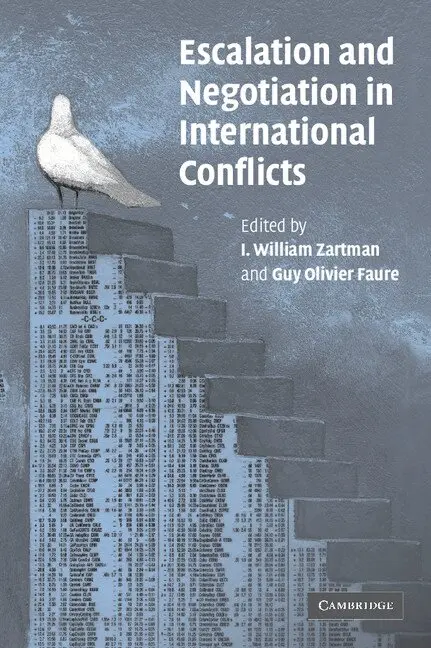
How can an escalation of conflict lead to negotiation? In this systematic study, Zartman and Faure bring together European and American scholars to examine this important topic and to define the point where the concepts and practices of escalation and negotiation meet. Political scientists, sociologists, social psychologists, and war-making and peace-making strategists, among others, examine the various forms escalation can take and relate them to conceptual advances in the analysis of negotiation. They argue that structures, crises, turning points, demands, readiness and ripeness can often define the conditions where the two concepts can meet and the authors take this opportunity to offer lessons for theory and practice. By relating negotiation to conflict escalation, two processes that have traditionally been studied separately, this book fills a significant gap in the existing knowledge and is directly relevant to the many ongoing conflicts and conflict patterns in the world today.
1 245 kr
Skickas inom 7-10 vardagar
How can an escalation of conflict lead to negotiation? In this systematic study, Zartman and Faure bring together European and American scholars to examine this important topic and to define the point where the concepts and practices of escalation and negotiation meet. Political scientists, sociologists, social psychologists, and war-making and peace-making strategists, among others, examine the various forms escalation can take and relate them to conceptual advances in the analysis of negotiation. They argue that structures, crises, turning points, demands, readiness and ripeness can often define the conditions where the two concepts can meet and the authors take this opportunity to offer lessons for theory and practice. By relating negotiation to conflict escalation, two processes that have traditionally been studied separately, this book fills a significant gap in the existing knowledge and is directly relevant to the many ongoing conflicts and conflict patterns in the world today.
2 661 kr
Skickas inom 3-6 vardagar
Sponsored jointly by the United Nations Educational, Scientific, and Cultural Organization and the International Institute for Applied Systems Analysis "It's much too late but this is the book we should have had in Paris during the five years effort to get a political settlement of the Vietnam War. . . . Thought provoking." --Indochina Chronology "An important contribution to a better understanding of international relations . . . with reflective discussions as well as thorough case studies." --Indian Express Culture--along with many other variables--often impacts international negotiations. Culture and Negotiation offers a unique contribution by focusing on the distinctive impact of culture, both in creating unexpected opportunities for dispute settlement and in imposing obstacles to agreement. Separated into three sections, part I presents expert views on the nature and limits of culture's influence on negotiation. Part II comprises the core of the book, and contains a wealth of case studies and analyses of international disputes regarding water resources. Each case asks the following key questions: What are the different cultural components that made a difference in the outcome? How did culture play a role in the negotiation process? What are some specific illustrations of culture's contributing role, both to the dispute and to the ways in which it was handled? Part III includes implications for practitioners and policymakers, along with new directions for future studies. Culture and Negotiation is an essential resource for international relations practitioners in both the private and public sectors, as well as scholars and researchers interested in either culture or the theory and practice of negotiation and dispute resolution.
1 215 kr
Skickas inom 5-8 vardagar
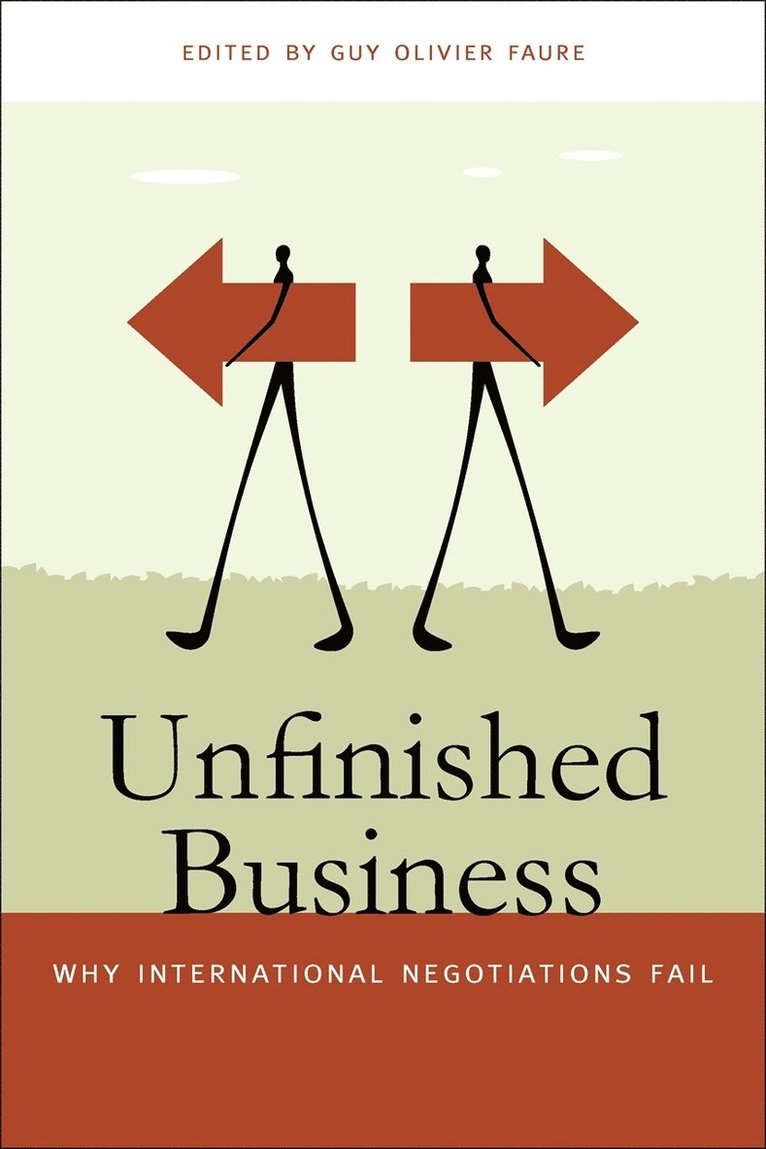
Most studies of international negotiations take successful talks as their subject. With a few notable exceptions, analysts have paid little attention to negotiations ending in failure. The essays in Unfinished Business show that as much, if not more, can be learned from failed negotiations as from successful negotiations with mediocre outcomes. Failure in this study pertains to a set of negotiating sessions that were convened for the purpose of achieving an agreement but instead broke up in continued disagreement.Seven case studies compose the first part of this volume: the United Nations negotiations on Iraq, the Middle East Peace Summit at Camp David in 2000, Iran-European Union negotiations, the Cyprus conflict, the Biological Weapons Convention, the London Conference of 1830–33 on the status of Belgium, and two hostage negotiations (Waco and the Munich Olympics). These case studies provide examples of different types of failed negotiations: bilateral, multilateral, and mediated (or trilateral). The second part of the book analyzes empirical findings from the case studies as causes of failure falling in four categories: actors, structure, strategy, and process. This is an analytical framework recommended by the Processes of International Negotiation, arguably the leading society dedicated to research in this area. The last section of Unfinished Business contains two summarizing chapters that provide broader conclusions—lessons for theory and lessons for practice.
487 kr
Skickas inom 5-8 vardagar
Most studies of international negotiations take successful talks as their subject. With a few notable exceptions, analysts have paid little attention to negotiations ending in failure. The essays in Unfinished Business show that as much, if not more, can be learned from failed negotiations as from successful negotiations with mediocre outcomes. Failure in this study pertains to a set of negotiating sessions that were convened for the purpose of achieving an agreement but instead broke up in continued disagreement.Seven case studies compose the first part of this volume: the United Nations negotiations on Iraq, the Middle East Peace Summit at Camp David in 2000, Iran-European Union negotiations, the Cyprus conflict, the Biological Weapons Convention, the London Conference of 1830–33 on the status of Belgium, and two hostage negotiations (Waco and the Munich Olympics). These case studies provide examples of different types of failed negotiations: bilateral, multilateral, and mediated (or trilateral). The second part of the book analyzes empirical findings from the case studies as causes of failure falling in four categories: actors, structure, strategy, and process. This is an analytical framework recommended by the Processes of International Negotiation, arguably the leading society dedicated to research in this area. The last section of Unfinished Business contains two summarizing chapters that provide broader conclusions—lessons for theory and lessons for practice.
China's Negotiating Mindset and Strategies
Historical and Cultural Foundations
Inbunden, Engelska, 2025
2 166 kr
Skickas inom 10-15 vardagar
This book analyzes the mindset with which China enters into negotiations, and applies these insights into contemporary arenas of Chinese activity around the world.The volume presents and analyses the historical and cultural foundations of Chinese thinking as used in the practice of present-day negotiation. It begins by addressing the essence of Chinese negotiations and the Chinese mindset, turning to a section that presents the cultural foundations of that mindset and strategy. The concepts of Confucianism, Taoism, Yin-Yang, and Chinese military strategy are highlighted. The cases of the Belt-and-Road Initiative and the South and East China Seas are examined to show the application of these concepts, with one addressing business and economic negotiations and the other examining cases of negotiation in geopolitics. Finally, a synthesis of what has been learned is presented, which will contribute to negotiation theory and ultimately will help Western practitioners contemplating negotiation with Chinese diplomats and businesses, as well as being a basis for policy analysts’ understanding of Chinese practices in international relations.This book will be of much interest to students of international negotiation, foreign policy, business studies, and international relations, as well as practitioners and policymakers.
1 034 kr
Skickas inom 10-15 vardagar
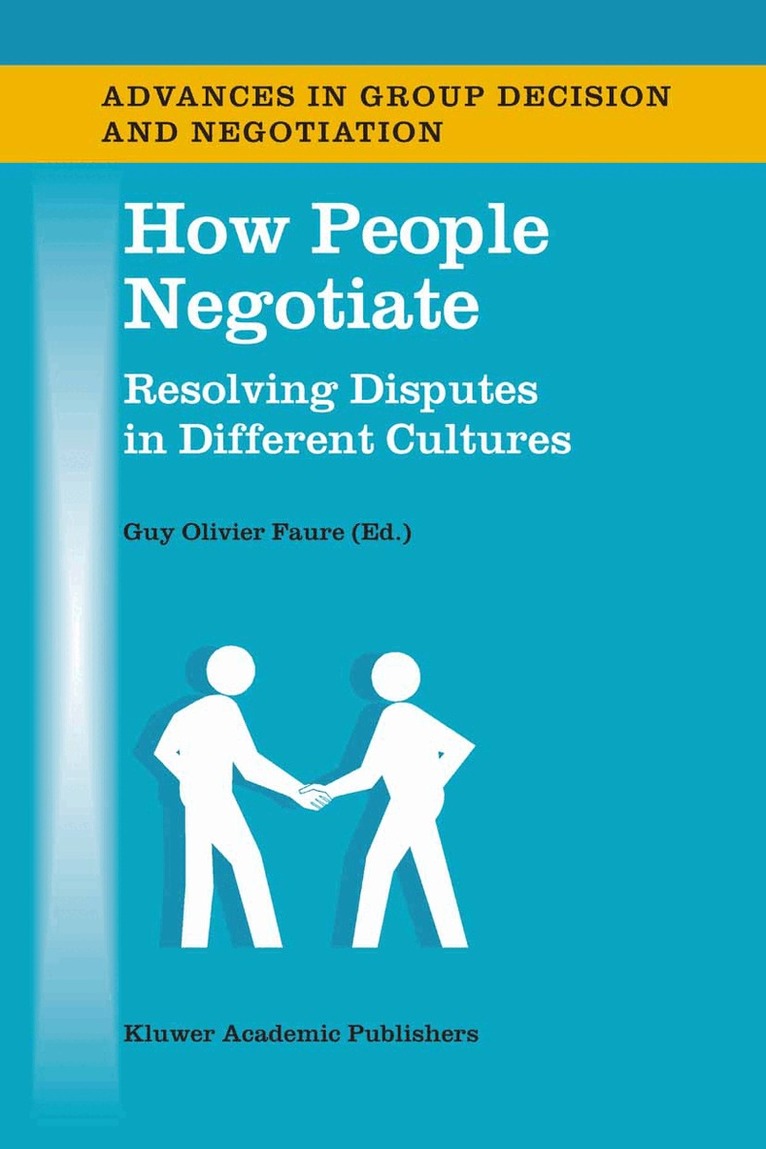
How People Negotiate brings together a set of negotiation stories, accompanied by an integrative overview. This volume provides cases and theoretical elaboration and includes a comprehensive overview of research on negotiation. Some negotiation stories are exotic and strange: they come from a large number of countries, ranging from China, to African Countries, to the Ancient Middle East. Others are drawn from Western settings such as France, Germany, and USA. The negotiations described take various forms: negotiating with oneself, negotiating one's own way through bicycle traffic or animals appearing to negotiate with each other. The stories begin with Abraham negotiating with the Lord about the fate of Sodom, the first-ever recorded account of negotiations. The negotiations in this volume present something new and unusual. They are catchy, intriguing, exciting, intellectually challenging and original. They give us a new perspective on negotiating, tell us something about the world we live in, and - by means of a worthwhile detour - they teach us about ourselves.
Del 1 - Advances in Group Decision and Negotiation
How People Negotiate
Resolving Disputes in Different Cultures
Häftad, Engelska, 2003
1 034 kr
Skickas inom 10-15 vardagar
How People Negotiate brings together a set of negotiation stories, accompanied by an integrative overview. This volume provides cases and theoretical elaboration and includes a comprehensive overview of research on negotiation. Some negotiation stories are exotic and strange: they come from a large number of countries, ranging from China, to African Countries, to the Ancient Middle East. Others are drawn from Western settings such as France, Germany, and USA. The negotiations described take various forms: negotiating with oneself, negotiating one's own way through bicycle traffic or animals appearing to negotiate with each other. The stories begin with Abraham negotiating with the Lord about the fate of Sodom, the first-ever recorded account of negotiations. The negotiations in this volume present something new and unusual. They are catchy, intriguing, exciting, intellectually challenging and original. They give us a new perspective on negotiating, tell us something about the world we live in, and - by means of a worthwhile detour - they teach us about ourselves.