Haiman John Haiman – författare
Visar alla böcker från författaren Haiman John Haiman. Handla med fri frakt och snabb leverans.
5 produkter
5 produkter
E-bok
PDF, Engelska, 19971 856 kr
Läs direkt efter köp
In their subject matter and in their theoretical orientation all the papers in this volume reflect the powerful influence of T. Givón. Most of them deal with questions of morphosyntactic typology, pragmatics, and grammaticalization theory. Many of them are directly based on extensive fieldwork on local languages of the Americas, Africa, Asia, and the Pacific. Others are based on statistical analyses of extensive written and spoken corpora of texts.
E-bok
PDF, Engelska, 19881 777 kr
Läs direkt efter köp
Traditionally the study of syntax is restricted to the study of what goes on within the boundaries of the prosodic sentence. Although the nature of clause combining within a prosodic sentence has always been a central concern of traditional syntax (in GG, e.g. it underlies important research on deletion and anaphora), work within a discourse analysis framework has hardly been done. Analyses like this are given in the present volume.
E-bok
PDF, Engelska, 19831 714 kr
Läs direkt efter köp
Canonical switch-reference is an inflectional category of the verb, which indicates whether or not its subject is identical with the subject of some other verb. Switch-reference may be analyzed from a structural or a functional point of view. Functionally, switch-reference is a device for referential tracking. Formally, switch-reference is almost always a verbal category, similar to the familiar category of verbal concord. In most languages switch-reference marking is indicated by a verbal affix, however in some languages it may be marked by an independent morpheme. The contributions to this volume are concerned with questions of form, function, and genesis of canonical switch-reference systems.
E-bok
PDF, Engelska, 19801 777 kr
Läs direkt efter köp
There is no country in the world where as many different languages are spoken as in New Guinea, approximately a fifth of the languages in the world. Most of these so-called Papuan languages seem to be unrelated to languages spoken elsewhere. The present work is the first truly comprehensive study of such a language, Hua. The chief typological peculiarity of Hua is the existence of a 'medial verb'construction used to conjoin clauses in compound and complex sentences. Hua also shows a fundamental morphological distinction between coordinate and subordinate medial clauses, the latter are not 'tense-iconic', the events they describe are not necessarily prior to the event described in later clauses. Moreover their truth is always presupposed. The distribution and behaviour of a post-nominal suffix - mo provides insights into the nature of topics, conditional clauses, and functional definitions of the parts of speech. In phonology, the central rules of assimilation are constrained by the universal hierarchy of sonority, which may, however, be derived from binary features. These are some of the areas in which the grammar of Hua is unusually perspicuous. The present work aims at a standard of completeness such that it would be a useful reference work for research in almost any theoretical topic.
E-bok
PDF, Engelska, 20111 525 kr
Läs direkt efter köp
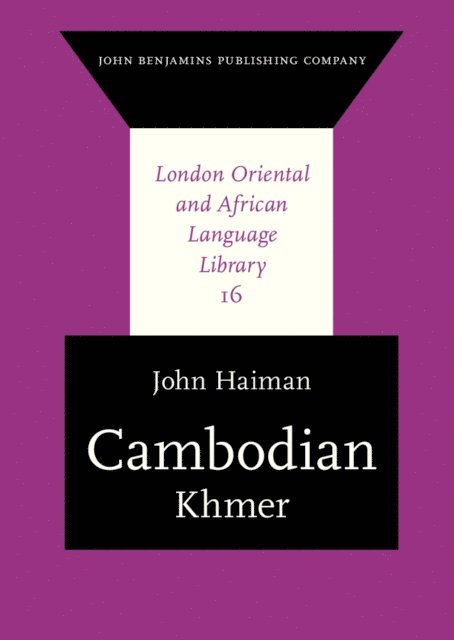
Cambodian is in many respects a typical Southeast Asian language, whose syntax at least on first acquaintance seems to approximate that of any SVO pidgin. On closer acquaintance, however, because of the richness of its idioms, the language seems to be a forbiddingly alien form of “Desesperanto” – a language of which one can read a page and understand every word individually, and have no inkling of what the page was all about. Like many of the languages of its genetic (Austroasiatic) family, its basic root vocabulary seems to consist largely of sesquisyllabic or iambic words, although there are an enormous number of unassimilated borrowings from Indic languages (which seem to play the same role in Cambodian that Latinate borrowings do in English). Morphologically, Cambodian has a fairly elaborate system of derivational affixes, and it is possible that the genesis of many of the most common of these affixes is related to (and undoes) the constant reduction of unstressed initial syllables in sesquisyllabic words. Again like many of the languages of Southeast Asia, Cambodian exhibits in its lexicon a penchant for symmetrical decorative compounding, a phenomenon which is so marginally attested in Western languages that the phenomenon has received little attention in the typological literature.