Hamed Pejhan – författare
Visar alla böcker från författaren Hamed Pejhan. Handla med fri frakt och snabb leverans.
4 produkter
4 produkter
E-bok
Engelska, 2022535 kr
Läs direkt efter köp
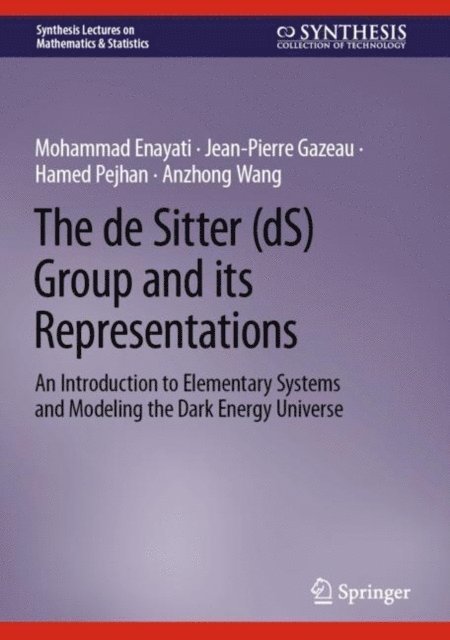
This book reviews the construction of elementary systems living in de Sitter (dS) spacetime, in both the classical and quantum senses. Field theories on dS spacetime are among the most studied mathematical models of the Universe, whether for its earlier period (inflationary phase) or for its current phase of expansion acceleration (dark energy or cosmological constant). Classical elementary systems are Hamiltonian phase spaces, which are associated with co-adjoint orbits of the relativity group. On the other hand, quantum elementary systems are associated with (projective) unitary irreducible representations of the (possibly extended) relativity group (or one of its covering). This study emphasizes the conceptual issues arising in the formulation of such systems and discusses known results in a mathematically rigorous way. Particular attention is paid to: “smooth” transition from classical to quantum theory; physical content under vanishing curvature, from the point of view of a local(“tangent”) Minkowskian observer; and thermal interpretation (on the quantum level), in the sense of the Gibbons-Hawking temperature. Such a mathematical construction is of paramount importance to the understanding of the early Universe (due to the critical role that the dS metric plays in the inflationary cosmological scenarii) as well as to the construction of possible models for late-time cosmology (since a small positive cosmological constant or dark energy seems to be required by recent data). In this sense, this book uniquely blends mathematical physics (spacetime symmetry on classical and quantum levels) and theoretical physics (quantization, quantum field theory, and cosmology). Moreover, the level of exposition varies in different parts of the book so that both experts and beginners alike can utilize the book.
Inbunden, Engelska, 2024
440 kr
Skickas inom 10-15 vardagar
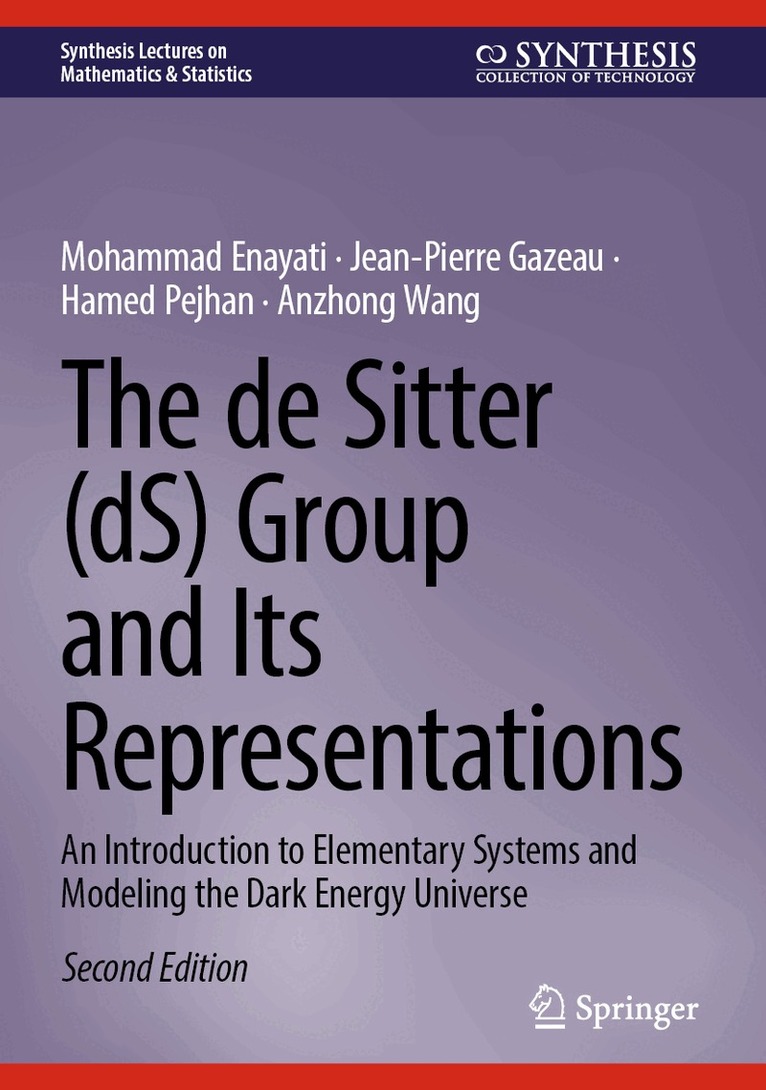
This Second Edition is a comprehensive update, integrating the latest research and theoretical advancements in the field of de Sitter (dS) group representations. Building on the success of the first edition, the book offers a more in-depth analysis of mathematical aspects, conceptual foundations, and practical implications related to the dS group, including its Lie manifold, Lie algebra, and co-adjoint orbits, viewing the latter as potential classical elementary systems within the context of dS spacetime. Additionally, the examination of unitary irreducible representations (UIRs) sheds light on the potential existence of quantum elementary systems within the dS spacetime framework. The authors emphasize consistency with Wigner's approach to elementary systems, incorporate Wigner's principles and exploring projective UIRs of the dS group, and provide a deeper insight into the nature of dS elementary systems. Particular attention is paid to: the “smooth” transition from classical to quantum theory, the physical content under vanishing curvature, and the thermal interpretation from a quantum perspective. The book also focuses on the physical interpretation of elementary systems in curved spacetimes, recognizing the limitations of traditional concepts derived from flat Minkowski spacetime and the Poincaré group.
E-bok
Engelska, 2024535 kr
Läs direkt efter köp
This Second Edition is a comprehensive update, integrating the latest research and theoretical advancements in the field of de Sitter (dS) group representations. Building on the success of the first edition, the book offers a more in-depth analysis of mathematical aspects, conceptual foundations, and practical implications related to the dS group, including its Lie manifold, Lie algebra, and co-adjoint orbits, viewing the latter as potential classical elementary systems within the context of dS spacetime. Additionally, the examination of unitary irreducible representations (UIRs) sheds light on the potential existence of quantum elementary systems within the dS spacetime framework. The authors emphasize consistency with Wigner''s approach to elementary systems, incorporate Wigner''s principles and exploring projective UIRs of the dS group, and provide a deeper insight into the nature of dS elementary systems. Particular attention is paid to: the “smooth” transition from classical to quantum theory, the physical content under vanishing curvature, and the thermal interpretation from a quantum perspective. The book also focuses on the physical interpretation of elementary systems in curved spacetimes, recognizing the limitations of traditional concepts derived from flat Minkowski spacetime and the Poincaré group.
Häftad, Engelska, 2025
440 kr
Skickas inom 10-15 vardagar
This Second Edition is a comprehensive update, integrating the latest research and theoretical advancements in the field of de Sitter (dS) group representations. Building on the success of the first edition, the book offers a more in-depth analysis of mathematical aspects, conceptual foundations, and practical implications related to the dS group, including its Lie manifold, Lie algebra, and co-adjoint orbits, viewing the latter as potential classical elementary systems within the context of dS spacetime. Additionally, the examination of unitary irreducible representations (UIRs) sheds light on the potential existence of quantum elementary systems within the dS spacetime framework. The authors emphasize consistency with Wigner's approach to elementary systems, incorporate Wigner's principles and exploring projective UIRs of the dS group, and provide a deeper insight into the nature of dS elementary systems. Particular attention is paid to: the “smooth” transition from classical to quantum theory, the physical content under vanishing curvature, and the thermal interpretation from a quantum perspective. The book also focuses on the physical interpretation of elementary systems in curved spacetimes, recognizing the limitations of traditional concepts derived from flat Minkowski spacetime and the Poincaré group.