Hans-Georg Elias - Böcker
Visar alla böcker från författaren Hans-Georg Elias. Handla med fri frakt och snabb leverans.
10 produkter
10 produkter
2 101 kr
Skickas inom 10-15 vardagar
The second edition of this textbook is identical with its fourth German edi tion and it thus has the same goals: precise definition of basic phenomena, a broad survey of the whole field, integrated representation of chemistry, physics, and technology, and a balanced treatment of facts and comprehen sion. The book thus intends to bridge the gap between the often oversimpli fied introductory textbooks and the highly specialized texts and monographs that cover only parts of macromolecular science. The text intends to survey the whole field of macromolecular science. Its organization results from the following considerations. The chemical structure of macromolecular compounds should be inde pendent of the method of synthesis, at least in the ideal case. Part I is thus concerned with the chemical and physical structure of polymers. Properties depend on structure. Solution properties are thus discussed in Part II, solid state properties in Part III. There are other reasons for dis cussing properties before synthesis: For example, it is difficult to understand equilibrium polymerization without knowledge of solution thermodynamics, the gel effect without knowledge of the glass transition temperature, etc. Part IV treats the principles of macromolecular syntheses and reactions.
1 860 kr
Skickas inom 10-15 vardagar
Like so many of its kind, this textbook originated from the requirements of teaching. While lecturing on macromolecular science as a required subject for chemists and materials scientists on the undergraduate, graduate, and postgraduate levels at Swiss Federal Institute of Technology at Zurich (1960-1971), I needed a one-volume textbook which treated the whole field of macromolecular science, from its chemistry and physics to its applications, in a not too elementary manner. This textbook thus intends to bridge the gap between the often oversimplified introductory books and the highly specialized texts and monographs that cover only parts of macromolecular science. This first English edition is based on the third German edition (1975), which is about 40% different from the first German edition (1971), a result of rapid progress in macromolecular science and the less rapid education of the writer. This text intends to survey the whole field of macromolecular science. Its organization results from the following considerations. The chemical structure of macromolecular compounds should be independent of the method of synthesis, at least in the ideal case. Part I is thus concerned with the chemical and physical structure of macro molecules. Properties depend on structure. Solution properties are thus discussed in Part II, solid state properties in Part III. There are other reasons for discussing properties before syntheses: For example, it is difficult to under stand equilibrium polymerization without knowledge of solution thermody of the glass temperature, etc.
1 226 kr
Skickas inom 11-20 vardagar
Polymer science at its best! A completely new approach reflecting the interdisciplinary nature of polymer science! Modern polymer science is firmly rooted not only in the chemistry of macromolecules but also in their physical chemistry and physics. Furthermore, this modern insight provides the reader with information on the three most important uses of synthetic polymers: elastomers, fibers, and plastics. Biopolymers are also considered. This book fulfills the need for a volume which introduces polymer science in a straightforward, rigorous, and practical way. It is divided into four parts that cover the chemistry, physical chemistry, physics, and technology of polymers. Whenever possible, physical equations are not just presented but are derived step by step from first principles enabling the newcomer to ease smoothy into the subject. The reference to industrial aspects makes this book an indispensable support for both students and professionals.
1 211 kr
Tillfälligt slut
This second edition of An Introduction to Plastics is the answer to manifold requests for an updated version by the readership. Since publication of the first edition in 1993, the field of plastics has seen tremendous development. Their manufacture and properties are discussed and correlated to the molecular and supermolecular properties of polymers. The contents have been thoroughly revised, restructured and enlarged. Several topics such as polymer composites and mixtures, morphology, flow properties and processing have been given more space, and chapters on electrical conductivity and non-linear optical properties have been newly added. Reviews of the first edition: "This book presents a precise, yet non-mathematical introduction to plastics, their raw materials, syntheses, properties and applications." (B. Sillion, Revue de l'Institut Francais du Petrole) "The volume is excellently written, with a simple, straightforward and comprehensive index. It provides an overview of all plastics, including raw materials: manufacture, structure, processing, properties and, of course, applications" (D.W. Taylor and J.F. Kennedy, Polymer International) "This book has all the earmarks of becoming a guide to or even a reference book for polymers in structural applications" (Willi Kreuder, Acta Polymerica)
10 265 kr
Tillfälligt slut
3 309 kr
Tillfälligt slut
3 507 kr
Skickas inom 3-6 vardagar
"Macromolecules" provides a broad survey of the entire subject; integrated representations of chemistry, physics, and technology; precise descriptions and definitions of basic phenomena; and balanced treatments of facts and theory. The book series thus intends to bridge the gap between introductory textbooks and the highly specialized texts and monographs that cover only part of polymer science and technology. Volume I is concerned with the fundamentals of chemical structure and principles of synthesis of macromolecules: constitution, configuration, conformation, polymerization equilibria, polymerization mechanisms (ionic, coordination, free-radical, step reactions, including solid-state and biochemical polymerizations), polymer reactions, and strategies for defined polymer architectures.Volume II discusses individual polymers and their industrial syntheses, Volume III the fundamentals of physical structures and properties, and Volume IV the processing and application of polymers as plastics, fibers, elastomers, thickeners, etc. The world of macromolecules in a nutshell.
3 309 kr
Tillfälligt slut
452 kr
Skickas inom 10-15 vardagar
Ohne Makromoleküle gibt es kein Leben. Menschen, Tiere und Pflanzen wären ohne Gerüst-, Vorrats- und Transport stoffe aus Makromolekülen nicht existent; ohne die makromo lekularen DNA und RNA könnte sich kein Leben fortpflanzen. Ohne Makromoleküle würden wir uns nur von Wasser, Zuk kern, Fetten, Vitaminen und Salzen ernähren, müßten aber auf Fleisch, Eier, Getreide, Gemüse und Früchte verzichten. Wir könnten nicht in Häusern wohnen, denn Holz und viele Gesteine sind aus Makromolekülen aufgebaut. Ohne Makro moleküle auch keine Kleidung: alle Fasern bestehen aus Makromolekülen. Kein jetziges Auto könnte fahren, da alle Reifen makromolekular sind. Ohne Makromoleküle keine fotografischen Filme, keine Elektronik ... Wenn Makromoleküle so wichtig sind, warum ist dann ihre Rolle so wenig bekannt und warum werden sie im Schulunter richt so wenig erwähnt? Wie häufig in der menschlichen Geschichte, spielt Tradition eine Rolle und die Wissenschaft macht da keine Ausnahme. Die Chemie etablierte sich als Chemie niedermolekularer Substanzen, weil diese am einfach sten zu untersuchen und chemisch umzuwandeln waren. Längst hatte die Chemie ein wunderbares Gedankengebäude errich tet, als die Idee von riesigen Molekülen, Makromolekülen, aufkam. In diesem Gebäude gab es einfach keinen Platz mehr für die Neuankömmlinge. Noch heute kann man Chemie stu dieren, ohne von Makromolekülen zu hören.
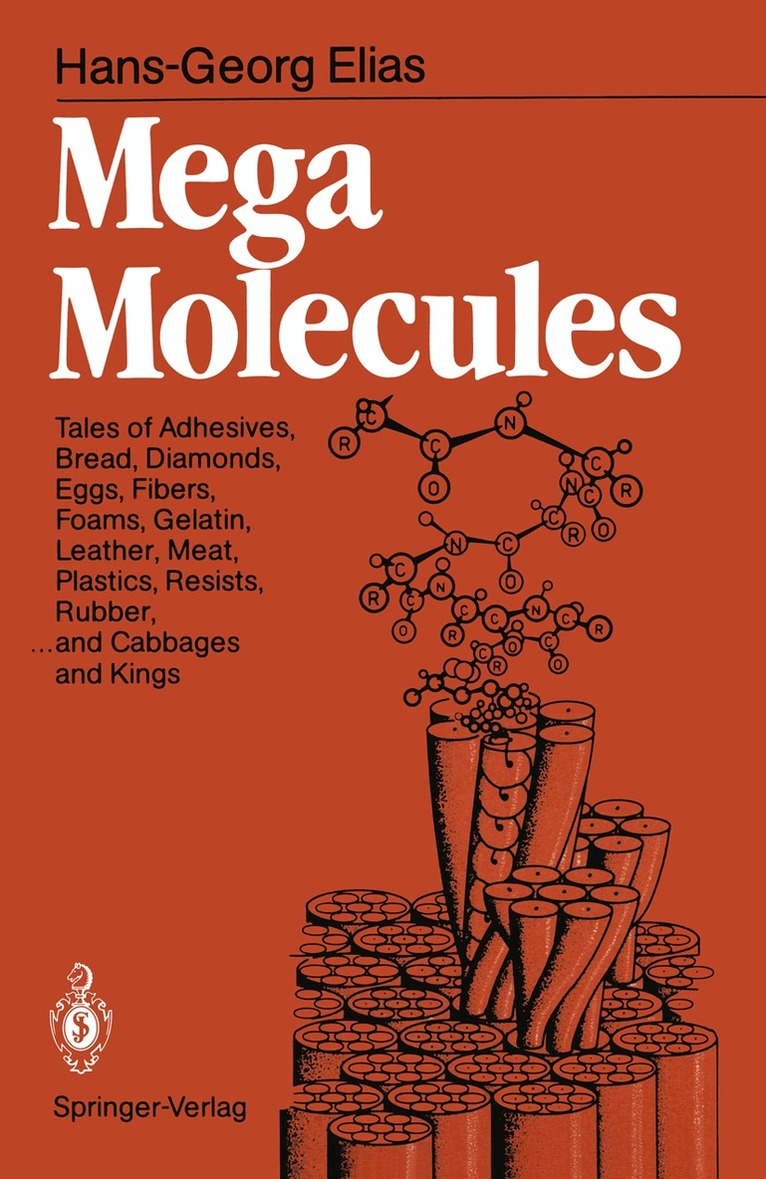
Mega Molecules
Tales of Adhesives, Bread, Diamonds, Eggs, Fibers, Foams, Gelatin, Leather, Meat, Plastics, Resists, Rubber, ... and Cabbages and Kings
Häftad, Engelska, 1987
536 kr
Skickas inom 10-15 vardagar
All life is based on big molecules, scientifically called "mac romolecules". Humans, animals, and plants cease to exist without these structural, reserve, and transport molecules. No life can be propagated without macromolecular DNA and RNA. Without macromolecules, we would only dine on water, sugars, fats, vitamins and salts but had to relinquish meat, eggs, cereals, vegetables, and fruits. We would not live in houses since wood and many stones consist of macromole cules. Without macromolecules, no clothes since all fibers are made from macromolecules. No present-day car could run: All tires are based on macromolecules. Without macromole cules no photographic films, no electronics ... If macromolecules are so important then why is commonly so little known about their roles and why are they so little mentioned in school, if at all? As often in human history, tra dition is important and science makes no exception. Chemis try was established as the chemistry of low molecular weight compounds since these were most easy to investigate, charac terize, and convert. A beautiful tower of thought was erected by the chemical sciences long before the idea of giant mole cules, macromolecules, took hold. There was no space for newcomers in this tower. Even today one can learn about chemistry without hearing a word about macromolecules.