Hans-Georg Klingemann - Böcker
Visar alla böcker från författaren Hans-Georg Klingemann. Handla med fri frakt och snabb leverans.
3 produkter
3 produkter
552 kr
Skickas inom 10-15 vardagar
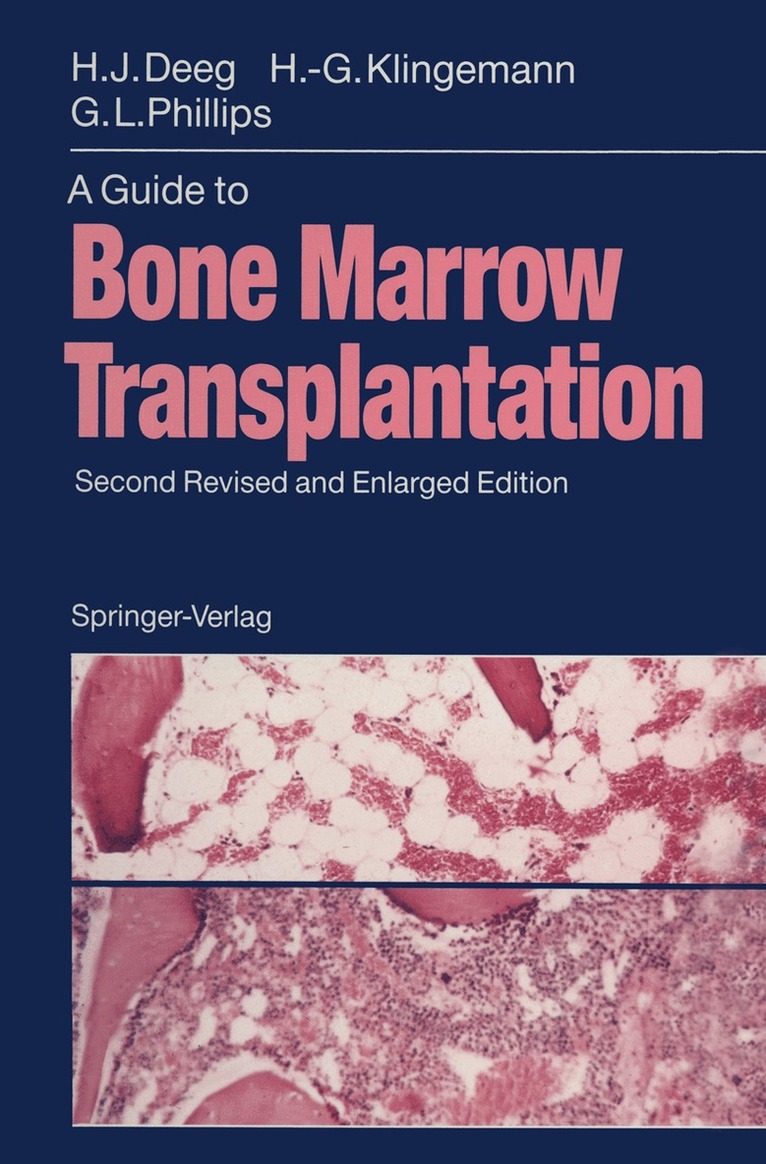
The first edition to A Guide to Bone Marrow Transplantation was published 10 years ago. At that time we perceived a need for an introductory text to the area of marrow transplantation, a rapidly developing field with few general texts avail able. Since then the situation has changed dramatically. Several introductory texts, therapeutic manuals and comprehensive volumes have been published. There is a heightened awareness of the availability, utility and potential of bone marrow transplantation, and of peripheral blood stem cell transplantation in particular. In many cases stem cell transplantation is being practiced by physi cians as a standard therapy. For those reasons we weighed carefully the question whether the Guide was still useful or even had a place. The feedback we received from physicians in practice or in training (including both hematologists and other physicians), as well as from nurses, physician's assistants, nurse practitioners, and other personnel in volved in one way or another in hematopoietic stem cell transplantation indicat ed that such a text was still desirable as an introduction that focused on princi ples rather than the latest up-to-date results.
1 451 kr
Skickas inom 5-8 vardagar
In the late 1940s investigators observed that mice given supralethai doses of total body irradiation were protected by infusion of viable spleen or marrow cells following irradiation, and that this was accomplished by hemopoietic reconsti tution with donor cells as proven using genetic markers. If a similar approach could be applied to humans, it should be possible to treat leukemia patients with any dose of chemoradiotherapy as far as nonmarrow toxicity permitted, and then rescue them by marrow transplantation. Early clinical attempts were gen erally unsuccessful, mostly due to a lack of knowledge of histocompatibility antigens and appropriate supportive care. These areas developed rather quickly during the 1960s, and for almost two decades now clinical marrow transplan tation has been carried out with increasing success. After initially using only bone marrow from HLA indentical siblings, the field has expanded rapidly to incorporate HLA nonidentical related donors, and recently even marrow from unrelated volunteer donors. Furthermore, since for numerous patients who oth erwise could benefit from transplantation a donor cannot be identified, there has been a growing interest in using the patient's own (autologous) bone marrow. Our understanding of the principles of transplantation and our knowledge of the potential risks and benefits have quickly grown. At times it is difficult, however, to decide what is the best option for a given patient.
1 451 kr
Skickas inom 5-8 vardagar
In 1988 we presented our Guide to Bone Marrow Transplan tation. The reception has been enthusiastic and we have re ceived a flood of critical comments, suggestions and requests to provide an update in due time. Although several books on marrow transplantation have recently been published, their scope and goal have generally been different. Hence, we have decided to prepare a second edition of the Guide. Our aim was to maintain a short, concise text which never theless would incorporate changes that have occurred over the past four or five years. We have streamlined the description of pretransplant considerations, by condensing two sections into one (Treatment Planning and Timing of Transplantation). This also facilitated the review of controversial indications for marrow transplantation, for example in patients with acute myelogenous leukemia in first chemotherapy-induced remission. We have updated the chapter dealing with conditioning regimens and have expanded the section on donor selection, in particular in regard to the current level of tissue typing and the identification of unrelated volunteer donors. In the chapter on collection, processing, and infusion of marrow, we have incorporated recent developments, for example, the use of closed systems for marrow harvesting and processing and the use of solid phase separation of stem cells.