Hans Jürgen Prömel – författare
Visar alla böcker från författaren Hans Jürgen Prömel. Handla med fri frakt och snabb leverans.
4 produkter
4 produkter
Inbunden, Engelska, 2013
549 kr
Skickas inom 10-15 vardagar
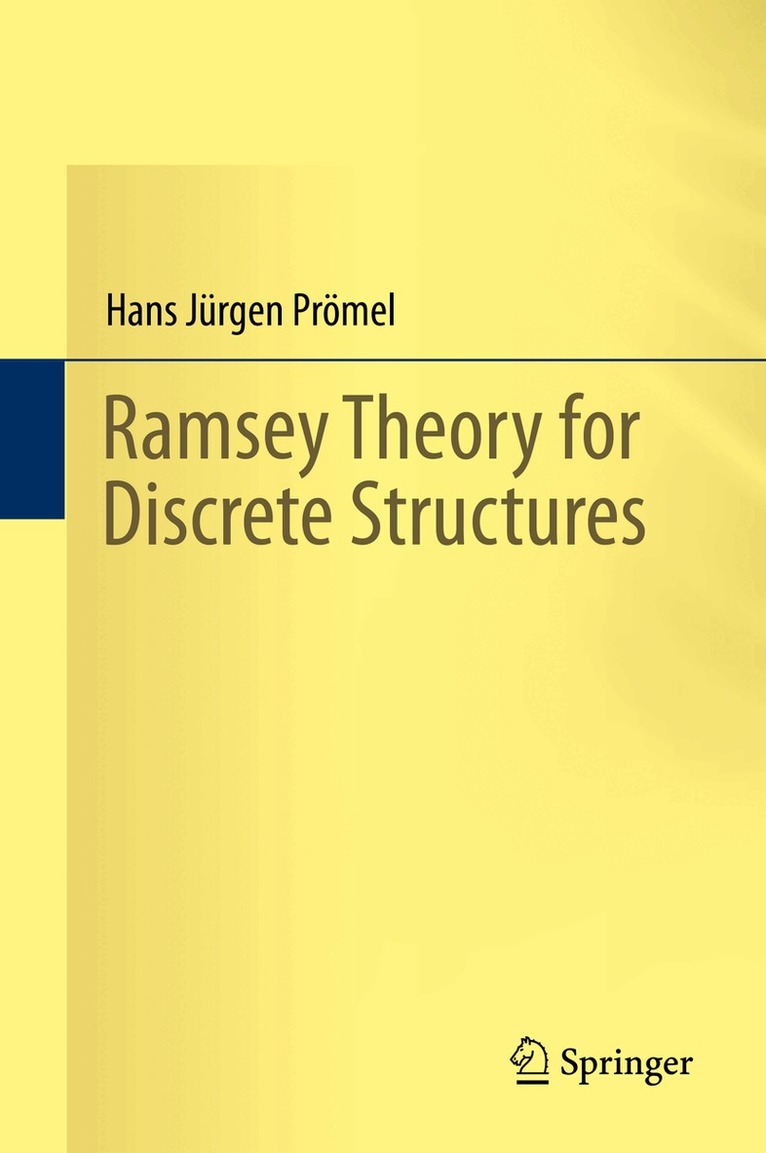
This monograph covers some of the most important developments in Ramsey theory from its beginnings in the early 20th century via its many breakthroughs to recent important developments in the early 21st century.The book first presents a detailed discussion of the roots of Ramsey theory before offering a thorough discussion of the role of parameter sets. It presents several examples of structures that can be interpreted in terms of parameter sets and features the most fundamental Ramsey-type results for parameter sets: Hales-Jewett's theorem and Graham-Rothschild¹s Ramsey theorem as well as their canonical versions and several applications. Next, the book steps back to the most basic structure, to sets. It reviews classic results as well as recent progress on Ramsey numbers and the asymptotic behavior of classical Ramsey functions. In addition, it presents product versions of Ramsey's theorem, a combinatorial proof of the incompleteness of Peano arithmetic, provides a digression to discrepancy theory and examines extensions of Ramsey's theorem to larger cardinals. The next part of the book features an in-depth treatment of the Ramsey problem for graphs and hypergraphs. It gives an account on the existence of sparse and restricted Ramsey theorem's using sophisticated constructions as well as probabilistic methods. Among others it contains a proof of the induced Graham-Rothschild theorem and the random Ramsey theorem. The book closes with a chapter on one of the recent highlights of Ramsey theory: a combinatorial proof of the density Hales-Jewett theorem.This book provides graduate students as well as advanced researchers with a solid introduction and reference to the field.
Häftad, Engelska, 2016
549 kr
Skickas inom 10-15 vardagar
This monograph covers some of the most important developments in Ramsey theory from its beginnings in the early 20th century via its many breakthroughs to recent important developments in the early 21st century.The book first presents a detailed discussion of the roots of Ramsey theory before offering a thorough discussion of the role of parameter sets. It presents several examples of structures that can be interpreted in terms of parameter sets and features the most fundamental Ramsey-type results for parameter sets: Hales-Jewett's theorem and Graham-Rothschild¹s Ramsey theorem as well as their canonical versions and several applications. Next, the book steps back to the most basic structure, to sets. It reviews classic results as well as recent progress on Ramsey numbers and the asymptotic behavior of classical Ramsey functions. In addition, it presents product versions of Ramsey's theorem, a combinatorial proof of the incompleteness of Peano arithmetic, provides a digression to discrepancy theory and examines extensions of Ramsey's theorem to larger cardinals. The next part of the book features an in-depth treatment of the Ramsey problem for graphs and hypergraphs. It gives an account on the existence of sparse and restricted Ramsey theorem's using sophisticated constructions as well as probabilistic methods. Among others it contains a proof of the induced Graham-Rothschild theorem and the random Ramsey theorem. The book closes with a chapter on one of the recent highlights of Ramsey theory: a combinatorial proof of the density Hales-Jewett theorem.This book provides graduate students as well as advanced researchers with a solid introduction and reference to the field.
Häftad, Engelska, 2002
495 kr
Skickas inom 10-15 vardagar
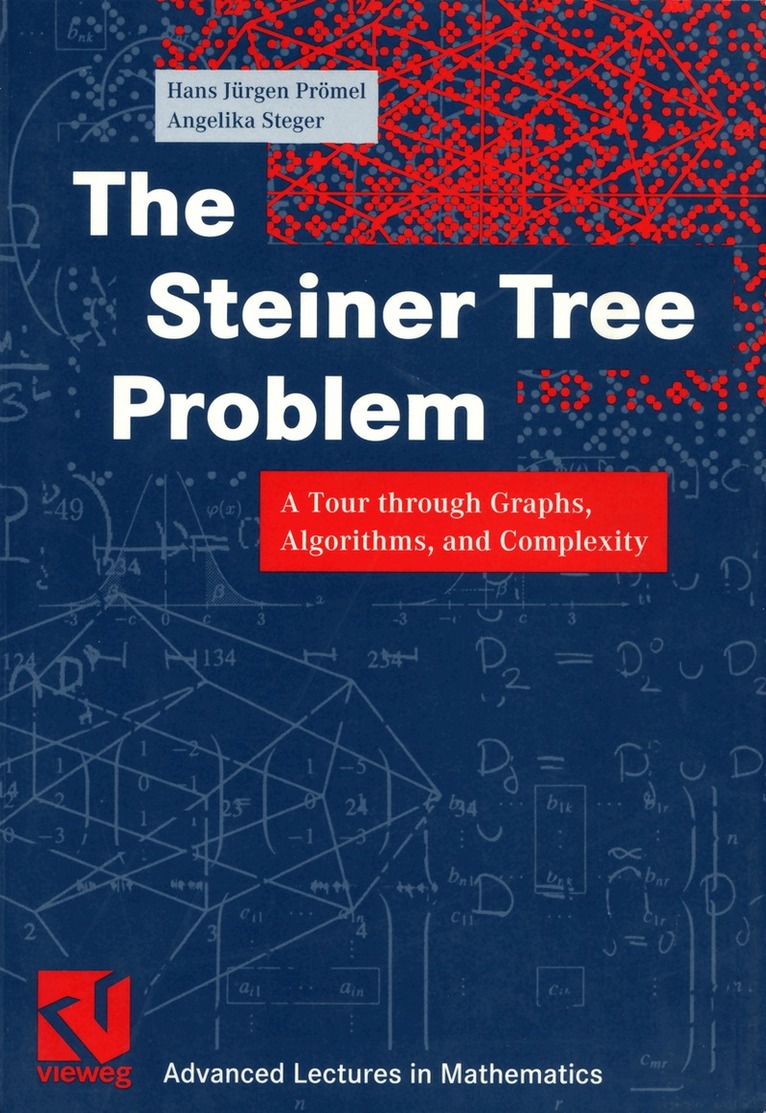
"A very simple but instructive problem was treated by Jacob Steiner, the famous representative of geometry at the University of Berlin in the early nineteenth century. Three villages A,B ,C are to be joined by a system of roads of minimum length. " Due to this remark of Courant and Robbins (1941), a problem received its name that actually reaches two hundred years further back and should more appropriately be attributed to the French mathematician Pierre Fermat. At the end of his famous treatise "Minima and Maxima" he raised the question to find for three given points in the plane a fourth one in such a way that the sum of its distances to the given points is minimized - that is, to solve the problem mentioned above in its mathematical abstraction. It is known that Evangelista Torricelli had found a geometrical solution for this problem already before 1640. During the last centuries this problem was rediscovered and generalized by many mathematicians, including Jacob Steiner. Nowadays the term "Steiner prob lem" refers to a problem where a set of given points PI, . . . ,Pn have to be connected in such a way that (i) any two of the given points are joined and (ii) the total length (measured with respect to some predefined cost function) is minimized.
Häftad, Engelska, 1998
565 kr
Skickas inom 10-15 vardagar
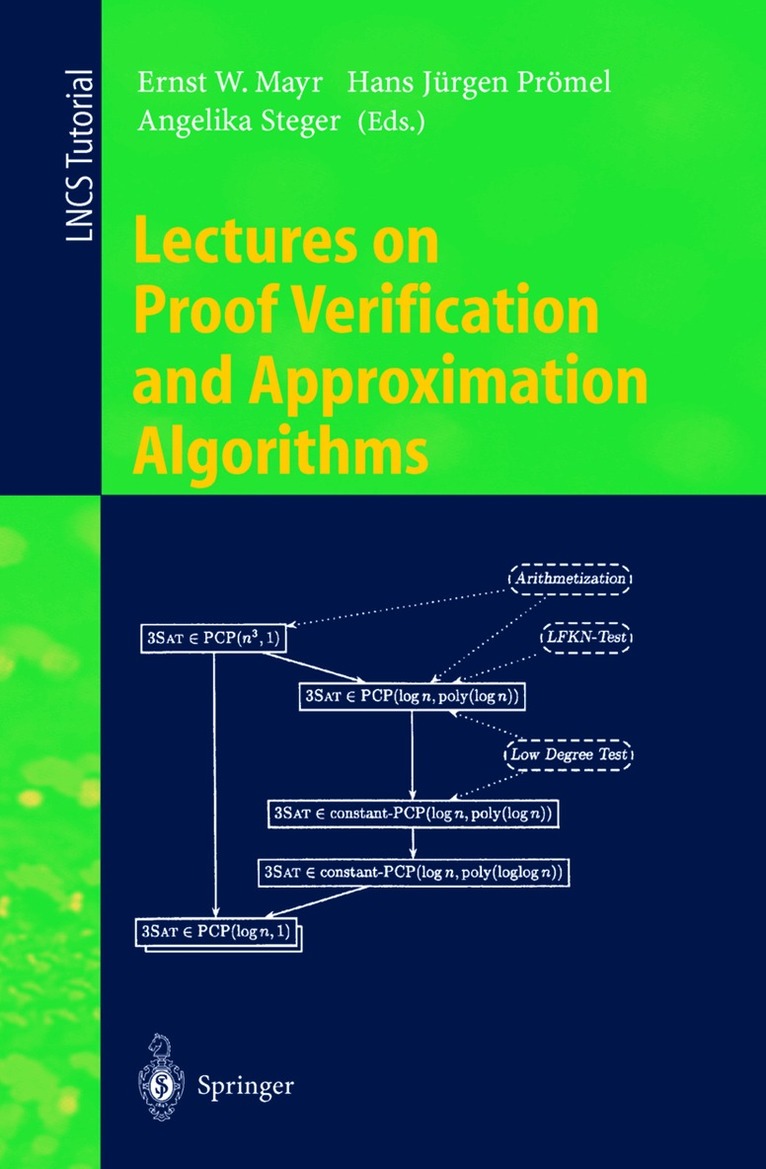
During the last few years, we have seen quite spectacular progress in the area of approximation algorithms: for several fundamental optimization problems we now actually know matching upper and lower bounds for their approximability. This textbook-like tutorial is a coherent and essentially self-contained presentation of the enormous recent progress facilitated by the interplay between the theory of probabilistically checkable proofs and aproximation algorithms. The basic concepts, methods, and results are presented in a unified way to provide a smooth introduction for newcomers. These lectures are particularly useful for advanced courses or reading groups on the topic.