Hans W. Guesgen – författare
Visar alla böcker från författaren Hans W. Guesgen. Handla med fri frakt och snabb leverans.
6 produkter
Human Behavior Recognition Technologies
Intelligent Applications for Monitoring and Security
Av Hans W. Guesgen, Stephen Marsland
Inbunden, 2013
2633 kr
Lägg i varukorg
Human Behavior Recognition Technologies: Intelligent Applications for Monitoring and Security
Av Stephen Marsland, Hans W. Guesgen
E-bok, 2013
3273 kr
Lägg i varukorg
Recently, the ICT field has seen a shift from machine-centered focuses to human and user knowledge-based approaches. However, as priorities shift, questions arise on how to detect and monitor users' behavior. Human Behavior Recognition Technologies: Intelligent Applications for Monitoring and …
Human Behavior Recognition Technologies: Intelligent Applications for Monitoring and Security
Av Stephen Marsland, Hans W. Guesgen
E-bok, 2013
3273 kr
Lägg i varukorg
Recently, the ICT field has seen a shift from machine-centered focuses to human and user knowledge-based approaches. However, as priorities shift, questions arise on how to detect and monitor users' behavior. Human Behavior Recognition Technologies: Intelligent Applications for Monitoring and …
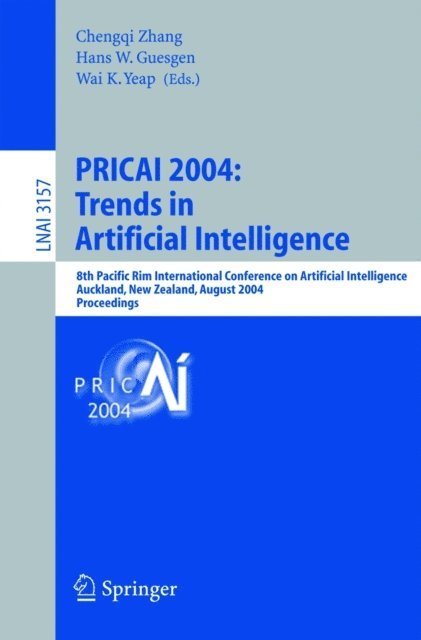
PRICAI 2004: Trends in Artificial Intelligence
8th Pacific Rim International Conference on Artificial Intelligence, Auckland, New Zealand, August 9-13, 2004, Proceedings
Av Chengqi Zhang, Hans W. Guesgen m. fl.
Häftad, 2004
1128 kr
Lägg i varukorg
The Pacific Rim International Conference on Artificial Intelligence (PRICAI) is a biennial international event which focuses on Artificial Intelligence (AI) theories and technologies, and their applications which are of social and economic importance for countries in the Pacific Rim region. Seven …
PRICAI 2004: Trends in Artificial Intelligence
8th Pacific Rim International Conference on Artificial Intelligence, Auckland, New Zealand, August 9-13, 2004, Proceedings
Av Wai K. Yeap, Hans W. Guesgen m. fl.
E-bok, 2004
1470 kr
Lägg i varukorg
The Pacific Rim International Conference on Artificial Intelligence (PRICAI) is a biennial international event which focuses on Artificial Intelligence (AI) theories and technologies, and their applications which are of social and economic importance for countries in the Pacific Rim region. Seven …
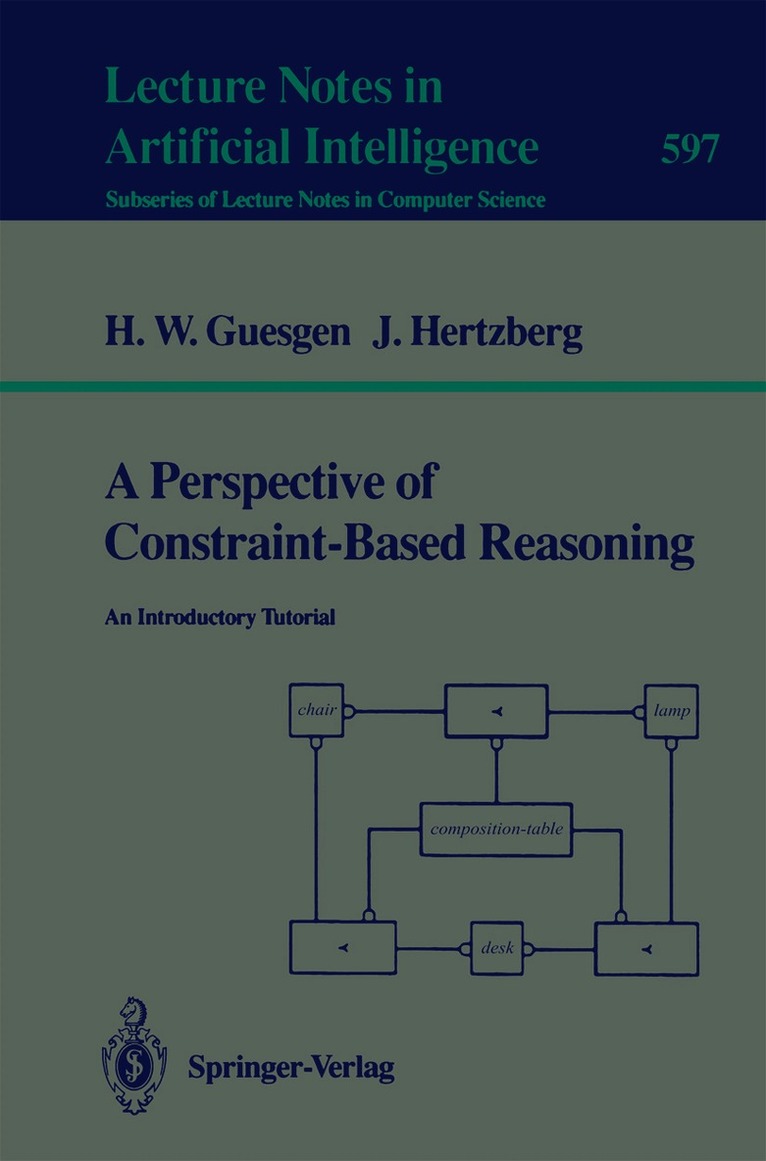
Perspective of Constraint-Based Reasoning
An Introductory Tutorial
Av Hans W. Guesgen, Joachim Hertzberg
Häftad, 1992
399 kr
Lägg i varukorg
Much of AI research is about problem-solving strategies, andseveral techniques have been crystalized. One such techniqueis constraint satisfaction or reasoning based on relations.Constraint-based reasoning is used to solve a wide field ofproblems, and recently constraint techniques have …