Harold K. Bush – författare
659 kr
Läs direkt efter köp
The writer’s fascination with America’s spiritual and religious evolution in the 19th century.
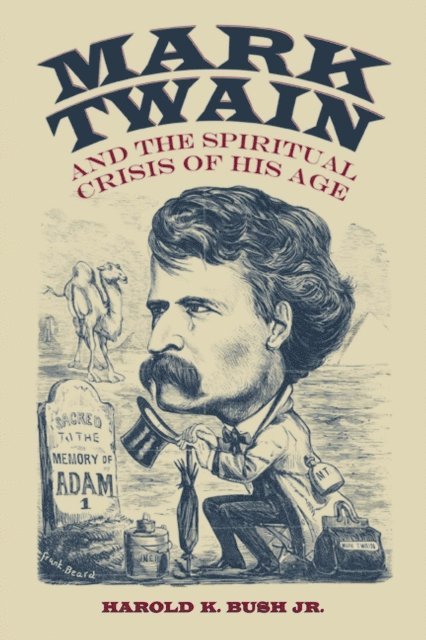
Mark Twain is often pictured as a severe critic of religious piety, shaking his fist at God and mocking the devout. Such a view, however, is only partly correct. It ignores the social realities of Twain’s major period as a writer and his own spiritual interests: his participation in church activities, his socially progressive agenda, his reliance on religious themes in his major works, and his friendships with clergymen, especially his pastor and best friend, Joe Twichell. It also betrays a conception of religion that is more contemporary than that of the period in which he lived.
Harold K. Bush Jr. highlights Twain’s attractions to and engagements with the wide variety of religious phenomena of America in his lifetime, and how these matters affected his writings. Though Twain lived in an era of tremendous religious vigor, it was also a time of spiritual upheaval and crisis. The rise of biological and psychological sciences, the criticism of biblical texts as literary documents, the influx of world religions and immigrant communities, and the trauma of the Civil War all had dramatic effects on America’s religious life. At the same time mass urban revivalism, the ecumenical movement, Social Christianity, and occultic phenomena, like spiritualism and mind sciences, all rushed in to fill the voids. The rapid growth of agnosticism in the 1870s and 1880s is also clearly reflected in Twain’s life and writings. Thus Twain’s career reflects in an unusually resonant way the vast changes in American belief during his lifetime.
Bush’s study offers both a new and more complicated understanding of Twain and his literary output and serves as the cultural biography of an era.
941 kr
Läs direkt efter köp
744 kr
Läs direkt efter köp
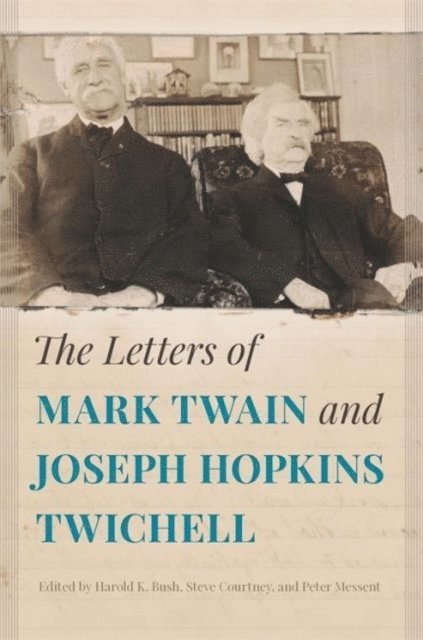
This book contains the complete texts of all known correspondence between Samuel L. Clemens (Mark Twain) and Joseph Hopkins Twichell. Theirs was a rich exchange. The long, deep friendship of Clemens and Twichell—a Congregationalist minister of Hartford, Connecticut—rarely fails to surprise, given the general reputation Twain has of being antireligious. Beyond this, an examination of the growth, development, and shared interests characterizing that friendship makes it evident that as in most things about him, Mark Twain defies such easy categorization or judgment.From the moment of their first encounter in 1868, a rapport was established. When Twain went to dinner at the Twichell home, he wrote to his future wife that he had “got up to go at 9.30 PM, & never sat down again—but [Twichell] said he was bound to have his talk out—& I was willing—& so I only left at 11.” This conversation continued, in various forms, for forty-two years—in both men’s houses, on Hartford streets, on Bermuda roads, and on Alpine trails.The dialogue between these two men—one an inimitable American literary figure, the other a man of deep perception who himself possessed both narrative skill and wit—has been much discussed by Twain biographers. But it has never been presented in this way before: as a record of their surviving correspondence; of the various turns of their decades-long exchanges; of what Twichell described in his journals as the “long full feast of talk” with his friend, whom he would always call “Mark.”
444 kr
Skickas inom 3-6 vardagar
714 kr
Läs direkt efter köp
This book contains the complete texts of all known correspondence between Samuel L. Clemens (Mark Twain) and Joseph Hopkins Twichell. Theirs was a rich exchange. The long, deep friendship of Clemens and Twichell—a Congregationalist minister of Hartford, Connecticut—rarely fails to surprise, given the general reputation Twain has of being antireligious. Beyond this, an examination of the growth, development, and shared interests characterizing that friendship makes it evident that as in most things about him, Mark Twain defies such easy categorization or judgment.From the moment of their first encounter in 1868, a rapport was established. When Twain went to dinner at the Twichell home, he wrote to his future wife that he had “got up to go at 9.30 PM, & never sat down again—but [Twichell] said he was bound to have his talk out—& I was willing—& so I only left at 11.” This conversation continued, in various forms, for forty-two years—in both men’s houses, on Hartford streets, on Bermuda roads, and on Alpine trails.The dialogue between these two men—one an inimitable American literary figure, the other a man of deep perception who himself possessed both narrative skill and wit—has been much discussed by Twain biographers. But it has never been presented in this way before: as a record of their surviving correspondence; of the various turns of their decades-long exchanges; of what Twichell described in his journals as the “long full feast of talk” with his friend, whom he would always call “Mark.”
664 kr
Skickas inom 3-6 vardagar