Harry C. Bunt - Böcker
Visar alla böcker från författaren Harry C. Bunt. Handla med fri frakt och snabb leverans.
2 produkter
2 produkter
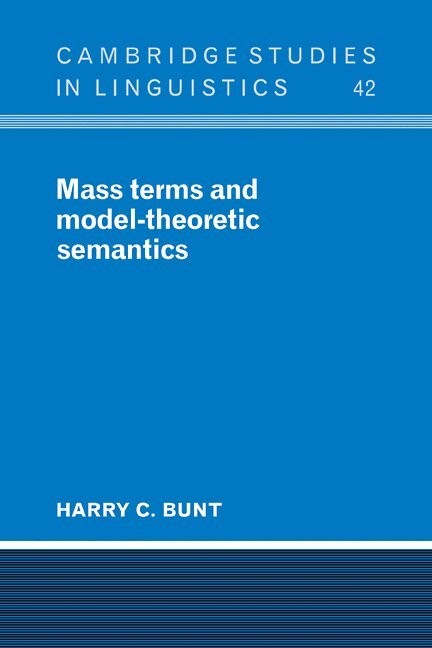
Del 42 - Cambridge Studies in Linguistics
Mass Terms and Model-Theoretic Semantics
Häftad, Engelska, 2009
577 kr
Skickas inom 7-10 vardagar
'Mass terms' like water, rice and traffic, have proved very difficult to accommodate in any theory of meaning since, unlike count nouns such as house or dog, they cannot be treated as denoting sets of individuals. In this study, motivated by the need to design a computer program for understanding natural language utterances containing mass terms, Harry Bunt provides a thorough analysis of the problem and offers an original and detailed solution. An extension of classical set theory, Ensemble Theory, is defined. This provides the formal basis of a framework for the analysis of natural language meaning which Dr Bunt calls two-level model-theoretic semantics. The validity of the framework is convincingly demonstrated by the detailed analysis of a fragment of English including sentences with quantified and modified mass terms. This significant advance in our understanding of the formal syntactic and semantic properties of mass terms will be of interest not only to linguists and logicians, but also to all those concerned with the processing of natural language.
1 624 kr
Skickas inom 10-15 vardagar
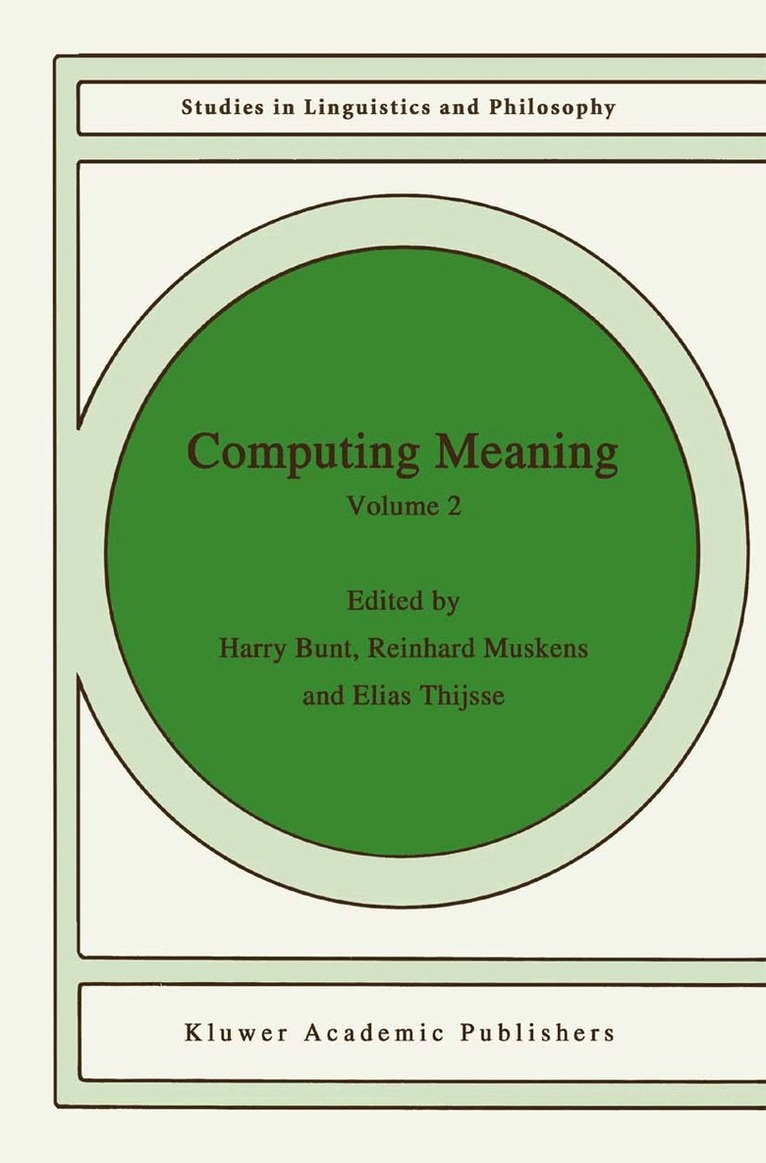
A collection of papers written by researchers in the emerging field of computational semantics. Computational semantics is concerned with the computation of the meanings of linguistic objects such as text fragments, spoken dialogue utterances and e-mail messages. The meaning of such an object is determined partly by linguistic information and partly by information from the context in which the object occurs. The information from these sources is combined by processes that infer which interpretation of the object applies in the given context. This applies not only to notoriously difficult aspects of interpreting linguistic objects, such as indexicals, anaphora and metonymy, but also to establishing the precise reference of common nouns and the scopes of noun phrases. The central issue in computational semantics is how processes of finding and combining the relevant linguistic and contextual information into contextually appropriate meanings can be organized. Traditional approaches of applying context information to disambiguated natural language expressions do not work well, due to the ambiguity in natural language.Recent work in computational semantics suggests that linguistic semantic information be represented in formal structures with underspecification, and that context information be applied in inference processes that result in further specification of these representations. Underspecified representation and inference are therefore key topics. This book is aimed at linguists, computer scientists and logicians who take an interest in the computation of meaning, and who want to know what is happening in this field of research.