Heinrich Wefing – författare
Visar alla böcker från författaren Heinrich Wefing. Handla med fri frakt och snabb leverans.
4 produkter
4 produkter
Häftad, Tyska, 2005
177 kr
Skickas inom 3-6 vardagar
Inbunden, Engelska, 2002
338 kr
Skickas inom 11-20 vardagar
Text in English and German. The Neues Haus, the new building for the Munchner Kammerspiele, is not a big building in any sense. The plot of land not far from Maximilian-strasse, whose greatest advantage is its proximity to Richard Riemerschmied's Schauspielhaus, is only about 1000 m2 in area. The most important quality of the design is in fact that it accepts the modesty of its role. The new building subordinates itself to the main Kammerspiele building, and manages without lavish foyers and extensive prestigious areas. The Neues Haus is a servant building, a place where work is done. A hasty passer-by would see the building simply as a white cube, reticent and introverted. Given the serene mastery of the brief and the architectural resources, one is almost inclined to call it a work of Peichl's old age, combining his love of clear volumes with a sovereign grasp of technical requirements. Like the silvery-sparkling ORF studios, the ground radio station in Styria and the liner-like phosphate elimination plant in Berlin before it, the Neues Haus is also crammed full of technology. It contains three stages, and two of them can be used at the same time. The largest playing area is elaborately equipped with gallery and under-stage; it is therefore intended as the main rehearsal area in future. The two large auditoriums are stacked one above the other like shoe-boxes and form a massive hollow core surrounded by all the service functions. The interior is dominated by a plainness that oscillates between poverty and asceticism. The corridors and foyers are narrow, the stairs simple, the interval areas positively sparse. The only opulent feature is the splendid technical equipment. Peichl's handwriting can be seen in the treatment of the details and his ingenious practice of self-quotation. Many of the motifs are reminiscent of earlier projects, and of course the typical portholes, spiral staircases and railings made of steel hawsers crop up again, all Peichl's usual maritime metaphors. In this way he has produced a building whose cool elegance reveals scarcely anything of its inner values.
Inbunden, Engelska, 2026
363 kr
Kommande
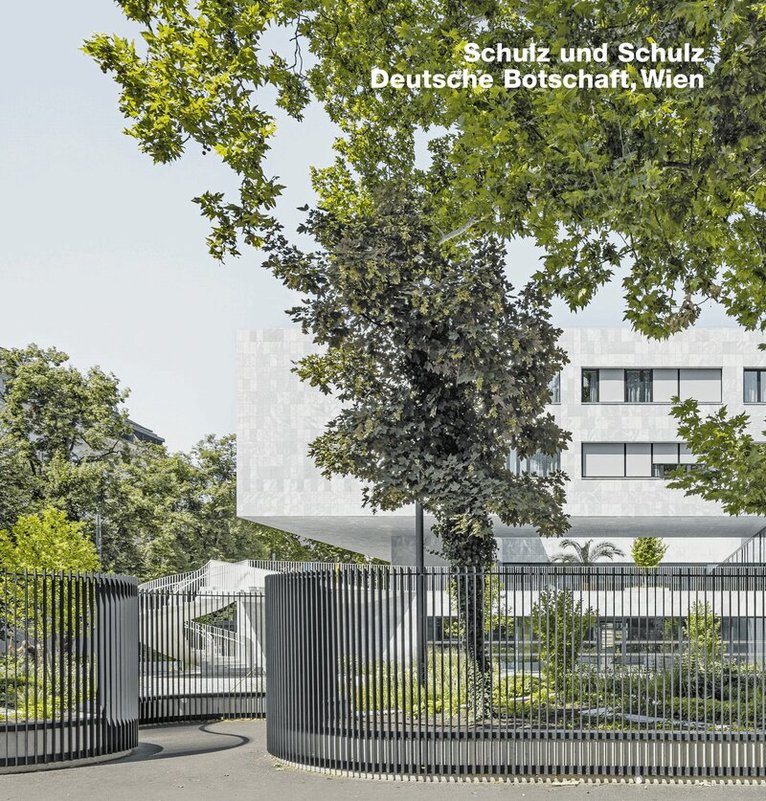
There is scarcely a country where the relationship between architecture and democracy has been debated as intensely and persistently as in Germany. From the first tentative, still rather provisional buildings in Bonn to the countless major federal projects in Berlin following the relocation of the government, the question of the special role and aesthetic mandate of »democracy as a client« has been raised again and again. The aim has always been not merely to create square metres and fulfil functions, but also to convey political messages.The new German Embassy in Vienna by Schulz und Schulz has also been “read” in this way. Yet it eludes any superficial symbolism. The building is devoid of any historicising elements; the architecture dispenses with any classical gesture of authority, developing asymmetrically, with no columns, no axes of symmetry, and no façade.The Leipzig-based architects have designed a sharp-edged, almost abstracted standalone building that creates a stark contrast to the pleasing Gründerzeit buildings in the neighbourhood. It stands at the heart of the Austrian capital’s diplomatic quarter, on a plot, which is arguably the most prominent one in the area: the former gardens of Prince Metternich. Here, the development steps back from the perimeter of the block, making way for an open space, for a green area filled with valuable old trees, in which the embassy building appears almost like a contemporary palace.
Häftad, Engelska, 2019
366 kr
Skickas inom 5-8 vardagar