Helen M. Campbell – författare
Visar alla böcker från författaren Helen M. Campbell. Handla med fri frakt och snabb leverans.
6 produkter
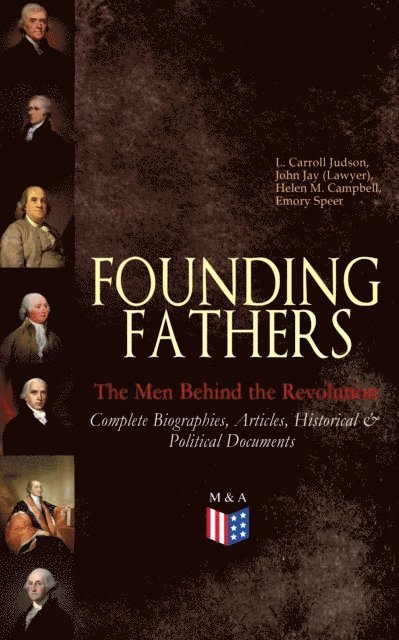
FOUNDING FATHERS - The Men Behind the Revolution: Complete Biographies, Articles, Historical & Political Documents
John Adams, Benjamin Franklin, Alexander Hamilton, John Jay, Thomas Jefferson, James Madison and George Washington
Av Emory Speer, Helen M. Campbell m. fl.
E-bok, 2017
28 kr
Lägg i varukorg
This book is dedicated to seven outstanding men to whom America owes its freedom: John Adams, Benjamin Franklin, Alexander Hamilton, John Jay, Thomas Jefferson, James Madison, and George Washington. In seven fascinating life stories you will meet the men behind the great names we all know. …
Evolution of the U.S. Constitution
Unveiling the Origins and Impact of America''s Bill of Rights and Constitutional Framework
Av Helen M. Campbell, Center for Legislative Archives m. fl.
E-bok, 2018
23 kr
Lägg i varukorg
James Madison introduced 12 amendments to the First Congress in 1789. Ten of these would go on to become what we now consider to be the Bill of Rights. One was never passed, while another dealing with Congressional salaries was not ratified until 1992, when it became the 27th Amendment. Based on …
We the People: The Foundation & Evolution of the U.S. Constitution
Framing Unity: The Justice, Liberty, and Rights Shaping the American Constitution
Av Center for Legislative Archives, U.S. Congress m. fl.
E-bok, 2018
23 kr
Lägg i varukorg
"We the People of the United States, in Order to form a more perfect Union, establish Justice, ensure domestic Tranquility, provide for the common defence, promote the general Welfare, and secure the Blessings of Liberty to ourselves and our Posterity, do ordain and establish this Constitution for …
Formation & Evolution of the American Constitution
Debates of the Constitutional Convention of 1787, Biographies of the Founding Fathers & More
Av Helen M. Campbell, Center for Legislative Archives m. fl.
E-bok, 2018
23 kr
Lägg i varukorg
The anthology ''The Formation & Evolution of the American Constitution'' presents a nuanced exploration of one of the most pivotal legal documents in world history. This collection traverses a broad spectrum of literary styles, from the analytical and scholarly to the passionately polemic, …
U.S. Constitution: Foundation & Evolution (Including the Biographies of the Founding Fathers)
The Formation of the Constitution, Debates of the Constitutional Convention of 1787…
Av Center for Legislative Archives, U.S. Congress m. fl.
E-bok, 2018
23 kr
Lägg i varukorg
U.S. Constitution: Foundation & Evolution'' is a vital anthology that meticulously traces the development and enduring impact of the U.S. Constitution through a diverse array of texts and biographical sketches. The compilation spans seminal historical documents, analytical essays, and incisive …
Founding Fathers: Complete Biographies, Their Articles, Historical & Political Documents
John Adams, Benjamin Franklin, Alexander Hamilton, Thomas Jefferson, George Washington…
Av Emory Speer, Helen M. Campbell m. fl.
E-bok, 2018
23 kr
Lägg i varukorg
In ''Founding Fathers: Complete Biographies, Their Articles, Historical & Political Documents,'' readers are presented with a meticulously curated collection that explores the multifaceted personalities and philosophies of America''s foundational figures. This anthology spans a variety of literary …