Hengeveld Kees Hengeveld – författare
Visar alla böcker från författaren Hengeveld Kees Hengeveld. Handla med fri frakt och snabb leverans.
2 produkter
2 produkter
E-bok
Engelska, 20261 777 kr
Läs direkt efter köp
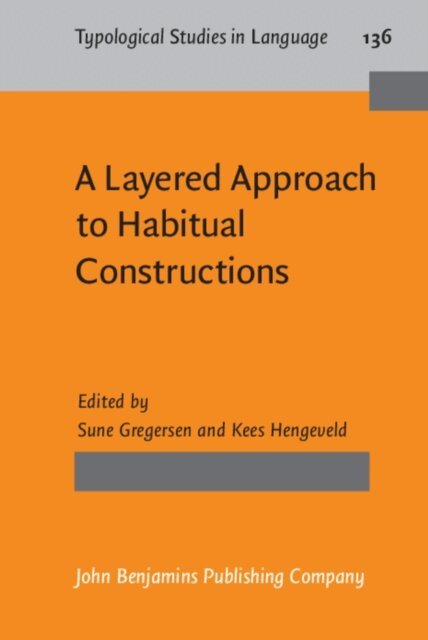
Habitual constructions, such as those based on English used to and Spanish soler, are linguistic expressions denoting situations that typically occur. This volume proposes a novel approach to such expressions, arguing that habituality is not a unified semantic category, but rather a family of related meanings which differ in their scopal position within the clause. The volume contains a detailed account of habitual meaning from the perspective of Functional Discourse Grammar as well as in-depth empirical studies of habitual constructions in ten languages: Coptic, Plains Cree, Dolgan, Ancient Greek, Kwaza, Mandarin, Portuguese, Russian, Slovak, and Spanish. It will be of interest not just to specialists of these languages, but to anyone working on habituality and other aspectual categories in the languages of the world.
E-bok
PDF, Engelska, 19981 525 kr
Läs direkt efter köp
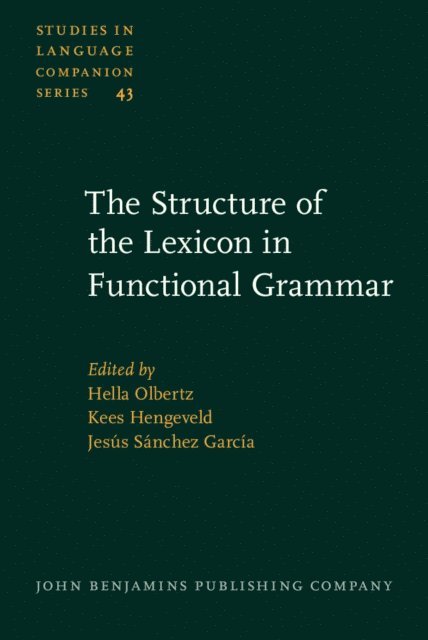
The papers collected in this volume concern five different aspects of the role of the lexicon in the theory of Functional Grammar such as developed by Simon C. Dik and his co-workers. The volume starts off with an eminently practical section on the Functional-Lexematic Model, a lexicological and lexicographical system which has largely been inspired by Dik’s principle of stepwise lexical decomposition. In addition to a theoretical introduction to the model, applications to English, German and Spanish are presented. The second part of the volume deals with the derivation of action-nouns, pseudo-reflexive verbs and causative constructions, thus offering new perspectives on predicate formation within Functional Grammar. This is followed by a section that centres around an important problem related to valency which up to now has had almost no attention within Functional Grammar: the question of how to account for the collocational properties of predicates. The fourth part of the book discusses (non-prototypical) transitive verbs and their relation to the typology of states of affairs, which leads to proposals of possible adaptations of Dik’s typology. The final section focusses on the relationship between the lexicon and the underlying structure of the clause. Three proposals of varying degrees of radicalism are presented to reconsider this relation.