Herbert Kritzer – författare
Visar alla böcker från författaren Herbert Kritzer. Handla med fri frakt och snabb leverans.
5 produkter
5 produkter
E-bok
Engelska, 2012411 kr
Läs direkt efter köp
The empirical study of law, legal systems and legal institutions is widely viewed as one of the most exciting and important intellectual developments in the modern history of legal research. Motivated by a conviction that legal phenomena can and should be understood not only in normative terms but also as social practices of political, economic and ethical significance, empirical legal researchers have used quantitative and qualitative methods to illuminate many aspects of law''s meaning, operation and impact.In the 43 chapters of The Oxford Handbook of Empirical Legal Research leading scholars provide accessible and original discussions of the history, aims and methods of empirical research about law, as well as its achievements and potential. The Handbook has three parts. The first deals with the development and institutional context of empirical legal research. The second - and largest - part consists of critical accounts of empirical research on many aspects of the legal world - on criminal law, civil law, public law, regulatory law and international law; on lawyers, judicial institutions, legal procedures and evidence; and on legal pluralism and the public understanding of law. The third part introduces readers to the methods of empirical research, and its place in the law school curriculum.
Inbunden, Engelska, 2010
3 136 kr
Skickas inom 7-10 vardagar
The empirical study of law, legal systems and legal institutions is widely viewed as one of the most exciting and important intellectual developments in the modern history of legal research. Motivated by a conviction that legal phenomena can and should be understood not only in normative terms but also as social practices of political, economic and ethical significance, empirical legal researchers have used quantitative and qualitative methods to illuminate many aspects of law's meaning, operation and impact.In the 43 chapters of The Oxford Handbook of Empirical Legal Research leading scholars provide accessible and original discussions of the history, aims and methods of empirical research about law, as well as its achievements and potential. The Handbook has three parts. The first deals with the development and institutional context of empirical legal research. The second - and largest - part consists of critical accounts of empirical research on many aspects of the legal world - on criminal law, civil law, public law, regulatory law and international law; on lawyers, judicial institutions, legal procedures and evidence; and on legal pluralism and the public understanding of law. The third part introduces readers to the methods of empirical research, and its place in the law school curriculum.
Häftad, Engelska, 2012
714 kr
Skickas inom 7-10 vardagar
The empirical study of law, legal systems and legal institutions is widely viewed as one of the most exciting and important intellectual developments in the modern history of legal research. Motivated by a conviction that legal phenomena can and should be understood not only in normative terms but also as social practices of political, economic and ethical significance, empirical legal researchers have used quantitative and qualitative methods to illuminate many aspects of law's meaning, operation and impact.In the 43 chapters of The Oxford Handbook of Empirical Legal Research leading scholars provide accessible and original discussions of the history, aims and methods of empirical research about law, as well as its achievements and potential. The Handbook has three parts. The first deals with the development and institutional context of empirical legal research. The second - and largest - part consists of critical accounts of empirical research on many aspects of the legal world - on criminal law, civil law, public law, regulatory law and international law; on lawyers, judicial institutions, legal procedures and evidence; and on legal pluralism and the public understanding of law. The third part introduces readers to the methods of empirical research, and its place in the law school curriculum.
Inbunden, Engelska, 2018
831 kr
Skickas inom 3-6 vardagar
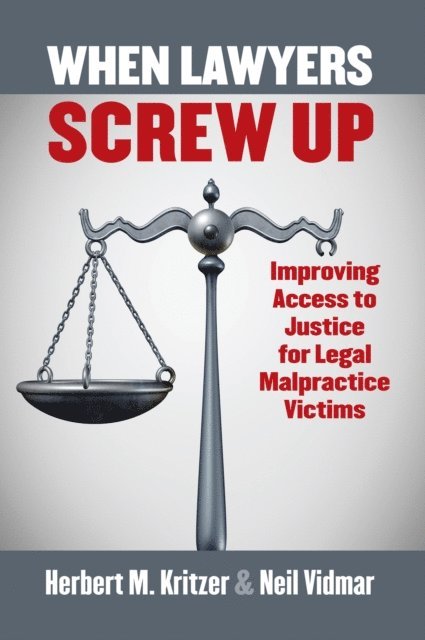
Unhappy clients bring thousands of legal malpractice claims every year, against mega law firms and solo practitioners, for simple errors or egregious misconduct, and for losses than can reach $100 million or more. This in an industry, legal services, generating nearly $300 billion a year in revenue and touching every facet of American society. Yet, scant if any scholarly attention has been paid to the questions and consequences of lawyers’ professional liability. This book is the first to fully explore the mistakes lawyers sometimes make, the nature of these mistakes, the harm they do, and the significant disparities in outcomes for corporate and individual victims of lawyers’ errors.A systematic, empirical study of legal malpractice, When Lawyers Screw Up employs both quantitative and qualitative methods to examine the frequency and nature of claims, the area of practice producing them, the amounts at stake, and the resolutions. The authors also use a range of data sources to study the frequency and outcomes of legal malpractice trials, whether bench or jury. Their comparison of legal malpractice cases involving the corporate and personal service sectors reveal the difficulties confronting claims coming from the personal sector—difficulties that often deny victims redress, even when they have suffered significant harm.When Lawyers Screw Up draws on a series of interviews to describe the practices of lawyers with expertise in handling legal malpractice claims, even as it notes how few such experts are available to prosecute these claims. In light of their findings, the authors suggest a range of reforms that would help victims of legal malpractice, particularly individuals and small businesses, in pursuing their claims.
635 kr
Läs direkt efter köp
Unhappy clients bring thousands of legal malpractice claims every year, against mega law firms and solo practitioners, for simple errors or egregious misconduct, and for losses than can reach $100 million or more. This in an industry, legal services, generating nearly $300 billion a year in revenue and touching every facet of American society. Yet, scant if any scholarly attention has been paid to the questions and consequences of lawyers’ professional liability. This book is the first to fully explore the mistakes lawyers sometimes make, the nature of these mistakes, the harm they do, and the significant disparities in outcomes for corporate and individual victims of lawyers’ errors.A systematic, empirical study of legal malpractice, When Lawyers Screw Up employs both quantitative and qualitative methods to examine the frequency and nature of claims, the area of practice producing them, the amounts at stake, and the resolutions. The authors also use a range of data sources to study the frequency and outcomes of legal malpractice trials, whether bench or jury. Their comparison of legal malpractice cases involving the corporate and personal service sectors reveal the difficulties confronting claims coming from the personal sector—difficulties that often deny victims redress, even when they have suffered significant harm.When Lawyers Screw Up draws on a series of interviews to describe the practices of lawyers with expertise in handling legal malpractice claims, even as it notes how few such experts are available to prosecute these claims. In light of their findings, the authors suggest a range of reforms that would help victims of legal malpractice, particularly individuals and small businesses, in pursuing their claims.