Herbert Venghaus - Böcker
Visar alla böcker från författaren Herbert Venghaus. Handla med fri frakt och snabb leverans.
6 produkter
6 produkter
Del 161 - Springer Series in Optical Sciences
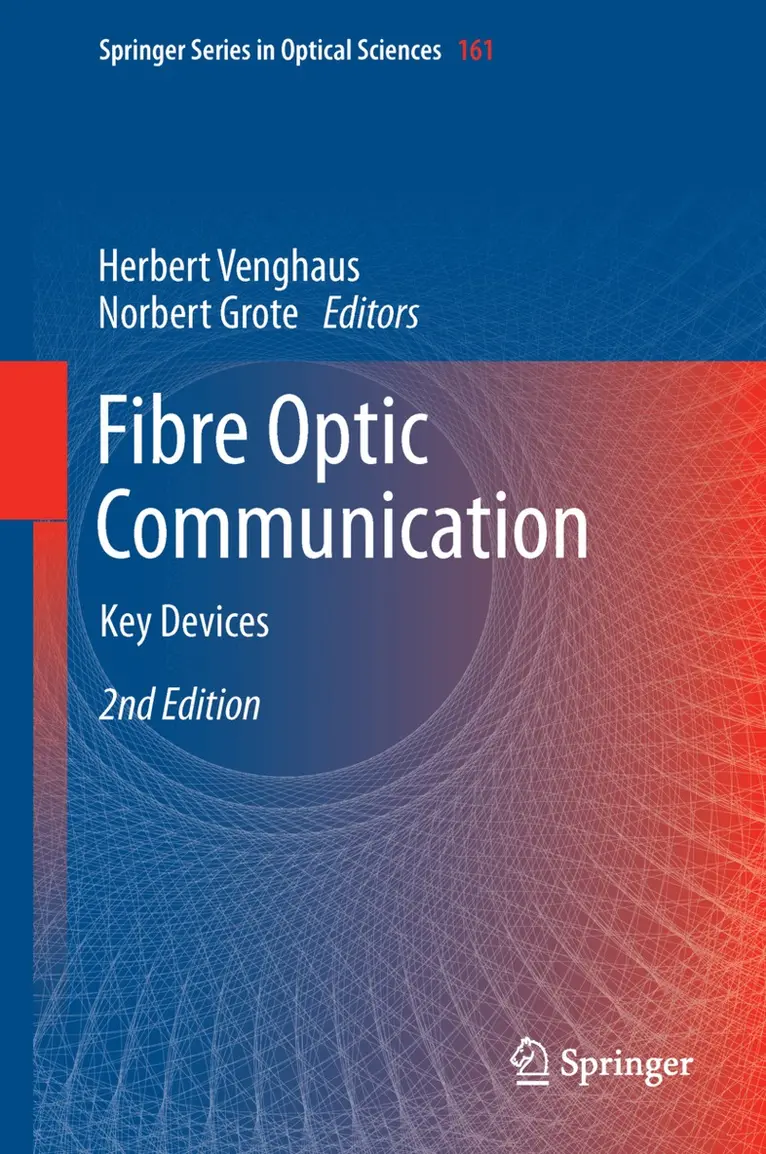
Fibre Optic Communication
Key Devices
Inbunden, Engelska, 2017
3 149 kr
Skickas inom 10-15 vardagar
Devices treated include semiconductor lasers, optical amplifiers, modulators, wavelength filters and other passives, detectors, all-optical switches, but relevant properties of optical fibres and network aspects are included as well.
Del 161 - Springer Series in Optical Sciences
Fibre Optic Communication
Key Devices
Häftad, Engelska, 2018
3 149 kr
Skickas inom 10-15 vardagar
Devices treated include semiconductor lasers, optical amplifiers, modulators, wavelength filters and other passives, detectors, all-optical switches, but relevant properties of optical fibres and network aspects are included as well.
Del 123 - Springer Series in Optical Sciences
Wavelength Filters in Fibre Optics
Inbunden, Engelska, 2006
1 578 kr
Skickas inom 10-15 vardagar
Information and communication technologies have been growing and - veloping steadily for as long as any of us can remember. Growth was p- ticularly strong in the last few decades, and fibre optic communication s- tems have become predominant whenever information is to be transmitted over medium or long distances. Even when the ‘telecommunication bubble’ burst at the beginning of the new millennium, the only thing which vanished was the expectation of making a fortune by buying and reselling telecom device and equipment manufacturing companies; the upgrading of existing fibre optic links and the deployment of new ones continued unabated. The reason for the predominance of communication via optical fibres is the vast amount of information a single fibre can carry. However, in order to take advantage of this potential, it is mandatory to transmit different wavelength channels simultaneously over a single optical fibre, and the handling of these wavelength channels requires wavelength selective - vices or wavelength filters. Among the functionalities optical filters have to accomplish are the selection of single or several channels out of a larger number of channels, the separation of one channel wavelength from - wanted spurious noise at different wavelengths, filters have to support routing, enable the lossless (or low loss) combination of wavelengths, and they have to compensate for wavelength dispersion effects.
1 064 kr
Skickas inom 10-15 vardagar
The book covers all essential elements of current and next generation fibre optic networks, including many that are ignored in other books. The reader gains an in-depth understanding of the current and future capabilities of fibre optic communication networks. He can estimate what fibre optics has to provide and where its (current and long-term) limitations may lie. Optoelectronic devices and glass fibres are the basis of contemporary communication systems. The book deals with the various components of these systems such as lasers, amplifiers, modulation devices, converters, optical switches, filters, detectors, emitters, sensors and fibre transfer systems. A systematic evaluation of the state of the art in related technological research and the level reached in application is given.
Del 123 - Springer Series in Optical Sciences
Wavelength Filters in Fibre Optics
Häftad, Engelska, 2010
1 578 kr
Skickas inom 10-15 vardagar
Information and communication technologies have been growing and - veloping steadily for as long as any of us can remember. Growth was p- ticularly strong in the last few decades, and fibre optic communication s- tems have become predominant whenever information is to be transmitted over medium or long distances. Even when the ‘telecommunication bubble’ burst at the beginning of the new millennium, the only thing which vanished was the expectation of making a fortune by buying and reselling telecom device and equipment manufacturing companies; the upgrading of existing fibre optic links and the deployment of new ones continued unabated. The reason for the predominance of communication via optical fibres is the vast amount of information a single fibre can carry. However, in order to take advantage of this potential, it is mandatory to transmit different wavelength channels simultaneously over a single optical fibre, and the handling of these wavelength channels requires wavelength selective - vices or wavelength filters. Among the functionalities optical filters have to accomplish are the selection of single or several channels out of a larger number of channels, the separation of one channel wavelength from - wanted spurious noise at different wavelengths, filters have to support routing, enable the lossless (or low loss) combination of wavelengths, and they have to compensate for wavelength dispersion effects.
1 064 kr
Skickas inom 10-15 vardagar
Modern communication technologies have revolutionized society and econ omy on a global scale, and progress in this field is still breathtaking. Among the crucial features of these developments is the possibility to transmit/receive ever-increasing bit rates at lower and lower cost. This is due to some ex tent to improved electronics, but it is much more due to the capabilities of opticaL fibre-based communication systems. Optical communication tech nologies were initially introduced in order to improve traditional information exchange, but they have recently become a key prerequisite for the tremen dous growth in internet traffic, and optical technologies will be even more important in enabling and supporting the future expansion of internet traffic with annual growth rates forecast at 100%-200%. It is the purpose of the present book to describe the enabling components of optical communication systems, in particular their fundamentals, principles and current status, as well as the potential for future developments. Following such a scheme, it is the editors' hope that this book will not only attract the attention of experts already working in the field, but be, at least, likewise directed to interested newcomers. The book is organized into eleven chapters addressing the essential optical and optoelectronic components which form the hardware basis of today's, and most likely of future, optical networks.