Herman Verbist – författare
2 596 kr
Läs direkt efter köp
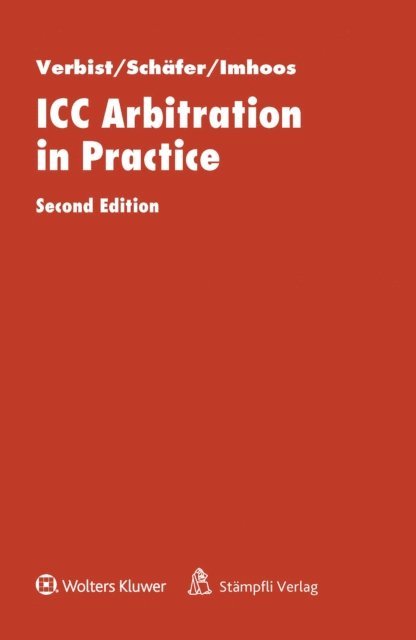
The Rules of Arbitration of the International Chamber of Commerce - commonly referred to as the ICC Rules — are the rules most frequently used in commercial disputes between business partners from different countries. Since they were first launched in 1922, these Rules have been applied in over 21,000 cases.
The second revised edition of this eminently practical volume provides an article-by-article commentary of the current version of the ICC Rules of Arbitration in force as from 1 January 2012. Using clear and concise language, unencumbered by footnotes and illustrated by flow diagrams, the authors guide the reader through the various stages of ICC arbitration proceedings, from initiation to the final award. This thorough analysis is enhanced with other invaluable material, including:
• a digest of statistics relating to ICC arbitration for the years 2009 to 2013;• references to selected national arbitration laws and to the UNCITRAL Model Law on International Commercial Arbitration;• a bibliography, including useful web sites; and• a separate chapter on ICC’s other dispute resolution services, such as mediation, expert proceedings, dispute boards, DOCDEX and the pre-arbitral referee procedure.Appendices provide the reader with the texts of ICC’s various dispute resolution rules and other relevant documents.
The authors, all practicing lawyers, have all worked as counsel at the Secretariat of the ICC International Court of Arbitration. They have gone on to represent parties and act as arbitrators in many international proceedings. They also serve as mediators and party representatives in international mediations. They are also members of the ICC Commission on Arbitration and ADR and participated in the discussions leading to the 2012 ICC Rules of Arbitration.
Written from a practical perspective, this book remains an essential resource for company lawyers who wish to familiarize themselves with ICC arbitration, assess the pros and cons of entering into an arbitration clause referring to the ICC Rules, or obtain information and guidance on how to proceed in a given situation. Arbitration practitioners will find useful information on the practice of ICC arbitration, including various notes of the ICC Court Secretariat and reports of the ICC Commission on Arbitration and ADR.
2 596 kr
Läs direkt efter köp
The Rules of Arbitration of the International Chamber of Commerce - commonly referred to as the ICC Rules — are the rules most frequently used in commercial disputes between business partners from different countries. Since they were first launched in 1922, these Rules have been applied in over 21,000 cases.
The second revised edition of this eminently practical volume provides an article-by-article commentary of the current version of the ICC Rules of Arbitration in force as from 1 January 2012. Using clear and concise language, unencumbered by footnotes and illustrated by flow diagrams, the authors guide the reader through the various stages of ICC arbitration proceedings, from initiation to the final award. This thorough analysis is enhanced with other invaluable material, including:
• a digest of statistics relating to ICC arbitration for the years 2009 to 2013;• references to selected national arbitration laws and to the UNCITRAL Model Law on International Commercial Arbitration;• a bibliography, including useful web sites; and• a separate chapter on ICC’s other dispute resolution services, such as mediation, expert proceedings, dispute boards, DOCDEX and the pre-arbitral referee procedure.Appendices provide the reader with the texts of ICC’s various dispute resolution rules and other relevant documents.
The authors, all practicing lawyers, have all worked as counsel at the Secretariat of the ICC International Court of Arbitration. They have gone on to represent parties and act as arbitrators in many international proceedings. They also serve as mediators and party representatives in international mediations. They are also members of the ICC Commission on Arbitration and ADR and participated in the discussions leading to the 2012 ICC Rules of Arbitration.
Written from a practical perspective, this book remains an essential resource for company lawyers who wish to familiarize themselves with ICC arbitration, assess the pros and cons of entering into an arbitration clause referring to the ICC Rules, or obtain information and guidance on how to proceed in a given situation. Arbitration practitioners will find useful information on the practice of ICC arbitration, including various notes of the ICC Court Secretariat and reports of the ICC Commission on Arbitration and ADR.
2 621 kr
Skickas inom 5-8 vardagar
2 312 kr
Läs direkt efter köp
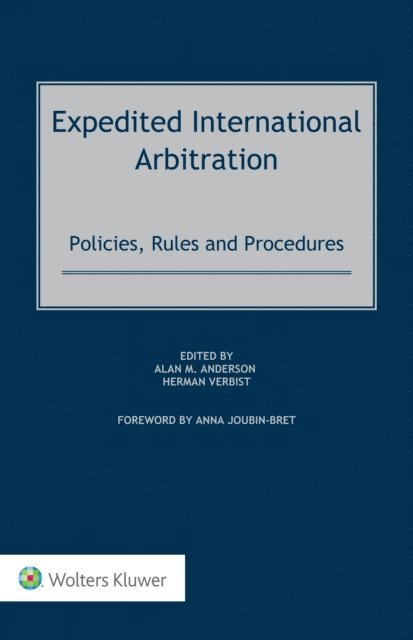
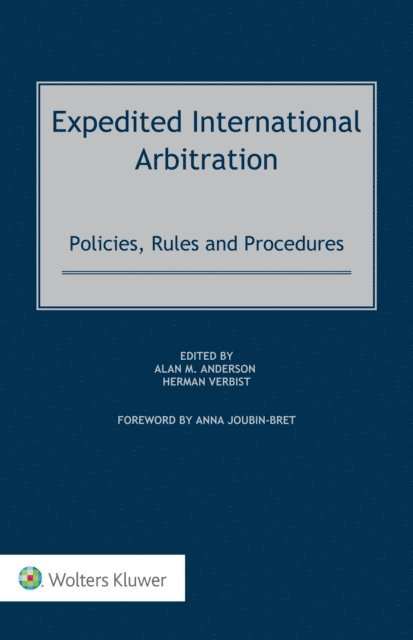
Increasingly, international commercial arbitration has come to resemble the judicial process it was intended to replace, especially in terms of speed, costs and efficiency. Arbitration institutions worldwide have adopted rules or procedures to expedite the arbitral process to address these concerns. This book brings together thirty-one distinguished practitioners, academics and experts in the field from around the world to consider in nineteen chapters how these policies and procedures, including the 2021 UNCITRAL Expedited Arbitration Rules, operate and affect international commercial arbitration, investor-State arbitration and mediation.
This book presents diverse and rich perspectives on the variety of methods adopted to provide an expeditious and cost-effective means for dispute resolution while recognizing the due process risks involved. Its comprehensive analysis of the case for expedited arbitration and the principles underpinning it covers such aspects as:
expedited arbitration rules adopted by major arbitration institutions;
expedited arbitration rules in the ‘ad hoc’ (non-institutional) context, including the UNCITRAL Expedited Arbitration Rules and UNCITRAL model clauses;
expedited arbitration rules in various geographic regions, including China, Southeast Asia, the Caribbean, and the Middle East, focusing on specific jurisdictions in each region;
new ICSID rules on mediation of investor-State disputes; and
expedited arbitration-mediation (Arb-Med) in the Far East, focusing on Macau.
Arbitrators and parties to international agreements will gain a greater understanding of the issues, options, and consequences that may result from expedited arbitration. Practitioners will benefit from guidance in drafting arbitration clauses and in weighing the advantages and disadvantages of expedited arbitration procedures in various jurisdictions. The insights in this book will benefit international commercial arbitration as its stakeholders seek to return international commercial arbitration to its foundational underpinnings: a prompt, efficacious and cost-effective means of resolving commercial disputes.
2 231 kr
Läs direkt efter köp
Increasingly, international commercial arbitration has come to resemble the judicial process it was intended to replace, especially in terms of speed, costs and efficiency. Arbitration institutions worldwide have adopted rules or procedures to expedite the arbitral process to address these concerns. This book brings together thirty-one distinguished practitioners, academics and experts in the field from around the world to consider in nineteen chapters how these policies and procedures, including the 2021 UNCITRAL Expedited Arbitration Rules, operate and affect international commercial arbitration, investor-State arbitration and mediation.
This book presents diverse and rich perspectives on the variety of methods adopted to provide an expeditious and cost-effective means for dispute resolution while recognizing the due process risks involved. Its comprehensive analysis of the case for expedited arbitration and the principles underpinning it covers such aspects as:
expedited arbitration rules adopted by major arbitration institutions;
expedited arbitration rules in the ‘ad hoc’ (non-institutional) context, including the UNCITRAL Expedited Arbitration Rules and UNCITRAL model clauses;
expedited arbitration rules in various geographic regions, including China, Southeast Asia, the Caribbean, and the Middle East, focusing on specific jurisdictions in each region;
new ICSID rules on mediation of investor-State disputes; and
expedited arbitration-mediation (Arb-Med) in the Far East, focusing on Macau.
Arbitrators and parties to international agreements will gain a greater understanding of the issues, options, and consequences that may result from expedited arbitration. Practitioners will benefit from guidance in drafting arbitration clauses and in weighing the advantages and disadvantages of expedited arbitration procedures in various jurisdictions. The insights in this book will benefit international commercial arbitration as its stakeholders seek to return international commercial arbitration to its foundational underpinnings: a prompt, efficacious and cost-effective means of resolving commercial disputes.