HIROTAKA NAKAYAMA – författare
Visar alla böcker från författaren HIROTAKA NAKAYAMA. Handla med fri frakt och snabb leverans.
8 produkter
8 produkter
E-bok
PDF, Engelska, 19851 662 kr
Läs direkt efter köp
In this book, we study theoretical and practical aspects of computing methods for mathematical modelling of nonlinear systems. A number of computing techniques are considered, such as methods of operator approximation with any given accuracy; operator interpolation techniques including a non-Lagrange interpolation; methods of system representation subject to constraints associated with concepts of causality, memory and stationarity; methods of system representation with an accuracy that is the best within a given class of models; methods of covariance matrix estimation;methods for low-rank matrix approximations; hybrid methods based on a combination of iterative procedures and best operator approximation; andmethods for information compression and filtering under condition that a filter model should satisfy restrictions associated with causality and different types of memory.As a result, the book represents a blend of new methods in general computational analysis,and specific, but also generic, techniques for study of systems theory ant its particularbranches, such as optimal filtering and information compression.- Best operator approximation,- Non-Lagrange interpolation,- Generic Karhunen-Loeve transform- Generalised low-rank matrix approximation- Optimal data compression- Optimal nonlinear filtering
Del 285 - Lecture Notes in Economics and Mathematical Systems
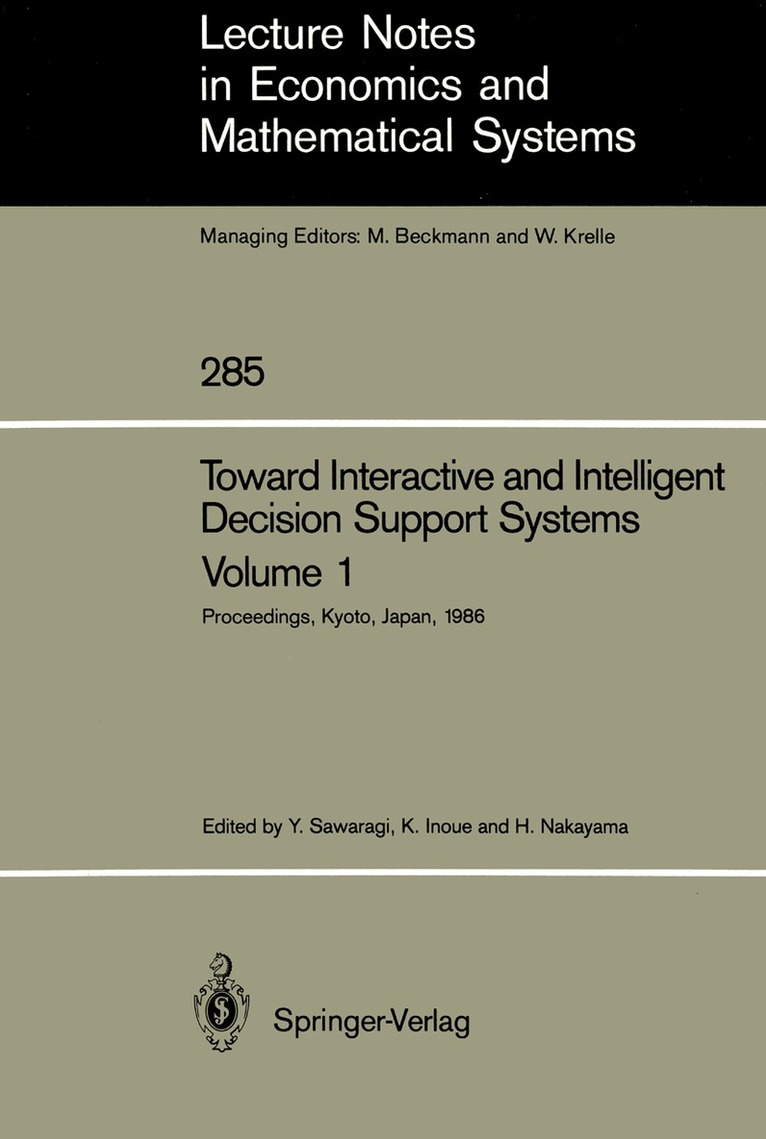
Toward Interactive and Intelligent Decision Support Systems
Volume 1 Proceedings of the Seventh International Conference on Multiple Criteria Decision Making, Held at Kyoto, Japan, August 18–22, 1986
Häftad, Engelska, 1987
1 116 kr
Skickas inom 10-15 vardagar
These proceedings include papers presented at the VII-th Internatio nal Conference on Multiple Criteria Decision Making which was held in Kyoto/Japan on August 18-22, 1986. Multiple Criteria Decision Making (MCDM) has been a greatly import ant subject in many practical fields, for example, in planning, design, control and management in both private and public sectors. After remark able developments of theory, methodology and pilot case studies in rec ent years, it is now facing the stage of real applications and develop ment of more sophisticated methodology as interactive intelligent decision support systems. The conference aimed to provide a significant contribu tion to the future of MCDM as one of total systems including human factors: Substantial emphasis was given to knowledge engineering and cognitive sci ence. The conference inherits the tradition and the style of the previous conferences: (1) Jouy-en-Josas/France (1975), (2) Buffalo/U.S.A. (1977), (3) Konigswinter/FRG (1978), (4) Delaware/U.S.A. (1980), (5) Mons/Belgium (1982), (6) Cleveland/U.S.A. (1984). This time a great many Japanese com panies provided grants for the conference. As a result, the total number of participants was over 120, and a computer demonstration could be reali zed on an extensive scale as well as the conference sessions. Throughout the conference, it was observed that MCDM is making steady progress not only in theory but also as a tool for decision support.
Del 286 - Lecture Notes in Economics and Mathematical Systems
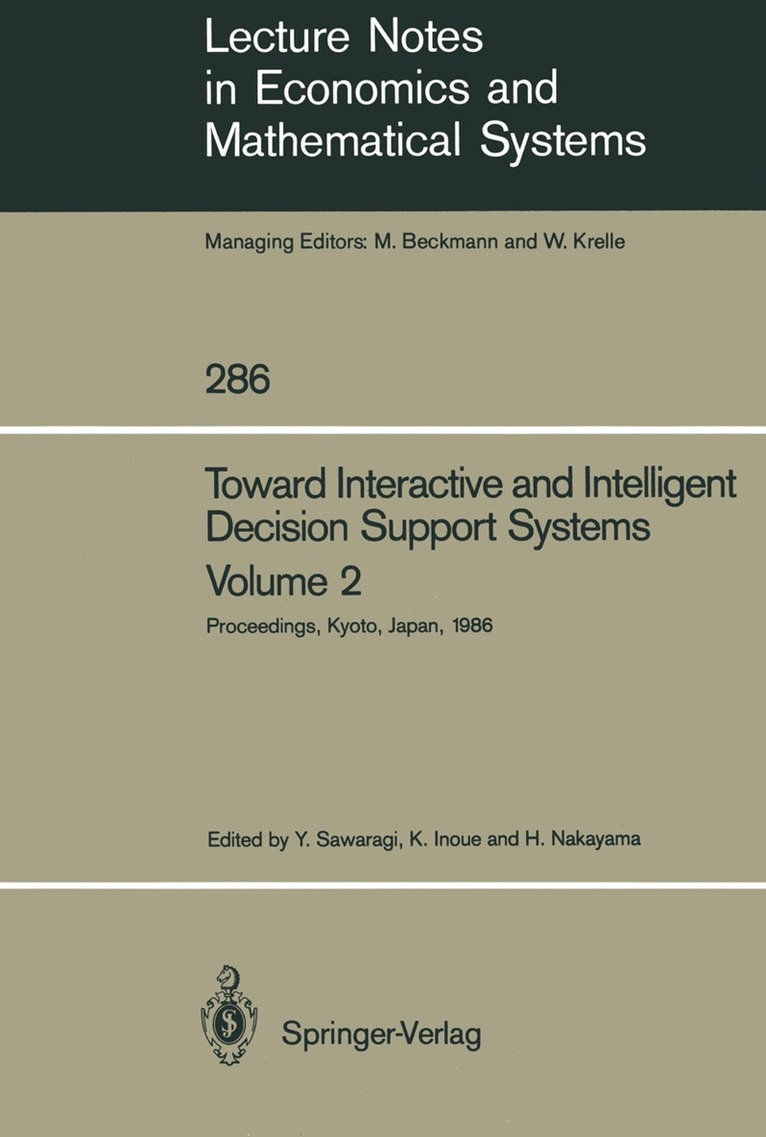
Toward Interactive and Intelligent Decision Support Systems
Volume 2 Proceedings of the Seventh International Conference on Multiple Criteria Decision Making Held at Kyoto, Japan August 18–22, 1986
Häftad, Engelska, 1987
1 116 kr
Skickas inom 10-15 vardagar
In the past, technological as well as economic forces dominated the evolution of industrial structures: these factors have been treated extensively in numerous studies. However, another major factor which has begun to have a decisive influ ence on the performance of the chemical industry is technological risk and public and environmental health considerations, in particular those related to toxic and hazardous substances used in industrial production processes. The issues of con trolling process risk, waste streams, and potential environmental consequences of accidental or routine release of hazardous chemicals are rapidly gaining in impor tance vis CI vis narrow economic considerations, and are increasingly reflected in national and international legislation. In the context of several ongoing R&D projects aiming at the development of a new generation of tools for "intelligent" decision support, two related problem areas that have been identified are: (i) Structuring the industry or plant for the minimum cost of production as well as least risk - e.g., toxicity of chemicals involved. In this multi-criteria framework, we seek to resolve the conflict between industrial structure or plant design established by economic considerations and the one shaped by environmental concerns. This can be formulated as a design problem for nor mal production conditions. In section 3.1. and 3.2. an approach on how to deal with this problem at the industry and plant level is discussed.
Inbunden, Engelska, 2009
1 623 kr
Skickas inom 10-15 vardagar
Many kinds of practical problems such as engineering design, industrial m- agement and ?nancial investment have multiple objectives con?icting with eachother. Thoseproblemscanbeformulatedasmultiobjectiveoptimization. In multiobjective optimization, there does not necessarily a unique solution which minimizes (or maximizes) all objective functions. We usually face to the situation in which if we want to improve some of objectives, we have to give up other objectives. Finally, we pay much attention on how much to improve some of objectives and instead how much to give up others. This is called “trade-o?. ” Note that making trade-o? is a problem of value ju- ment of decision makers. One of main themes of multiobjective optimization is how to incorporate value judgment of decision makers into decision s- port systems. There are two major issues in value judgment (1) multiplicity of value judgment and (2) dynamics of value judgment. The multiplicity of value judgment is treated as trade-o? analysis in multiobjective optimi- tion. On the other hand, dynamics of value judgment is di?cult to treat. However, it is natural that decision makers change their value judgment even in decision making process, because they obtain new information during the process. Therefore, decision support systems are to be robust against the change of value judgment of decision makers. To this aim, interactive p- grammingmethodswhichsearchasolutionwhileelicitingpartialinformation on value judgment of decision makers have been developed. Those methods are required to perform ?exibly for decision makers’ attitude.
E-bok
PDF, Engelska, 20092 049 kr
Läs direkt efter köp
Many kinds of practical problems such as engineering design, industrial m- agement and ?nancial investment have multiple objectives con?icting with eachother. Thoseproblemscanbeformulatedasmultiobjectiveoptimization. In multiobjective optimization, there does not necessarily a unique solution which minimizes (or maximizes) all objective functions. We usually face to the situation in which if we want to improve some of objectives, we have to give up other objectives. Finally, we pay much attention on how much to improve some of objectives and instead how much to give up others. This is called “trade-o?. ” Note that making trade-o? is a problem of value ju- ment of decision makers. One of main themes of multiobjective optimization is how to incorporate value judgment of decision makers into decision s- port systems. There are two major issues in value judgment (1) multiplicity of value judgment and (2) dynamics of value judgment. The multiplicity of value judgment is treated as trade-o? analysis in multiobjective optimi- tion. On the other hand, dynamics of value judgment is di?cult to treat. However, it is natural that decision makers change their value judgment even in decision making process, because they obtain new information during the process. Therefore, decision support systems are to be robust against the change of value judgment of decision makers. To this aim, interactive p- grammingmethodswhichsearchasolutionwhileelicitingpartialinformation on value judgment of decision makers have been developed. Those methods are required to perform ?exibly for decision makers’ attitude.
Häftad, Engelska, 2011
1 623 kr
Skickas inom 10-15 vardagar
Many kinds of practical problems such as engineering design, industrial m- agement and ?nancial investment have multiple objectives con?icting with eachother. Thoseproblemscanbeformulatedasmultiobjectiveoptimization. In multiobjective optimization, there does not necessarily a unique solution which minimizes (or maximizes) all objective functions. We usually face to the situation in which if we want to improve some of objectives, we have to give up other objectives. Finally, we pay much attention on how much to improve some of objectives and instead how much to give up others. This is called “trade-o?. ” Note that making trade-o? is a problem of value ju- ment of decision makers. One of main themes of multiobjective optimization is how to incorporate value judgment of decision makers into decision s- port systems. There are two major issues in value judgment (1) multiplicity of value judgment and (2) dynamics of value judgment. The multiplicity of value judgment is treated as trade-o? analysis in multiobjective optimi- tion. On the other hand, dynamics of value judgment is di?cult to treat. However, it is natural that decision makers change their value judgment even in decision making process, because they obtain new information during the process. Therefore, decision support systems are to be robust against the change of value judgment of decision makers. To this aim, interactive p- grammingmethodswhichsearchasolutionwhileelicitingpartialinformation on value judgment of decision makers have been developed. Those methods are required to perform ?exibly for decision makers’ attitude.
E-bok
PDF, Engelska, 20121 459 kr
Läs direkt efter köp
These proceedings include papers presented at the VII-th Internatio nal Conference on Multiple Criteria Decision Making which was held in Kyoto/Japan on August 18-22, 1986. Multiple Criteria Decision Making (MCDM) has been a greatly import ant subject in many practical fields, for example, in planning, design, control and management in both private and public sectors. After remark able developments of theory, methodology and pilot case studies in rec ent years, it is now facing the stage of real applications and develop ment of more sophisticated methodology as interactive intelligent decision support systems. The conference aimed to provide a significant contribu tion to the future of MCDM as one of total systems including human factors: Substantial emphasis was given to knowledge engineering and cognitive sci ence. The conference inherits the tradition and the style of the previous conferences: (1) Jouy-en-Josas/France (1975), (2) Buffalo/U.S.A. (1977), (3) Konigswinter/FRG (1978), (4) Delaware/U.S.A. (1980), (5) Mons/Belgium (1982), (6) Cleveland/U.S.A. (1984). This time a great many Japanese com panies provided grants for the conference. As a result, the total number of participants was over 120, and a computer demonstration could be reali zed on an extensive scale as well as the conference sessions. Throughout the conference, it was observed that MCDM is making steady progress not only in theory but also as a tool for decision support.
E-bok
PDF, Engelska, 20121 420 kr
Läs direkt efter köp
In the past, technological as well as economic forces dominated the evolution of industrial structures: these factors have been treated extensively in numerous studies. However, another major factor which has begun to have a decisive influ ence on the performance of the chemical industry is technological risk and public and environmental health considerations, in particular those related to toxic and hazardous substances used in industrial production processes. The issues of con trolling process risk, waste streams, and potential environmental consequences of accidental or routine release of hazardous chemicals are rapidly gaining in impor tance vis CI vis narrow economic considerations, and are increasingly reflected in national and international legislation. In the context of several ongoing R&D projects aiming at the development of a new generation of tools for "intelligent" decision support, two related problem areas that have been identified are: (i) Structuring the industry or plant for the minimum cost of production as well as least risk - e.g., toxicity of chemicals involved. In this multi-criteria framework, we seek to resolve the conflict between industrial structure or plant design established by economic considerations and the one shaped by environmental concerns. This can be formulated as a design problem for nor mal production conditions. In section 3.1. and 3.2. an approach on how to deal with this problem at the industry and plant level is discussed.