
Horace W. Davenport – författare
Visar alla böcker från författaren Horace W. Davenport. Handla med fri frakt och snabb leverans.
2 produkter
2 produkter
Häftad, Engelska, 1974
314 kr
Skickas inom 5-8 vardagar
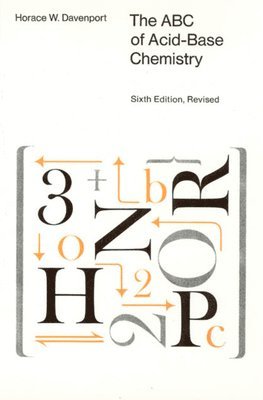
The ABC of Acid-Base Chemistry provides physiologists, medical students, and physicians with an intelligible outline of the elements of physiological acid-base chemistry. This new edition of Horace W. Davenport's standard text takes into account different ways of looking at the problems of acid-base derived from new instrumentation. The exposition has been modified to allow the student to apply his understanding to other systems of description of the acid-base status. Although the pH system has been retained, there is increasing emphasis on the use of hydrogen ion concentration. Topics discussed include: partial pressure of gases, composition of alveolar gas, transport of oxygen and carbon dioxide in the blood, buffer action of hemoglobin and seperated plasma, oxygenated whole blood and reduced blood, concepts of base excess and base deficit, and chemical regulation of respiration. "Any reader who clearly understands the subject matter of this book will have a firm grounding in the principles of the subject; I find it the clearest text of this type that I have read."—British Journal of Hospital Medicine "This little book is of great value to chemically trained physicians and medical students who want to get a clearer idea of the physiology of acid base chemistry in the blood."—The Journal of Gastroenterology
E-bok
PDF, Engelska, 20131 148 kr
Läs direkt efter köp
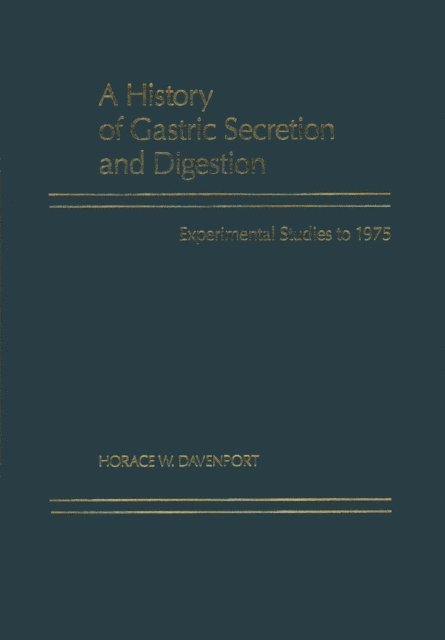
For centuries men speculated about the process of gastric digestion, but Iate in the eighteenth and early in the nineteenth centuries physiologists, both physicians and laymen, began to accumulate experimental evidence about its nature. At the same time, others discovered that the stomach is capable of secreting a strong mineral acid, and the questions of how that secretion is produced and how it is controlled became enduring problems. A Iittle later, the discovery that an acid extract of dead gastric mucosa is capable of digesting meat put the study of gastric secretion and digestion on a firm mechanistic foundation. From that time to the present, physi ologists have assiduously investigated gastric secretion and digestion, with the result that knowledge ofthose topics is as comprehensive and penetrating as isthat about other physiological processes. In addition, that knowledge is the basis of discrimi nating and effective clinical practice. I have described the experimental study of gastric secretion and digestion for two reasons. The firstisthat the successes and some ofthe failures ofphysiologists over two centuries are important parts of intellectual history that deserve to be recorded. The second is that some of those who use the accumulated knowledge every day are curious about its genesis. I assume that my readers have the technical knowledge to understand what I have written. If my account does not fully satisfy their curiosity, I have provided references that will open the path to further study.