Howard Bowman – författare
Visar alla böcker från författaren Howard Bowman. Handla med fri frakt och snabb leverans.
8 produkter
8 produkter
E-bok
PDF, Engelska, 20162 840 kr
Läs direkt efter köp
This book presents the leading edge in several related fields, specifically object orientated programming, open distributed systems and formal methods for object oriented systems. With increased support within industry regarding these areas, this book captures the most up-to-date information on the subject. Many topics are discussed, including the following important areas: object oriented design and programming; formal specification of distributed systems; open distributed platforms; types, interfaces and behaviour; formalisation of object oriented methods.
Inbunden, Engelska, 1997
2 216 kr
Skickas inom 10-15 vardagar
This text presents the leading edge in several related fields, specifically object-orientated programming, open distributed systems and formal methods for object-oriented systems. Topics discussed include: object-oriented design and programming; formal specification of distributed systems; open distributed platforms; types, interfaces and behaviour; and formalization of object-oriented methods. This volume comprises the proceedings of the International Workshop on Formal Methods for Open Object-based Distributed Systems (FMOODS '97), sponsored by the International Federation for Information Processing (IFIP) held in Canterbury, United Kingdom, in July 1997.
Häftad, Engelska, 2011
700 kr
Skickas inom 7-10 vardagar
Originally published in 2002, this book presents techniques in the application of formal methods to object-based distributed systems. A major theme of the book is how to formally handle the requirements arising from OO distributed systems, such as dynamic reconfiguration, encapsulation, subtyping, inheritance, and real-time aspects. These may be supported either by enhancing existing notations, such as UML, LOTOS, SDL and Z, or by defining fresh notations, such as Actors, Pi-calculus and Ambients. The major specification notations and modelling techniques are introduced and compared by leading researchers. The book also includes a description of approaches to the specification of non-functional requirements, and a discussion of security issues. Researchers and practitioners in software design, object-oriented computing, distributed systems, and telecommunications systems will gain an appreciation of the relationships between the major areas of concerns and learn how the use of object-oriented based formal methods provides workable solutions.
Inbunden, Engelska, 2001
1 974 kr
Skickas inom 7-10 vardagar
Originally published in 2002, this book presents techniques in the application of formal methods to object-based distributed systems. A major theme of the book is how to formally handle the requirements arising from OO distributed systems, such as dynamic reconfiguration, encapsulation, subtyping, inheritance, and real-time aspects. These may be supported either by enhancing existing notations, such as UML, LOTOS, SDL and Z, or by defining fresh notations, such as Actors, Pi-calculus and Ambients. The major specification notations and modelling techniques are introduced and compared by leading researchers. The book also includes a description of approaches to the specification of non-functional requirements, and a discussion of security issues. Researchers and practitioners in software design, object-oriented computing, distributed systems, and telecommunications systems will gain an appreciation of the relationships between the major areas of concerns and learn how the use of object-oriented based formal methods provides workable solutions.
E-bok
PDF, Engelska, 20062 110 kr
Läs direkt efter köp
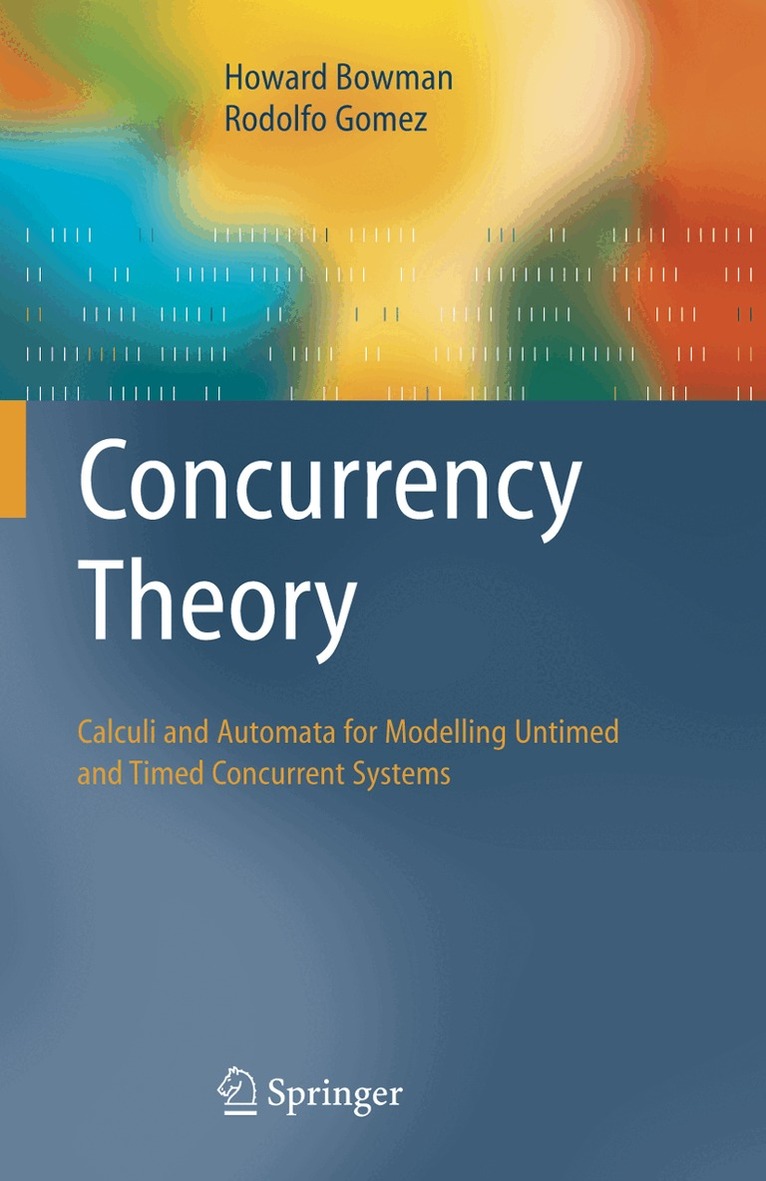
Intheworldweliveinconcurrencyisthenorm.Forexample,thehumanbody isamassivelyconcurrentsystem,comprisingahugenumberofcells,allsim- taneously evolving and independently engaging in their individual biological processing.Inaddition,inthebiologicalworld,trulysequentialsystemsrarely arise. However, they are more common when manmade artefacts are cons- ered. In particular, computer systems are often developed from a sequential perspective. Why is this? The simple reason is that it is easier for us to think about sequential, rather than concurrent, systems. Thus, we use sequentiality as a device to simplify the design process. However, the need for increasingly powerful, ?exible and usable computer systems mitigates against simplifying sequentiality assumptions. A good - ample of this is the all-powerful position held by the Internet, which is highly concurrent at many di?erent levels of decomposition. Thus, the modern c- puter scientist (and indeed the modern scientist in general) is forced to think aboutconcurrentsystemsandthesubtleandintricatebehaviourthatemerges from the interaction of simultaneously evolving components. Over a period of 25 years, or so, the ?eld of concurrency theory has been involved in the development of a set of mathematical techniques that can help system developers to think about and build concurrent systems. These theories are the subject matter of this book.
Häftad, Engelska, 2010
1 587 kr
Skickas inom 5-8 vardagar
Intheworldweliveinconcurrencyisthenorm.Forexample,thehumanbody isamassivelyconcurrentsystem,comprisingahugenumberofcells,allsim- taneously evolving and independently engaging in their individual biological processing.Inaddition,inthebiologicalworld,trulysequentialsystemsrarely arise. However, they are more common when manmade artefacts are cons- ered. In particular, computer systems are often developed from a sequential perspective. Why is this? The simple reason is that it is easier for us to think about sequential, rather than concurrent, systems. Thus, we use sequentiality as a device to simplify the design process. However, the need for increasingly powerful, ?exible and usable computer systems mitigates against simplifying sequentiality assumptions. A good - ample of this is the all-powerful position held by the Internet, which is highly concurrent at many di?erent levels of decomposition. Thus, the modern c- puter scientist (and indeed the modern scientist in general) is forced to think aboutconcurrentsystemsandthesubtleandintricatebehaviourthatemerges from the interaction of simultaneously evolving components. Over a period of 25 years, or so, the ?eld of concurrency theory has been involved in the development of a set of mathematical techniques that can help system developers to think about and build concurrent systems. These theories are the subject matter of this book.
Inbunden, Engelska, 2005
1 664 kr
Skickas inom 10-15 vardagar
Intheworldweliveinconcurrencyisthenorm.Forexample,thehumanbody isamassivelyconcurrentsystem,comprisingahugenumberofcells,allsim- taneously evolving and independently engaging in their individual biological processing.Inaddition,inthebiologicalworld,trulysequentialsystemsrarely arise. However, they are more common when manmade artefacts are cons- ered. In particular, computer systems are often developed from a sequential perspective. Why is this? The simple reason is that it is easier for us to think about sequential, rather than concurrent, systems. Thus, we use sequentiality as a device to simplify the design process. However, the need for increasingly powerful, ?exible and usable computer systems mitigates against simplifying sequentiality assumptions. A good - ample of this is the all-powerful position held by the Internet, which is highly concurrent at many di?erent levels of decomposition. Thus, the modern c- puter scientist (and indeed the modern scientist in general) is forced to think aboutconcurrentsystemsandthesubtleandintricatebehaviourthatemerges from the interaction of simultaneously evolving components. Over a period of 25 years, or so, the ?eld of concurrency theory has been involved in the development of a set of mathematical techniques that can help system developers to think about and build concurrent systems. These theories are the subject matter of this book.
Del 15 - Progress In Neural Processing
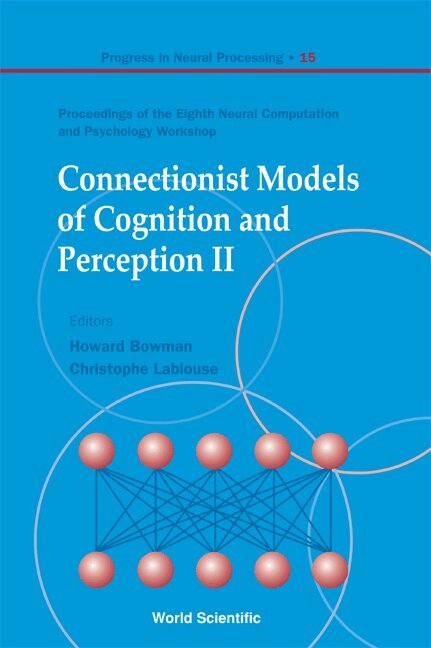
Connectionist Models Of Cognition And Perception Ii - Proceedings Of The Eighth Neural Computation And Psychology Workshop
Inbunden, Engelska, 2004
2 495 kr
Tillfälligt slut
This book collects together refereed versions of papers presented at the Eighth Neural Computation and Psychology Workshop (NCPW 8). NCPW is a well-established workshop series that brings together researchers from different disciplines, such as artificial intelligence, cognitive science, computer science, neurobiology, philosophy and psychology. The articles are centred on the theme of connectionist modelling of cognition and perceptionn.The proceedings have been selected for coverage in:• Index to Scientific & Technical Proceedings® (ISTP® / ISI Proceedings)• Index to Scientific & Technical Proceedings (ISTP CDROM version / ISI Proceedings)• Index to Social Sciences & Humanities Proceedings® (ISSHP® / ISI Proceedings)• Index to Social Sciences & Humanities Proceedings (ISSHP CDROM version / ISI Proceedings)• CC Proceedings — Engineering & Physical Sciences• CC Proceedings — Biomedical, Biological & Agricultural Sciences