
I.A. Ibragimov – författare
Visar alla böcker från författaren I.A. Ibragimov. Handla med fri frakt och snabb leverans.
4 produkter
4 produkter
Inbunden, Engelska, 1978
1 299 kr
Skickas inom 10-15 vardagar
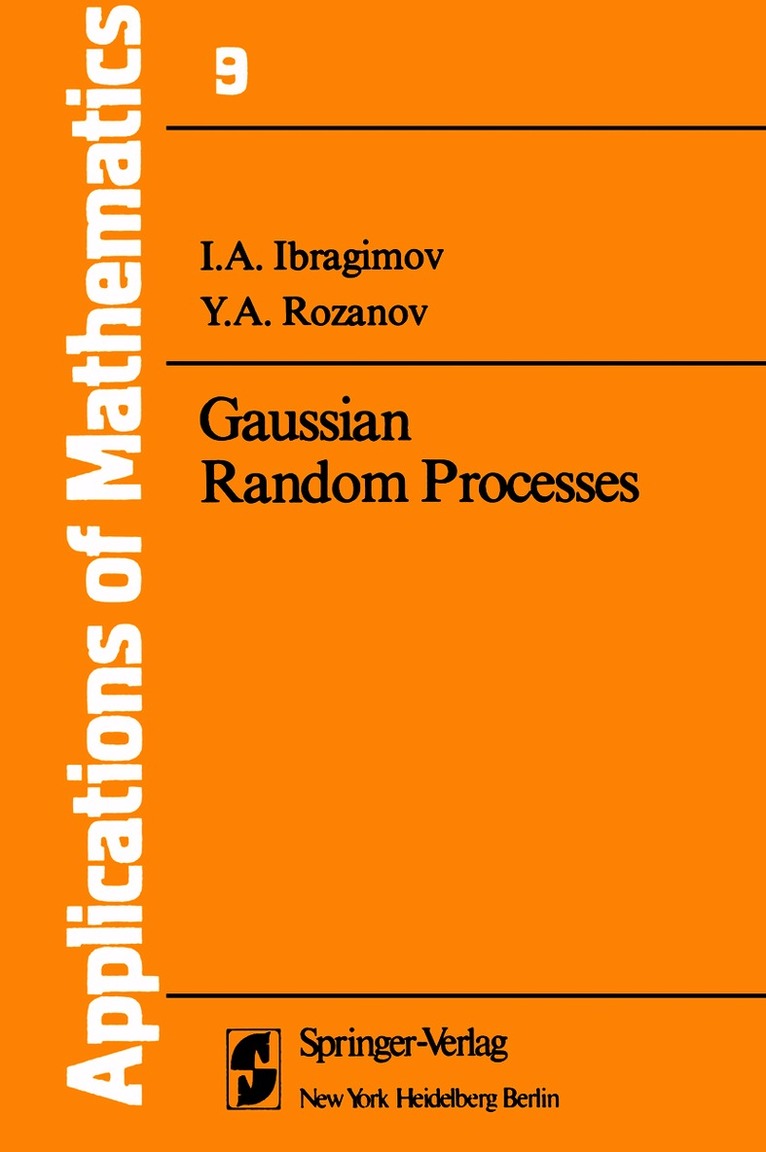
The book deals mainly with three problems involving Gaussian stationary processes. The first problem consists of clarifying the conditions for mutual absolute continuity (equivalence) of probability distributions of a "random process segment" and of finding effective formulas for densities of the equiva lent distributions. Our second problem is to describe the classes of spectral measures corresponding in some sense to regular stationary processes (in par ticular, satisfying the well-known "strong mixing condition") as well as to describe the subclasses associated with "mixing rate". The third problem involves estimation of an unknown mean value of a random process, this random process being stationary except for its mean, i. e. , it is the problem of "distinguishing a signal from stationary noise". Furthermore, we give here auxiliary information (on distributions in Hilbert spaces, properties of sam ple functions, theorems on functions of a complex variable, etc. ). Since 1958 many mathematicians have studied the problem of equivalence of various infinite-dimensional Gaussian distributions (detailed and sys tematic presentation of the basic results can be found, for instance, in [23]). In this book we have considered Gaussian stationary processes and arrived, we believe, at rather definite solutions. The second problem mentioned above is closely related with problems involving ergodic theory of Gaussian dynamic systems as well as prediction theory of stationary processes.
E-bok
PDF, Engelska, 2012712 kr
Läs direkt efter köp
The book deals mainly with three problems involving Gaussian stationary processes. The first problem consists of clarifying the conditions for mutual absolute continuity (equivalence) of probability distributions of a "random process segment" and of finding effective formulas for densities of the equiva lent distributions. Our second problem is to describe the classes of spectral measures corresponding in some sense to regular stationary processes (in par ticular, satisfying the well-known "strong mixing condition") as well as to describe the subclasses associated with "mixing rate". The third problem involves estimation of an unknown mean value of a random process, this random process being stationary except for its mean, i. e. , it is the problem of "distinguishing a signal from stationary noise". Furthermore, we give here auxiliary information (on distributions in Hilbert spaces, properties of sam ple functions, theorems on functions of a complex variable, etc. ). Since 1958 many mathematicians have studied the problem of equivalence of various infinite-dimensional Gaussian distributions (detailed and sys tematic presentation of the basic results can be found, for instance, in [23]). In this book we have considered Gaussian stationary processes and arrived, we believe, at rather definite solutions. The second problem mentioned above is closely related with problems involving ergodic theory of Gaussian dynamic systems as well as prediction theory of stationary processes.
Del 9 - Stochastic Modelling and Applied Probability
Gaussian Random Processes
Häftad, Engelska, 2011
545 kr
Skickas inom 10-15 vardagar
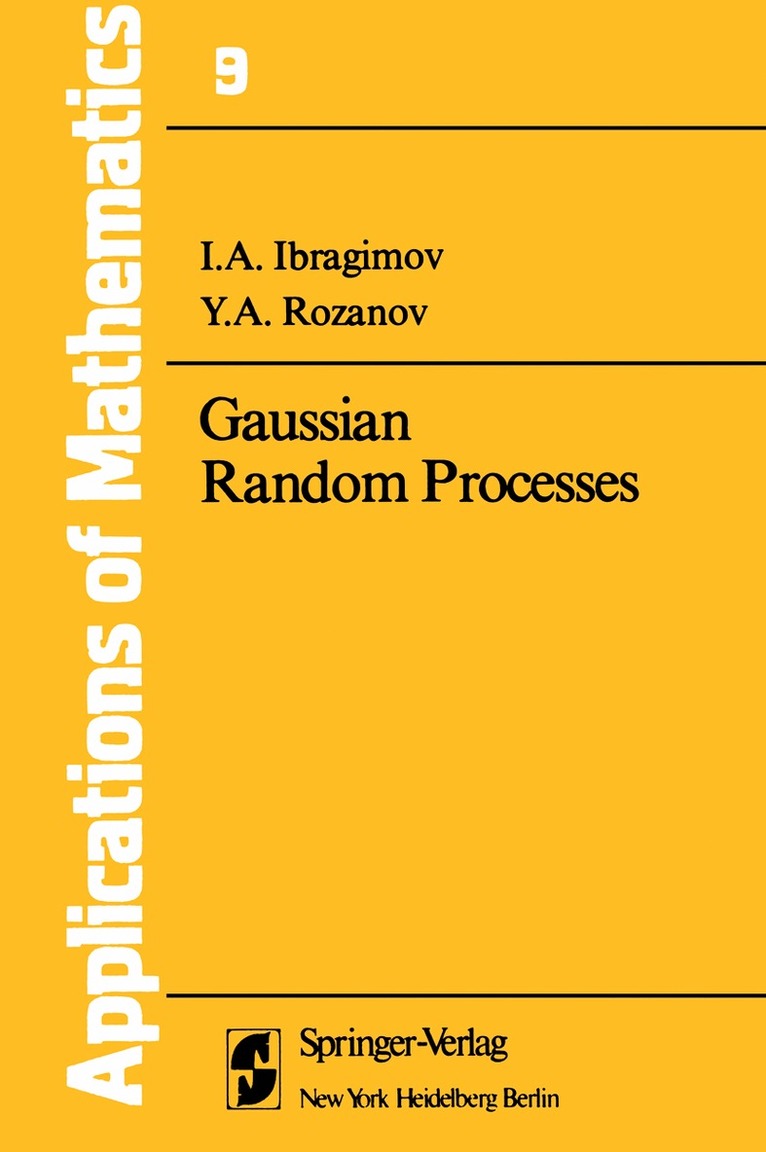
The book deals mainly with three problems involving Gaussian stationary processes. The first problem consists of clarifying the conditions for mutual absolute continuity (equivalence) of probability distributions of a "random process segment" and of finding effective formulas for densities of the equiva lent distributions. Our second problem is to describe the classes of spectral measures corresponding in some sense to regular stationary processes (in par ticular, satisfying the well-known "strong mixing condition") as well as to describe the subclasses associated with "mixing rate". The third problem involves estimation of an unknown mean value of a random process, this random process being stationary except for its mean, i. e. , it is the problem of "distinguishing a signal from stationary noise". Furthermore, we give here auxiliary information (on distributions in Hilbert spaces, properties of sam ple functions, theorems on functions of a complex variable, etc. ). Since 1958 many mathematicians have studied the problem of equivalence of various infinite-dimensional Gaussian distributions (detailed and sys tematic presentation of the basic results can be found, for instance, in [23]). In this book we have considered Gaussian stationary processes and arrived, we believe, at rather definite solutions. The second problem mentioned above is closely related with problems involving ergodic theory of Gaussian dynamic systems as well as prediction theory of stationary processes.
E-bok
PDF, Engelska, 20131 108 kr
Läs direkt efter köp
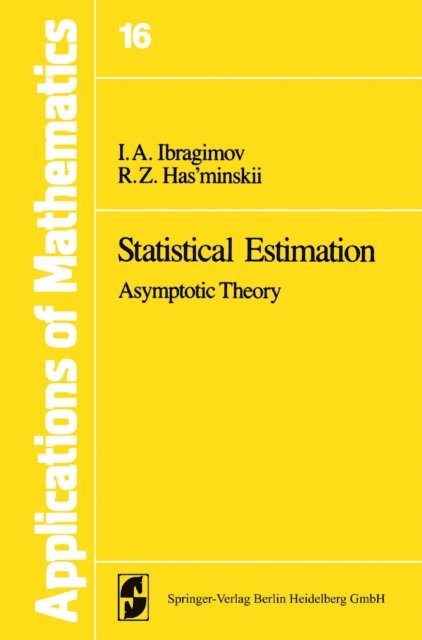
when certain parameters in the problem tend to limiting values (for example, when the sample size increases indefinitely, the intensity of the noise ap proaches zero, etc.) To address the problem of asymptotically optimal estimators consider the following important case. Let X 1, X 2, ... , X n be independent observations with the joint probability density !(x,O) (with respect to the Lebesgue measure on the real line) which depends on the unknown patameter o e 9 c R1. It is required to derive the best (asymptotically) estimator 0:( X b ... , X n) of the parameter O. The first question which arises in connection with this problem is how to compare different estimators or, equivalently, how to assess their quality, in terms of the mean square deviation from the parameter or perhaps in some other way. The presently accepted approach to this problem, resulting from A. Wald''s contributions, is as follows: introduce a nonnegative function w(0l> ( ), Ob Oe 9 (the loss function) and given two estimators Of and O! n 2 2 the estimator for which the expected loss (risk) Eown(Oj, 0), j = 1 or 2, is smallest is called the better with respect to Wn at point 0 (here EoO is the expectation evaluated under the assumption that the true value of the parameter is 0). Obviously, such a method of comparison is not without its defects.