Ian Ruxton – författare
Visar alla böcker från författaren Ian Ruxton. Handla med fri frakt och snabb leverans.
14 produkter
14 produkter
E-bok
Engelska, 201898 kr
Läs direkt efter köp
The second volume of Sir Ernest Satow''s diaries, 1912-1920 sees the publication of his seminal ''Guide to Diplomatic Practice'' in 1917, and preparations for the publication of ''A Diplomat in Japan'' in 1921, while he continues to lead a very full and active life in Ottery St. Mary, Devon. This volume includes the index to both volumes, maps and photographs of the town. The foreword by T.G. Otte, bibliography and Satow family tree are in Volume One. This is a world first publication.
Häftad, Engelska, 2011
486 kr
Skickas inom 5-8 vardagar
E-bok
Engelska, 201654 kr
Läs direkt efter köp
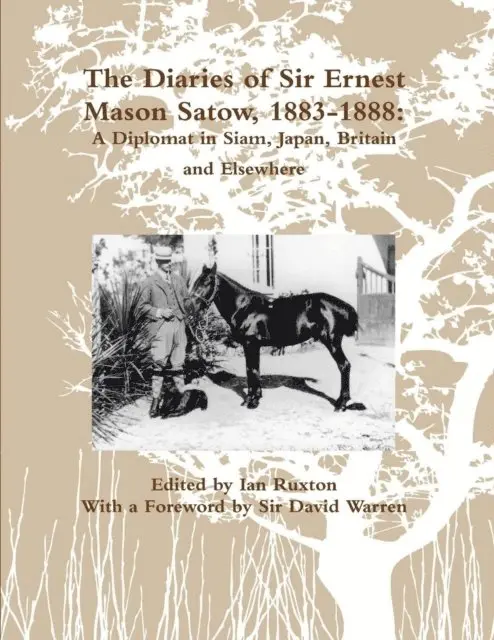
These are the edited (i.e. transcribed, annotated and indexed) diaries of Sir Ernest Satow (1843-1929) for the six years from the time when he left Japan early in 1883, through his time as Agent and Consul-General and subsequent promotion to Minister Resident at Bangkok, until his return to London and his request in December 1887 for another posting on health grounds. The period includes his visits to Japan (officially for rest and recuperation) in 1884 and 1886, and to Rome and Lisbon for research into the Jesuits in Japan conducted early in 1888, and the confirmation of his appointment to Montevideo in October of that year. Throughout the period his ultimate goal was promotion to Minister in Japan, which he achieved in 1895. The original diaries are in the National Archives (UK). Published for the first time on lulu.com.
Inbunden, Engelska, 2018
386 kr
Skickas inom 5-8 vardagar
E-bok
Engelska, 201899 kr
Läs direkt efter köp
The distinguished diplomat Sir Ernest Satow''s retirement began in 1906 and continued until his death in 1929. From 1907 he settled in the small town of Ottery St. Mary in rural Devon. He was very active, serving as a British delegate at the Second Hague Peace Conference in 1907 and on various committees related to church, missionary and other more local affairs: he was a magistrate and chairman of the Urban District Council. He had a very wide social circle of family, friends and former colleagues, with frequent distinguished visitors. He produced two seminal books: ''A Guide to Diplomatic Practice'' (1917, now in its seventh revised edition and referred to as ''Satow'') and ''A Diplomat in Japan'' (1921). The latter is highly evaluated as a rare foreigner''s view of the years leading to the Meiji Restoration of 1868. These two volumes are part of a series of Satow''s diaries and letters edited by Ian Ruxton. Maps and photographs are in both volumes. The index is in Volume Two. This is the first-ever publication.
Häftad, Engelska, 2005
519 kr
Skickas inom 5-8 vardagar
Häftad, Engelska, 2019
477 kr
Skickas inom 5-8 vardagar
Inbunden, Engelska, 2016
3 838 kr
Skickas inom 5-8 vardagar
The scholar and diplomat Sir Ernest Satow was the best-known Westerner who lived in Meiji Japan. Although he rose to become British Minister to Japan, the most interesting part of his career was the start of it, when he witnessed, and in a small way influenced, the fall of the Bakufu and the Meiji Restoration. He wrote an account of this in a memoir called A Diplomat in Japan, published in 1921.Satow was, however, both Japanophile and Sinophile. In 1906 at the age of 63 he was ready to retire, although he would have accepted a return to Tokyo if it had been offered. The Peking post had been a demanding job with long and arduous hours. He chose to reside at Beaumont House, Ottery St. Mary, near Exeter partly because it reminded him of family holidays in nearby Sidmouth, and partly to distance himself from London and the Foreign Office. Though he was not offered another post, the Foreign Office appointed him one of Britain’s representatives at the Second Hague Peace Conference in 1907. He was careful not to discuss his service with journalists, and gave the Rede lecture at Cambridge in 1908 on an historical subject, the career of the Austrian diplomat Hübner. Satow’s participation at the Hague helped to launch his second career in retirement as a specialist in international law, which was very much tempered with history in his case. Satow found time post-retirement to join in local activities such as magistrate, at both local and county levels. He put down deep roots in the Ottery community and was buried in the churchyard. He often saw old Japan friends and his English family came to stay frequently. He was careful of his health, and went for frequent walks with his dog, and took holidays when he could. The editor has added extensive annotations and explanations to these diaries, making this book an indispensable reference work for students of Satow’s life and times, as well as a snapshot album of rural England just after the turn of the century.
Inbunden, Engelska, 2016
5 645 kr
Skickas inom 5-8 vardagar
PUBLISHED BY EUREKA PRESS, TOKYO, AND DISTRIBUTED BY ROUTLEDGE OUTSIDE JAPAN.The scholar and diplomat Sir Ernest Satow was the best-known Westerner who lived in Meiji Japan. Although he rose to become British Minister to Japan, the most interesting part of his career was the start of it, when he witnessed, and in a small way influenced, the fall of the Bakufu and the Meiji Restoration. This volume of his diaries continues the story up to the time when Satow leaves Japan for subsequent appointments in Bangkok, Montevideo and Tangier, before returning to Tokyo as Envoy Extraordinary and Minister Plenipotentiary in 1895. Although the years 1870-1883 were an interlude between the exciting years of the Bakumatsu and the promotion to Consul General in Bangkok, they give much detail of Satow’s journeys under difficult conditions including appalling weather in the interior of Japan, and a firsthand account of the Satsuma Rebellion which was beginning as Satow returned to Japan from Europe in January 1877. There is also an account of a visit to Korea in late 1878, and of the visit to Japan of the British royal princes Arthur and George in 1881. His two leaves in Europe reflect his cultural interests, though Japan is mentioned only occasionally. The editor has added extensive annotations and explanations to these diaries, making this book an indispensable reference work for students of early Meiji Japan, and indeed anybody who wants to understand the story of how a very young, very clever, but rather awkward Englishman could have penetrated the very highest levels of the Japanese hierarchy to witness the transformation of the country from a feudal, inward-looking society to one that would become a major industrialized power to shock the world.
Inbunden, Engelska, 2016
9 910 kr
Skickas inom 5-8 vardagar
The scholar and diplomat Sir Ernest Satow was the best-known Westerner who lived in Meiji Japan. Although he rose to become British Minister to Japan and China, the most interesting part of his career was the start of it, when he witnessed, and in a small way influenced, the fall of the Bakufu and the Meiji Restoration. He wrote an account of this in a memoir called A Diplomat in Japan, published in 1921.While Satow’s appointment as Minister to Tokyo in 1895 was understandable in terms of his background and skills, he was not the obvious choice for the Beijing (Peking) Embassy in 1900. He was also well aware that the China post would be more challenging, given Britain’s large commercial interests in the country, the large number of British residents and their dominance at the treaty ports. Satow arrived in China in late September 1900. After a brief stop in Shanghai, he moved up to Peking and began work. He was at first unable to present his credentials as minister, because the allies considered themselves at war with the court. So from September 1900 until January 1902 he was technically not the British minister but rather the British High Commissioner for negotiations leading to the settlement of claims arising from the Boxer uprising. Many issues of substance are to be found in these diaries: the negotiations for the Boxer Protocol of 1901, the status of the Peking Legation Quarter, the stationing of foreign troops in China for protection purposes, and the Chinese indemnity etc. Later Russo-Japanese tension over the Russian presence in Manchuria, and the Russo-Japanese War of 1904-05, receive much attention. Other important issues included missionary matters, railways and railway concessions, the Chinese Imperial Maritime Customs, and the British China Consular Service. The editor has added extensive annotations and explanations to these diaries, making this book an indispensable reference work for students of China at the start of the 20th century. For this edition Satow’s separate diary for the cottage at Ku-miao-tsun has also been included and annotated.
Häftad, Engelska, 2009
404 kr
Tillfälligt slut
Häftad, Engelska, 2006
364 kr
Tillfälligt slut
Häftad, Engelska, 2006
344 kr
Tillfälligt slut
Inbunden, Engelska, 2006
4 692 kr
Tillfälligt slut