
Inge Cort Madsen – författare
Visar alla böcker från författaren . Handla med fri frakt och snabb leverans.
3 produkter
3 produkter
1 698 kr
Skickas
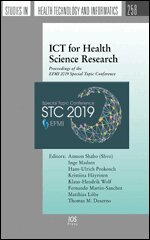
Information and Communications Technology (ICT) is used in healthcare and health science research in application domains such as clinical trials and the development of drug and medical devices, as well as in translational medicine, with the aim of improving prevention, diagnosis, and interventions in health and care.This book presents accepted papers from the 2019 European Federation of Medical Informatics conference (EFMI STC 2019), held in Hanover, Germany, from 7 – 10 April 2019. More than 90 submissions were received, from which, after review, the Scientific Program Committee (SPC) accepted 50 full papers to be included in this volume of proceedings. In addition, 16 poster presentations were accepted. This year, ICT for Health Science Research was selected as the focus topic, and the conference also honors Prof. Peter Leo Reichertz (1930 – 1987), one of the founding fathers of ICT healthcare and an originator of the term Medical Informatics. The conference focuses on recent research & development supporting information systems in biomedical, translational and clinical research, as well as semantic interoperability across such systems for the purpose of data sharing and the analytics of cross-system integrated data. Papers are divided into 12 categories covering topics including digitization; data privacy; interoperability; data-driven decision support; mobile data capture; and ICT for clinical trials.The book will be of interest to all healthcare researchers and practitioners whose work involves the use of ICT.

Digital health and medical informatics have grown in importance in recent years, and have now become central to the provision of effective healthcare around the world.This book presents the proceedings of the 30th Medical Informatics Europe conference (MIE). This edition of the conference, hosted by the European Federation for Medical Informatics (EFMI) since the 1970s, was due to be held in Geneva, Switzerland in April 2020, but as a result of measures to prevent the spread of the Covid19 pandemic, the conference itself had to be cancelled.Nevertheless, because this collection of papers offers a wealth of knowledge and experience across the full spectrum of digital health and medicine, it was decided to publish the submissions accepted in the review process and confirmed by the Scientific Program Committee for publication, and these are published here as planned. The 232 papers are themed under 6 section headings: biomedical data, tools and methods; supporting care delivery; health and prevention; precision medicine and public health; human factors and citizen centered digital health; and ethics, legal and societal aspects. A 7th section deals with the Swiss personalized health network, and section 8 includes the 125 posters accepted for the conference.Offering an overview of current trends and developments in digital health and medical informatics, the book provides a valuable information resource for researchers and health practitioners alike.

3 228 kr
Skickas
Modern information and communication technologies make it easier for individuals to be involved in their own health and social care. They also facilitate contact between individuals and service providers and deliver more efficient tools for healthcare staff. Artificial Intelligence (AI) promises to bring even more benefits in the future, with more effectiveness and the provision of decision support. This book presents the proceedings of the 33rd Medical Informatics Europe Conference, MIE2023, held in Gothenburg, Sweden, from 22 to 25 May 2023. The theme of MIE2023 was ‘Caring is Sharing – Exploiting Value in Data for Health and Innovation’, stressing the increasing importance of sharing digital-health data and the related challenges. The sharing of health data is developing rapidly, both in Europe and beyond, so the focus of the conference was on the enabling of trustworthy sharing of data to improve health. Topics covered include healthcare, community care, self-care, public health, and the innovation and development of future-proof digital-health solutions, and the almost 300 papers divided into 10 chapters also cover important advances in the sub domains of biomedical informatics: decision support systems, clinical information systems, clinical research informatics, knowledge management and representation, consumer health informatics, natural language processing, public health informatics, privacy, ethical and societal aspects among them. Describing innovative approaches to the collection, organization, analysis, and data-sharing related to health and wellbeing, the book contributes to the expertise required to take medical informatics to the next level, and will be of interest to all those working in the field.