Iqbal Chand Malhotra – författare
Visar alla böcker från författaren . Handla med fri frakt och snabb leverans.
10 produkter
10 produkter
E-bok
Engelska, 2022220 kr
Läs direkt efter köp
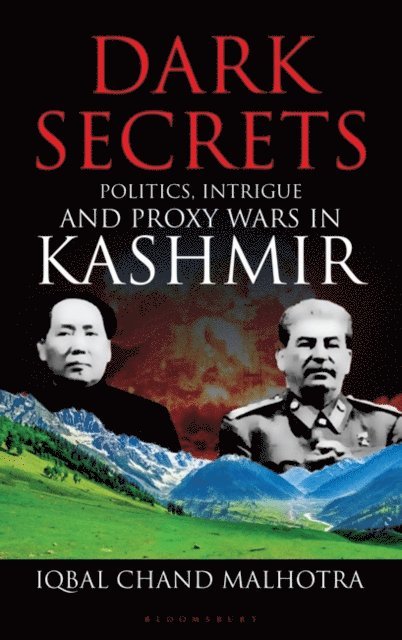
Was Britain spying on Soviet nuclear activities in Soviet Kazakhstan and Sinkiang from Gilgit between 1945 and 1955? Did MI6 conduct regular military reconnaissance flights over Soviet Russia from airbases in Pakistan?Was the Partition of India advanced so that British nuclear monitoring bases in the Gilgit Agency could be secured?Did India and Pakistan fight ''The First Kashmir War'' because it suited British interests?Did Joseph Stalin order Mao Tse-tung to invade Aksai Chin to speed up the extraction of uranium ores for the Soviet nuclear bomb?Was Mao''s intrusion into Aksai Chin in 1950 a consequence of Stalin''s urgency to extract and transport uranium from this region?Did India ever realise it faced a British and Russian fait accompli in Kashmir? Dark Secrets is an investigative account that uniquely reexamines India''s contemporary history about the Kashmir conflict and its foreign relationships with Britain, Soviet Russia, Pakistan and China. It reveals the convoluted nature of British policy in the Indian subcontinent and how it impacted both India and Pakistan. The history of the Kashmir conflict now needs to be repositioned in terms of the British necessity to secure under its continuing control as much of the Gilgit Agency and North-West Frontier Province at the time of Partition as was possible to follow the progress of the Soviet nuclear bomb. This was essential if Britain was to secure a foothold in the nuclear club. Further, the Soviets exerted pressure on China to occupy Aksai Chin for its nuclear-related minerals. Stalin hoped to achieve this through Mao, exploiting both Sinkiang''s and Kashmir''s natural resources to become a nuclear power.As India celebrates its 75th year of independence, this book reveals the dark secrets hidden in India''s contemporary history around and after the Partition of India with major international players vested in the future of Kashmir.
E-bok
Engelska, 2023270 kr
Läs direkt efter köp
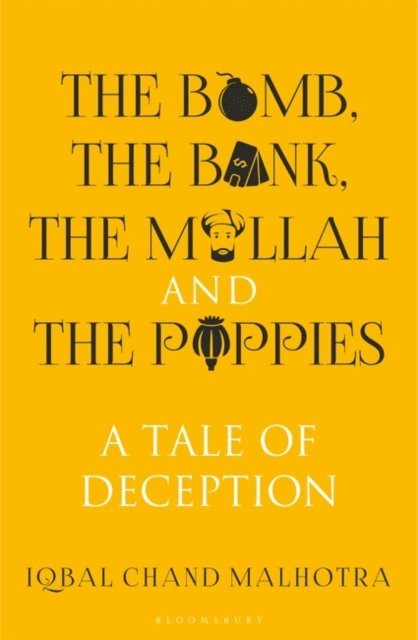
When and why did Pakistani prime minister Zulfikar Ali Bhutto decide to build a nuclear weapon? Did he mandate Agha Hassan Abedi to launch the Bank of Credit and Commerce International (BCCI) to fund Pakistan''s nuclear programme? Why did the BCCI become privileged bankers to Pablo Escobar''s Medellin Cartel, General Manuel Noriega of Panama and Pakistani president General Zia-ul-Haq? Was George H.W. Bush embarrassed by his ties to General Noriega, General Zia-ul-Haq and the BCCI when he decided to run for presidency in 1988? Did Pervez Musharraf, as Director General of Military Operations, select Mullah Omar to head the Taliban? The Bomb, the Bank, the Mullah and the Poppies is a historical account from a forensic perspective of how the Pakistani state innovatively used a dodgy bank, poppy cultivation and trade as a means to finance its nuclear programme. It reveals the convoluted psyche of the men in charge of Pakistan who clandestinely transformed Pakistan into a state where a premium was placed on thuggery, deceit and deception. This enabled Pakistan to grow from being a US pawn in the Reagan administration''s war against the erstwhile Soviet Union to a narco-nuclear state with an independent nuclear deterrent. In the process, the patrons of the Pakistani deep state enriched themselves with drug money at the expense of the citizens mired in abject poverty. This is a story of a succession of powerful men who cleverly fooled the world into believing their innocence and helplessness when in fact the opposite was true at every juncture in the history of their nation.
Häftad, Engelska, 2024
278 kr
Skickas inom 5-8 vardagar
Inbunden, Engelska, 2025
442 kr
Skickas inom 5-8 vardagar
Inbunden, Engelska, 2020
308 kr
Skickas inom 5-8 vardagar
E-bok
Engelska, 2019276 kr
Läs direkt efter köp
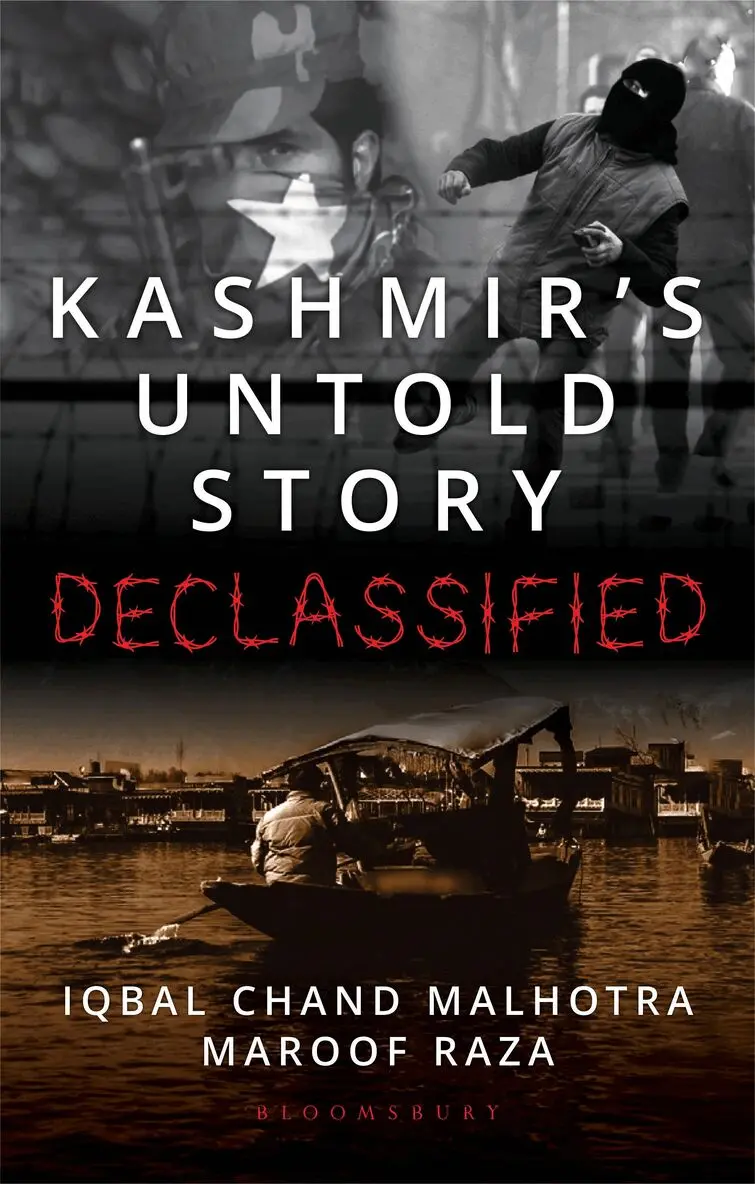
Why has this state of siege in the Kashmir valley continued for 72 years since the Partition of India?What role has Pakistan played in it all of these years? And will there ever be a resolution to the militancy in the state? How will Islamabad get the forces of Islamic jihad-nurtured and based in Pakistan-to ever reconcile to the existing boundaries of J&K? How important is the ownership of the waters of the rivers of the Indus system for Pakistan-despite generous supplies under the Indus Waters Treaty-in determining an end to the siege within Kashmir?What are China''s interests in J&K and how does the success of the China-Pakistan Economic Corridor (CPEC) for oil and gas supplies hinge on Pakistan''s occupation of northern areas of Kashmir? Why does the future survival and growth of the Chinese microchip industry depend upon the continuance of China''s control of the waters and dams in the Indus river system?Kashmir''s Untold Story: Declassified provides answers to these gripping questions and joins the dots in presenting the matrix of a consistent and compelling argument regarding the future of the state of Jammu and Kashmir. Today, the state''s water resources are coveted by the beleaguered Chinese microchip industry and it appears that this is going to determine the continuing militancy in the state. Malhotra and Raza argue that China and its client Pakistan will actively back the militancy, come what may.Delving deeper, the book also reveals amazing insights into the Government of India''s policy towards the state, right from 1889, when it first imposed central rule and dispossessed the rule of the then Maharaja, till date. Owing to its strategic location, the intrigues within the state and the machinations of its neighbours have resulted in the government directly administering its affairs, one way or the other, for the last 130 years. It is a riveting account of the history of Jammu and Kashmir, from the time of its political and geographic consolidation under Maharaja Gulab Singh to present-day India.
E-bok
Engelska, 2020276 kr
Läs direkt efter köp
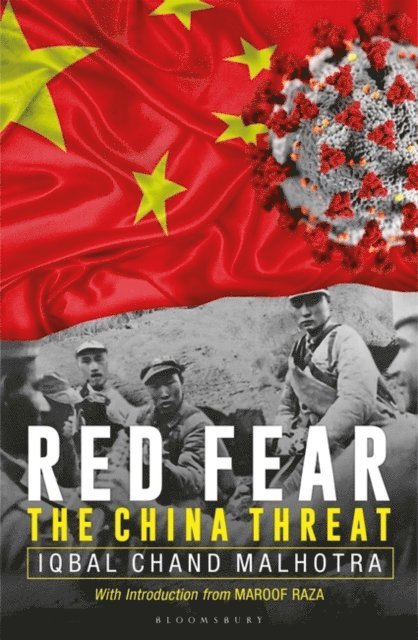
What was the reason for the first real armed encounter between Indian and Chinese troops on Chinese soil in the town of Dinghai on Chusan Island in July 1840?Were the orders for the invasion of Aksai Chin issued by Mao from Moscow in December 1949, at Stalin''s behest?Was the pluck and raw courage of Lt. Gen. Sagat Singh to hold Nathu La first in 1965 and then again in 1967 the basis for General K. Sundarji''s bold moves at Sumdorong Chu in 1986 and 1987? Red Fear: The China Threat catalogues, evaluates and infers the consequences of the political and military confrontations between India and China from the 15th to the 21st century.Contrary to the glowing accounts in popular imagination of a congruence of values and interests between these two nations, the relationship has been confrontational and antagonistic at many levels throughout these last six centuries.The lessons of history are hard to learn. Nevertheless, China seems to have learnt them better than India. It bided its time well and positioned itself to humiliate and denigrate India whenever possible as retribution for the perceived harm India and Indians did to its society and economy during the infamous Chinese century of humiliation between 1839 to 1940. For India, today''s post-Galwan situation is reminiscent of the challenge India''s first Prime Minister Jawaharlal Nehru faced in 1962 and the identical challenge India''s 14th Prime Minister Narendra Modi faces in 2020. Vedic philosophy argues that time is cyclical, and not linear, and by this argument, the year 2020 completes a 60-year cycle that began in 1960. How Modi responds to this challenge will define India''s relationship with China as well as its position in the world through the rest of the 21st century.
Inbunden, Engelska, 2023
264 kr
Tillfälligt slut
Häftad, Engelska, 2024
243 kr
Tillfälligt slut
Häftad, Engelska, 2024
250 kr
Tillfälligt slut