Isaac B. Bersuker - Böcker
Visar alla böcker från författaren Isaac B. Bersuker. Handla med fri frakt och snabb leverans.
4 produkter
4 produkter
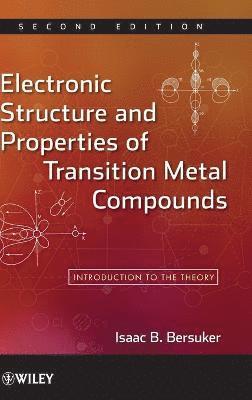
Electronic Structure and Properties of Transition Metal Compounds
Introduction to the Theory
Inbunden, Engelska, 2010
1 825 kr
Tillfälligt slut
With more than 40% new and revised materials, this second edition offers researchers and students in the field a comprehensive understanding of fundamental molecular properties amidst cutting-edge applications. Including ~70 Example-Boxes and summary notes, questions, exercises, problem sets, and illustrations in each chapter, this publication is also suitable for use as a textbook for advanced undergraduate and graduate students. Novel material is introduced in description of multi-orbital chemical bonding, spectroscopic and magnetic properties, methods of electronic structure calculation, and quantum-classical modeling for organometallic and metallobiochemical systems. This is an excellent reference for chemists, researchers and teachers, and advanced undergraduate and graduate students in inorganic, coordination, and organometallic chemistry.
Electronic Structure and Properties of Transition Metal Compounds
Theory and Applications
Inbunden, Engelska, 2025
2 178 kr
Skickas inom 7-10 vardagar
Presents the latest achievements in the theory of electronic structure and properties of transition metal coordination compounds with applications to a range of chemical and physical problems Electronic Structure and Properties of Transition Metal Compounds offers a detailed and authoritative account of the theory of electronic structure and the properties of transition metal compounds with applications to various chemical and physical problems. The fully updated third edition incorporates recent developments and methods in the field, including new coverage of methods of ab initio calculations of the electronic structure of coordination compounds and the application of vibronic coupling and the Jahn-Teller effect to solve coordination chemistry problems. Revised chapters provide up-to-date views on reactivity, chemical activation, and catalysis. New and expanded questions, exercises, and problems in each chapter are supported by new problem-solving examples, illustrations, graphic presentations, and references. Designed to be intelligible to advanced students, researchers, and instructors, Electronic Structure and Properties of Transition Metal Compounds: Provides thorough coverage of the theory underlying the electronic structure and properties of transition metal compounds, including the physical methods of their investigationHelps readers understand the origin of observable properties in transition metal compounds and choose a suitable method of their investigationContains numerous problems with solutions and illustrative examples demonstrating the application of the theory to solving specific chemical and physical problemsPresents a generalized view of the modern state of the field, beginning from the main ideas of quantum chemistry and atomic states to applications to various chemical and physical problems Features novel problems never fully considered in books on coordination chemistry, such as relativistic effects in bonding, optical band shapes, and electron transfer in mixed-valence compoundsElectronic Structure and Properties of Transition Metal Compounds: Theory and Applications, Third Edition is an excellent textbook for graduate and advanced undergraduate chemistry students, as well as a useful reference for inorganic, bioinorganic, coordination, organometallic, and physical chemists and industrial and academic researchers working in catalysis, organic synthesis, materials science, and physical methods of investigation.
Del 49 - Springer Series in Chemical Physics
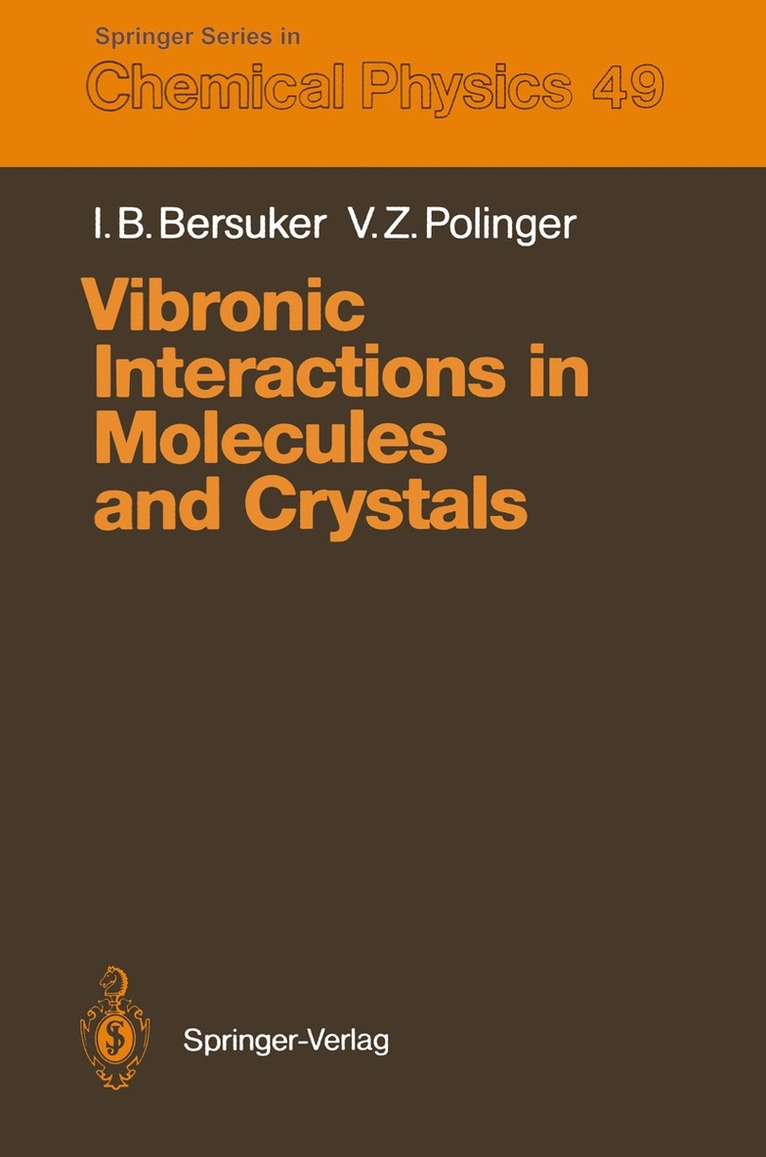
Vibronic Interactions in Molecules and Crystals
Häftad, Engelska, 2011
536 kr
Skickas inom 10-15 vardagar
Vibronic interaction effects constitute a new field of investigation in the physics and chemistry of molecules and crystals that combines all the phenomena and laws originating from the mixing of different electronic states by nuclear displacements. This field is based on a new concept which goes beyond the separate descriptions of electronic and nuclear motions in the adiabatic approximation. Publications on this topic often appear under the title of the lahn-Thller effect, although the area of application of the new approach is much wider: the term vibronic interaction seems to be more appropriate to the field as a whole. The present understanding of the subject was reached only recently, during the last quarter of a century. As a result of intensive development of the theory and experiment, it was shown that the nonadiabatic mixing of close-in-energy elec tronic states under nuclear displacements and the back influence of the modified electronic structure on the nuclear dynamics result in a series of new effects in the properties of molecules and crystals. The applications of the theory of vibronic in of spectroscopy [including visible, ultraviolet, in teractions cover the full range frared, Raman, EPR, NMR, nuclear quadrupole resonance (NQR), nuclear gam ma resonance (NOR), photoelectron and x-ray spectroscopy], polarizability and magnetic susceptibility, scattering phenomena, ideal and impurity crystal physics and chemistry (including structural as well as ferroelectric phase transitions), stereochemistry and instability of molecular (including biological) systems, mechanisms of chemical reactions and catalysis.
Del 6 - Computational Chemistry: Reviews Of Current Trends
Computational Chemistry: Reviews Of Current Trends, Vol. 6
Inbunden, Engelska, 2001
2 582 kr
Tillfälligt slut
There are strong indications that, in the 21st century, computational chemistry will be a prime research tool not only for the basic sciences but also for the life and materials sciences. Recent developments in nanotechnology allow us to detect a layer of single atoms. Researchers are able not only to image but also to manipulate molecules and atoms. It does not take much imagination to realize that before performing such a task on a real system it is much easier and faster to study models on computers. That is the aim of this volume — it provides up-to-date reviews which cover representative areas of computational chemistry.In Chapter 1, Y Ishikawa and M J Vilkas provide a review of multireference Moller-Plesset (MR-MP) perturbation theory. Fifteen years ago Roberto Car of Princeton University and Michele Parrinello of Max Planck Institute introduced a method that revolutionized electronic structure calculations for molecules, liquids and solids. Ursula Rothlisberger, a former member of Parrinello's group, reviews the formation of the method in its most common implementations in Chapter 2. In the third chapter, Isaac B Bersuker describes the general theory of the combined quantum mechanics-molecular mechanics (QM/MM) approach. In Chapter 4, Marcel Allavena and David White present a review of applications of computational chemistry to proton transfer, the primary process for acid-base chemistry on zeolites. Chapter 5 is a review by S Roszak and J Leszczynski of recent data on the clusters formed from the charged ion and weakly interacting ligands. The last chapter, contributed by Carlos R Handy, is devoted to recent developments in the incorporation of continuous wavelet transform analysis into quantum operator theory.