Israel Cohen - Böcker
Visar alla böcker från författaren Israel Cohen. Handla med fri frakt och snabb leverans.
17 produkter
17 produkter
380 kr
Skickas inom 10-15 vardagar
Vilna, the "Jerusalem of Lithuania," was the vibrant core of Eastern European Jewish life. Distinguished British historian, Israel Cohen, opens with the legend of the origin of Vilna in 1322 and traces the history of its Jewish community through vivid portraits of scholars, heroes, and leaders. The result is a book based on scholarship, yet full, too, of wonderful unforgettable stories.
168 kr
Skickas inom 5-8 vardagar
377 kr
Skickas inom 5-8 vardagar
238 kr
Skickas inom 5-8 vardagar
1 479 kr
Skickas inom 7-10 vardagar
A comprehensive guide to the theory and practice of signal enhancement and array signal processing, including matlab codes, exercises and instructor and solution manuals Systematically introduces the fundamental principles, theory and applications of signal enhancement and array signal processing in an accessible mannerOffers an updated and relevant treatment of array signal processing with rigor and concisionFeatures a companion website that includes presentation files with lecture notes, homework exercises, course projects, solution manuals, instructor manuals, and Matlab codes for the examples in the book
Del 18 - Springer Topics in Signal Processing
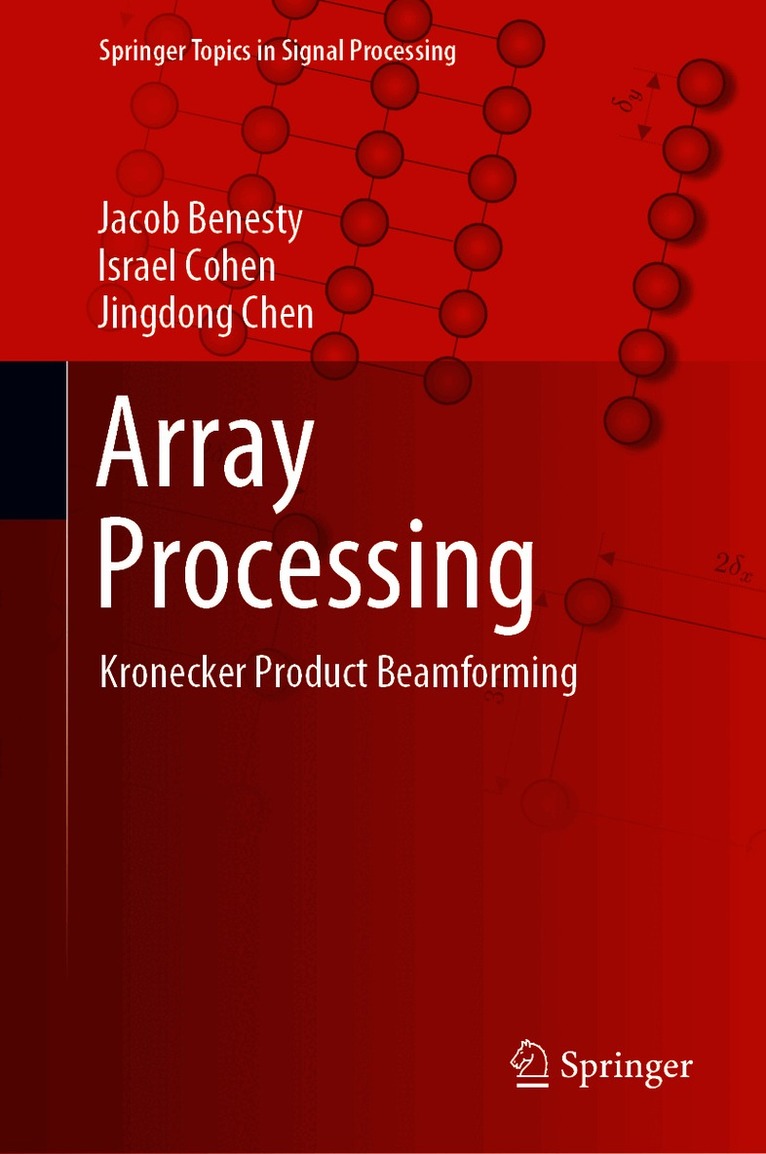
Array Processing
Kronecker Product Beamforming
Inbunden, Engelska, 2019
1 275 kr
Skickas inom 10-15 vardagar
The focus of this book is on array processing and beamforming with Kronecker products.
Del 20 - Springer Topics in Signal Processing
Array Beamforming with Linear Difference Equations
Inbunden, Engelska, 2021
926 kr
Skickas inom 10-15 vardagar
This book studies the link between differential beamforming and differential equations which in turn enables the study of fundamental theory and methods of beamforming from a different perspective, leading to new insights into the problem and new methods to solve the problem. The book first presents a brief overview of the problems and methods for beamforming and some performance measures popularly used either to evaluate beamformers or to derive optimal beamformers. Then, first-order, second-order, and general high-order linear difference equations are discussed, based on which the authors show how to formulate the beamforming problem and derive different beamforming methods, including fixed and adaptive ones. Furthermore, the authors show how to apply the theory of difference equations to the general problem of speech enhancement, and deduce a number of noise reduction filters, including the maximum SNR filter, the Wiener filter, the MVDR filter, etc. Also covered in the book are thedifference equations and differential beamforming from the spectral graph perspective.Presents basic concepts, fundamental principles, and methods for beamforming from the perspective of linear difference equations;Provides formulation and methods of conventional beamforming, and first-order, second-order, and general high-order linear difference equations for beamforming;Includes the applications of linear difference equations to the problem of noise reduction;Explains beamforming based on difference equations with graphs.
Del 20 - Springer Topics in Signal Processing
Array Beamforming with Linear Difference Equations
Häftad, Engelska, 2022
694 kr
Skickas inom 10-15 vardagar
This book studies the link between differential beamforming and differential equations which in turn enables the study of fundamental theory and methods of beamforming from a different perspective, leading to new insights into the problem and new methods to solve the problem. The book first presents a brief overview of the problems and methods for beamforming and some performance measures popularly used either to evaluate beamformers or to derive optimal beamformers. Then, first-order, second-order, and general high-order linear difference equations are discussed, based on which the authors show how to formulate the beamforming problem and derive different beamforming methods, including fixed and adaptive ones. Furthermore, the authors show how to apply the theory of difference equations to the general problem of speech enhancement, and deduce a number of noise reduction filters, including the maximum SNR filter, the Wiener filter, the MVDR filter, etc. Also covered in the book are thedifference equations and differential beamforming from the spectral graph perspective.Presents basic concepts, fundamental principles, and methods for beamforming from the perspective of linear difference equations;Provides formulation and methods of conventional beamforming, and first-order, second-order, and general high-order linear difference equations for beamforming;Includes the applications of linear difference equations to the problem of noise reduction;Explains beamforming based on difference equations with graphs.
Del 12 - Springer Topics in Signal Processing
Design of Circular Differential Microphone Arrays
Inbunden, Engelska, 2015
1 064 kr
Skickas inom 10-15 vardagar
Recently, we proposed a completely novel and efficient way to design differential beamforming algorithms for linear microphone arrays. Thanks to this very flexible approach, any order of differential arrays can be designed. Moreover, they can be made robust against white noise amplification, which is the main inconvenience in these types of arrays. The other well-known problem with linear arrays is that electronic steering is not really feasible.In this book, we extend all these fundamental ideas to circular microphone arrays and show that we can design small and compact differential arrays of any order that can be electronically steered in many different directions and offer a good degree of control of the white noise amplification problem, high directional gain, and frequency-independent response. We also present a number of practical examples, demonstrating that differential beamforming with circular microphone arrays is likely one of the best candidates for applications involving speech enhancement (i.e., noise reduction and dereverberation). Nearly all of the material presented is new and will be of great interest to engineers, students, and researchers working with microphone arrays and their applications in all types of telecommunications, security and surveillance contexts.
Del 12 - Springer Topics in Signal Processing
Design of Circular Differential Microphone Arrays
Häftad, Engelska, 2016
1 064 kr
Skickas inom 10-15 vardagar
Recently, we proposed a completely novel and efficient way to design differential beamforming algorithms for linear microphone arrays. Thanks to this very flexible approach, any order of differential arrays can be designed. Moreover, they can be made robust against white noise amplification, which is the main inconvenience in these types of arrays. The other well-known problem with linear arrays is that electronic steering is not really feasible.In this book, we extend all these fundamental ideas to circular microphone arrays and show that we can design small and compact differential arrays of any order that can be electronically steered in many different directions and offer a good degree of control of the white noise amplification problem, high directional gain, and frequency-independent response. We also present a number of practical examples, demonstrating that differential beamforming with circular microphone arrays is likely one of the best candidates for applications involving speech enhancement (i.e., noise reduction and dereverberation). Nearly all of the material presented is new and will be of great interest to engineers, students, and researchers working with microphone arrays and their applications in all types of telecommunications, security and surveillance contexts.
535 kr
Skickas inom 10-15 vardagar
This book focuses on the application of canonical correlation analysis (CCA) to speech enhancement using the filtering approach. The authors explain how to derive different classes of time-domain and time-frequency-domain noise reduction filters, which are optimal from the CCA perspective for both single-channel and multichannel speech enhancement. Enhancement of noisy speech has been a challenging problem for many researchers over the past few decades and remains an active research area. Typically, speech enhancement algorithms operate in the short-time Fourier transform (STFT) domain, where the clean speech spectral coefficients are estimated using a multiplicative gain function. A filtering approach, which can be performed in the time domain or in the subband domain, obtains an estimate of the clean speech sample at every time instant or time-frequency bin by applying a filtering vector to the noisy speech vector.Compared to the multiplicative gain approach, the filtering approach more naturally takes into account the correlation of the speech signal in adjacent time frames. In this study, the authors pursue the filtering approach and show how to apply CCA to the speech enhancement problem. They also address the problem of adaptive beamforming from the CCA perspective, and show that the well-known Wiener and minimum variance distortionless response (MVDR) beamformers are particular cases of a general class of CCA-based adaptive beamformers.
1 064 kr
Skickas inom 10-15 vardagar
Noise is everywhere and in most applications that are related to audio and speech, such as human-machine interfaces, hands-free communications, voice over IP (VoIP), hearing aids, teleconferencing/telepresence/telecollaboration systems, and so many others, the signal of interest (usually speech) that is picked up by a microphone is generally contaminated by noise. As a result, the microphone signal has to be cleaned up with digital signal processing tools before it is stored, analyzed, transmitted, or played out. This cleaning process is often called noise reduction and this topic has attracted a considerable amount of research and engineering attention for several decades. One of the objectives of this book is to present in a common framework an overview of the state of the art of noise reduction algorithms in the single-channel (one microphone) case. The focus is on the most useful approaches, i.e., filtering techniques (in different domains) and spectral enhancement methods. The other objective of Noise Reduction in Speech Processing is to derive all these well-known techniques in a rigorous way and prove many fundamental and intuitive results often taken for granted. This book is especially written for graduate students and research engineers who work on noise reduction for speech and audio applications and want to understand the subtle mechanisms behind each approach. Many new and interesting concepts are presented in this text that we hope the readers will find useful and inspiring.
1 064 kr
Skickas inom 10-15 vardagar
Noise is everywhere and in most applications that are related to audio and speech, such as human-machine interfaces, hands-free communications, voice over IP (VoIP), hearing aids, teleconferencing/telepresence/telecollaboration systems, and so many others, the signal of interest (usually speech) that is picked up by a microphone is generally contaminated by noise. As a result, the microphone signal has to be cleaned up with digital signal processing tools before it is stored, analyzed, transmitted, or played out. This cleaning process is often called noise reduction and this topic has attracted a considerable amount of research and engineering attention for several decades. One of the objectives of this book is to present in a common framework an overview of the state of the art of noise reduction algorithms in the single-channel (one microphone) case. The focus is on the most useful approaches, i.e., filtering techniques (in different domains) and spectral enhancement methods. The other objective of Noise Reduction in Speech Processing is to derive all these well-known techniques in a rigorous way and prove many fundamental and intuitive results often taken for granted. This book is especially written for graduate students and research engineers who work on noise reduction for speech and audio applications and want to understand the subtle mechanisms behind each approach. Many new and interesting concepts are presented in this text that we hope the readers will find useful and inspiring.
1 577 kr
Skickas inom 10-15 vardagar
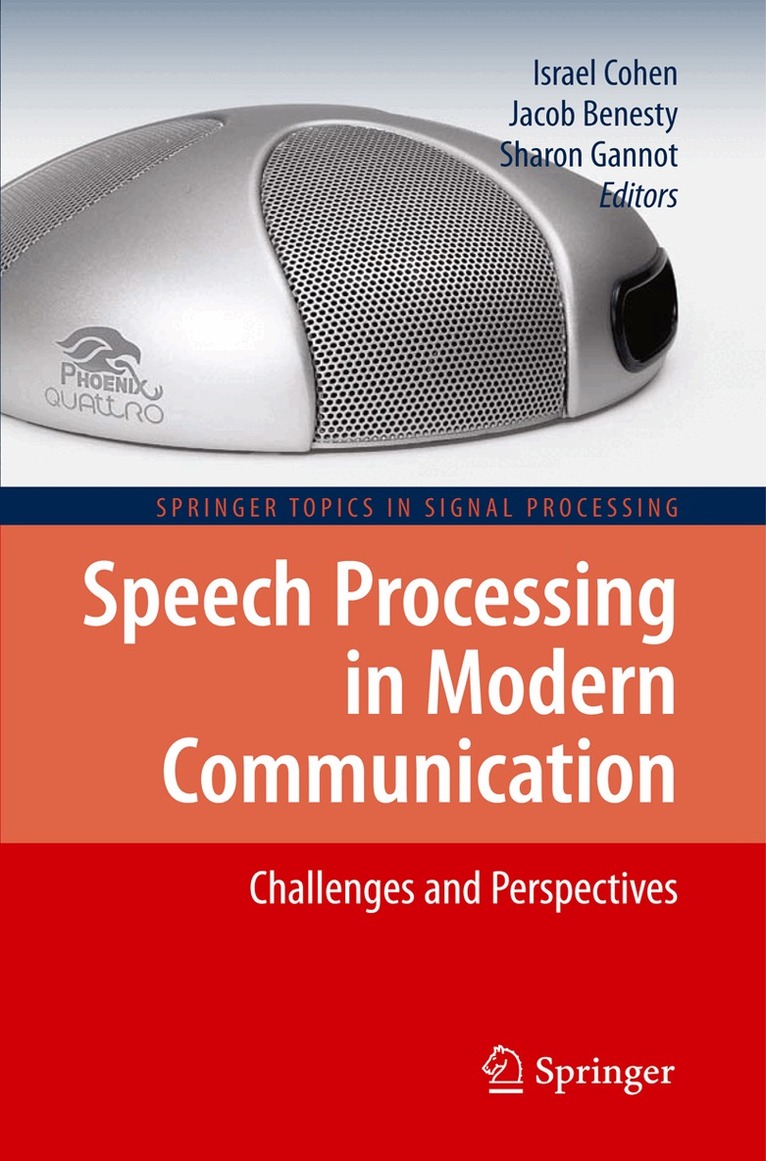
Modern communication devices, such as mobile phones, teleconferencing systems, VoIP, etc., are often used in noisy and reverberant environments. Therefore, signals picked up by the microphones from telecommunication devices contain not only the desired near-end speech signal, but also interferences such as the background noise, far-end echoes produced by the loudspeaker, and reverberations of the desired source. These interferences degrade the fidelity and intelligibility of the near-end speech in human-to-human telecommunications and decrease the performance of human-to-machine interfaces (i.e., automatic speech recognition systems).The proposed book deals with the fundamental challenges of speech processing in modern communication, including speech enhancement, interference suppression, acoustic echo cancellation, relative transfer function identification, source localization, dereverberation, and beamforming in reverberant environments.Enhancement of speech signals is necessary whenever the source signal is corrupted by noise. In highly non-stationary noise environments, noise transients, and interferences may be extremely annoying. Acoustic echo cancellation is used to eliminate the acoustic coupling between the loudspeaker and the microphone of a communication device. Identification of the relative transfer function between sensors in response to a desired speech signal enables to derive a reference noise signal for suppressing directional or coherent noise sources. Source localization, dereverberation, and beamforming in reverberant environments further enable to increase the intelligibility of the near-end speech signal.
1 577 kr
Skickas inom 10-15 vardagar
Modern communication devices, such as mobile phones, teleconferencing systems, VoIP, etc., are often used in noisy and reverberant environments. Therefore, signals picked up by the microphones from telecommunication devices contain not only the desired near-end speech signal, but also interferences such as the background noise, far-end echoes produced by the loudspeaker, and reverberations of the desired source. These interferences degrade the fidelity and intelligibility of the near-end speech in human-to-human telecommunications and decrease the performance of human-to-machine interfaces (i.e., automatic speech recognition systems).The proposed book deals with the fundamental challenges of speech processing in modern communication, including speech enhancement, interference suppression, acoustic echo cancellation, relative transfer function identification, source localization, dereverberation, and beamforming in reverberant environments.Enhancement of speech signals is necessary whenever the source signal is corrupted by noise. In highly non-stationary noise environments, noise transients, and interferences may be extremely annoying. Acoustic echo cancellation is used to eliminate the acoustic coupling between the loudspeaker and the microphone of a communication device. Identification of the relative transfer function between sensors in response to a desired speech signal enables to derive a reference noise signal for suppressing directional or coherent noise sources. Source localization, dereverberation, and beamforming in reverberant environments further enable to increase the intelligibility of the near-end speech signal.
412 kr
Skickas inom 5-8 vardagar
281 kr
Skickas inom 5-8 vardagar