J. Edward Hutson – författare
Visar alla böcker från författaren J. Edward Hutson. Handla med fri frakt och snabb leverans.
4 produkter
4 produkter
Inbunden, Engelska, 2005
786 kr
Skickas inom 10-15 vardagar
This work bring together in one volume a number of late-eighteenth-century monographs (the period known as the Age of Reason) on the diagnosis and treatment of diseases in African and creole slaves in the English-speaking Caribbean. These works have been almost forgotten, but they are of importance to many scholars, and Hutson provides a fully annotated text which explains archaic terminology, makes medical, botanical and Latin terminology accessible to non-specialists in those fields, and provides useful explanations of the eighteenth-century medical concepts.
Häftad, Engelska, 2010
271 kr
Skickas inom 10-15 vardagar
This work brings together, in one volume, a number of monographs from the mid to late eighteenth century (the period known as the Age of Reason) on the diagnosis and treatment of diseases of African and Creole slaves in the English-speaking Caribbean. Included here are James Grainger’s Essay on the More Common West-Indian Diseases (1764) and book 4 of The Sugar-Cane (1764); book 2 of the Reverend Griffith Hughes’s Natural History of the Island of Barbados (1750); and Benjamin Moseley’s Miscellaneous Medical Observations (1789).These monographs have been all but forgotten; however, they are of importance to scholars. Dr Hutson provides a fully annotated text that explains archaic terminology, makes medical, botanical and Latin terminology accessible to non-specialists in those fields, and provides useful explanations of eighteenth-century medical concepts. This fascinating collection has much to offer historians and health-care professionals, as well as general readers with an interest in the West Indies.
Inbunden, Engelska, 2011
786 kr
Skickas inom 10-15 vardagar
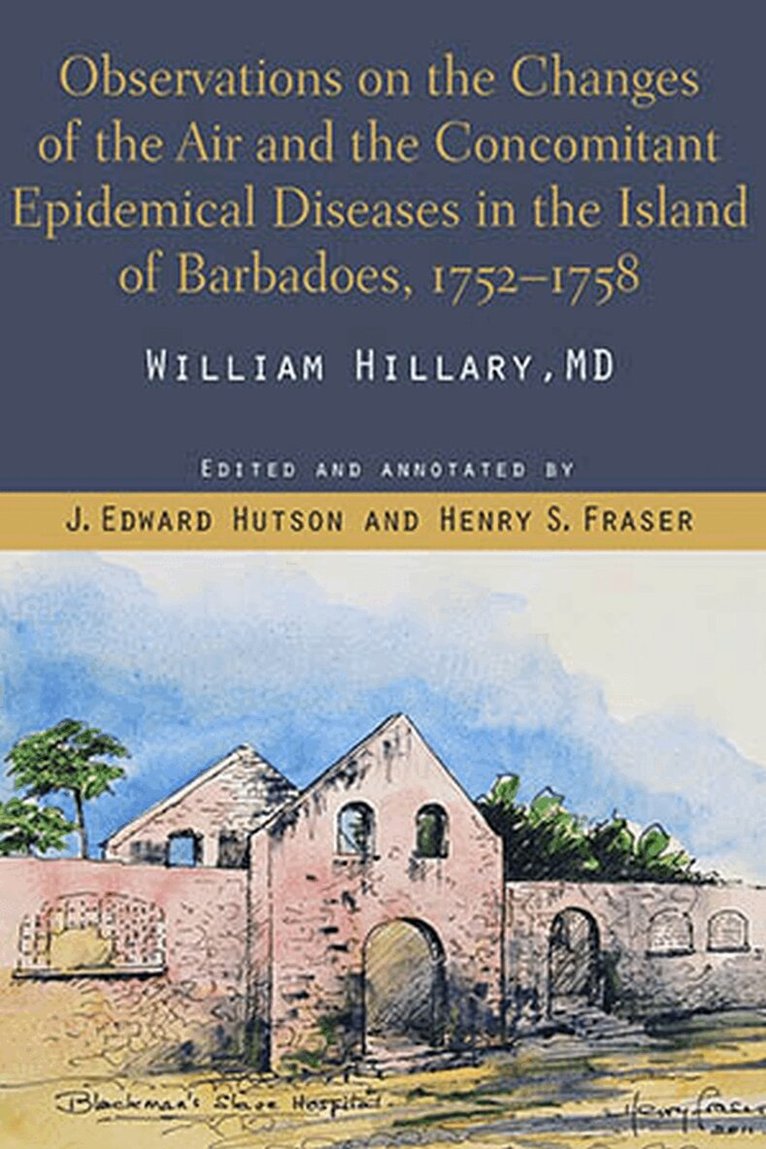
Observations on the Changes of the Air and the Concomitant Epidemical Diseases in the Island of Barbadoes was first published in 1759 in London. Remarkably, a third edition was published in Philadelphia in 1812, with praise and annotations by the famous American physician Dr Benjamin Rush, and with good reason. It is certainly the first comprehensive documentation of an epidemiological nature, in English, in the Caribbean, and justifies the title “first Caribbean epidemiologist” for Dr Hillary. He made rigorous observations and clear deductions that have stood the test of time surprisingly well. As Sir George Alleyne, director emeritus of PAHO, says: “We marvel at the conclusions he drew from his observations without the use of the technology which we have at our disposal. We are surprised by the accuracy of the symptomatology he describes.” Indeed, Hillary is famous for the earliest description of tropical sprue, but his description of what seemed to be yellow fever but “was not contagious”, as yellow fever was then thought to be, was absolutely accurate and this “Barbados jaundice” turned out to be leptospirosis. His methods, his clinical skills and his eloquent writing deserve to be widely read.
Häftad, Engelska, 2012
341 kr
Skickas inom 10-15 vardagar
Observations on the Changes of the Air and the Concomitant Epidemical Diseases in the Island of Barbadoes was first published in 1759 in London. Remarkably, a third edition was published in Philadelphia in 1812, with praise and annotations by the most famous American physician, Dr. Benjamin Rush, and with good reason. It is certainly the first comprehensive documentation of an epidemiological nature, in English, in the Caribbean, and justifies the title ‘first Caribbean epidemiologist’ for Dr Hillary. He made rigourous observations and clear deductions that have stood the test of time surprisingly well. As Sir George Alleyne, director emeritus of PAHO, says: “We marvel at the conclusions he drew from his observations without the use of the technology which we have at our disposal. We are surprised by the accuracy of the symptomatology he describes. “Indeed, Hillary is famous for the earliest description of tropical sprue, but his description of what seemed to be yellow fever but “was not contagious”, as yellow fever was then thought to be, was absolutely accurate and this “Barbados jaundice” turned out to be leptospirosis. His methods, his clinical skills and his eloquent writing deserve to be widely read.